Executive summary
I Integration of third-country nationals into a new country requires not only the migrants themselves but also the host society to play a part. Data show socio-economic gaps between third-country nationals and EU citizens, notably with regard to the risk of poverty or social exclusion, or unemployment rates. One of the financial instruments used by the EU to support migrant integration measures is the Asylum, Migration and Integration Fund. The resources of this Fund allocated to integration measures in national programmes of the EU member states totalled approximately €1 billion for 2014-2020 and increased to around €1.9 billion for 2021-2027.
II We examined whether the Commission and the member states, within their remits, have made sound and effective use of this Fund for the integration of third-country nationals during the two programming periods (2014-2020 and 2021-2027). We chose to audit the topic due to its importance in the EU, and its financial materiality for the EU budget. Our report complements the ECA’s previous audits of EU migration policy. We aim to provide valuable input for the Commission and the member states on improving the effectiveness of their implementation of integration measures funded by the Asylum, Migration and Integration Fund and the efficiency of projects supported by that funding. Moreover, our report should contribute to strengthening the monitoring tools.
III Overall, we conclude that the support from the Asylum, Migration, and Integration Fund played a relevant role in the integration of third-country nationals in the EU but that its impact could not yet be demonstrated.
IV We found that the legislative framework provided a clear rationale for Asylum, Migration, and Integration Fund intervention. The financing provided by the Fund was low in some member states compared to other available funding sources. There was a risk that its added value was limited by its administrative complexity in the member states. The member states we visited for our audit used the flexibility offered by the Fund to support national integration policies in quite diverse ways.
V We found there was limited coordination between the Asylum, Migration and Integration Fund and the European Social Fund in 2014-2020. We did not find good practice of these two EU funds being used in a coordinated manner in 2014-2020 to finance full integration pathways, such as an early integration measure funded by the Asylum, Migration and Integration Fund being continued by the European Social Fund in the medium term. However, we found progress in the demarcation between these two funds in 2021-2027.
VI We found that the activities supported by the Asylum, Migration and Integration Fund were relevant to integration needs, but that member states’ tailoring of integration measures for specific groups varied. Recognition of skills and qualifications is increasingly important for integration into the labour market. However, support from the Fund for this area was marginal, although other EU funds contributed. Projects broadly achieved their expected outputs, but procedures in place provided only limited assessments of costs.
VII We found that the Commission reviewed member state reporting within an existing structured system, but that data quality remained a challenge. Member states did not generally align their targets for participant numbers and results with 2021-2027 integration budget increases. The contribution of the Asylum, Migration and Integration Fund to integration was difficult to assess; for instance, because member states did not monitor integration pathways.
VIII The report makes four recommendations aimed at improving the efficiency and effectiveness of future action in the area of integration. In cooperation with the member states, the Commission should:
- analyse how to identify the financing gaps and streamline the programming of Asylum, Migration and Integration Fund support for the integration of third-country nationals;
- collect, analyse and disseminate best practice on Asylum, Migration and Integration Fund support for integration measures;
- improve the reliability of data and monitoring and reporting of Asylum, Migration and Integration Fund support for integration;
- analyse how to improve the reporting framework to enable the assessment of the performance of Asylum, Migration and Integration Fund support for the integration pathways of third-country nationals.
Introduction
Key characteristics of third-country nationals in the EU and their integration
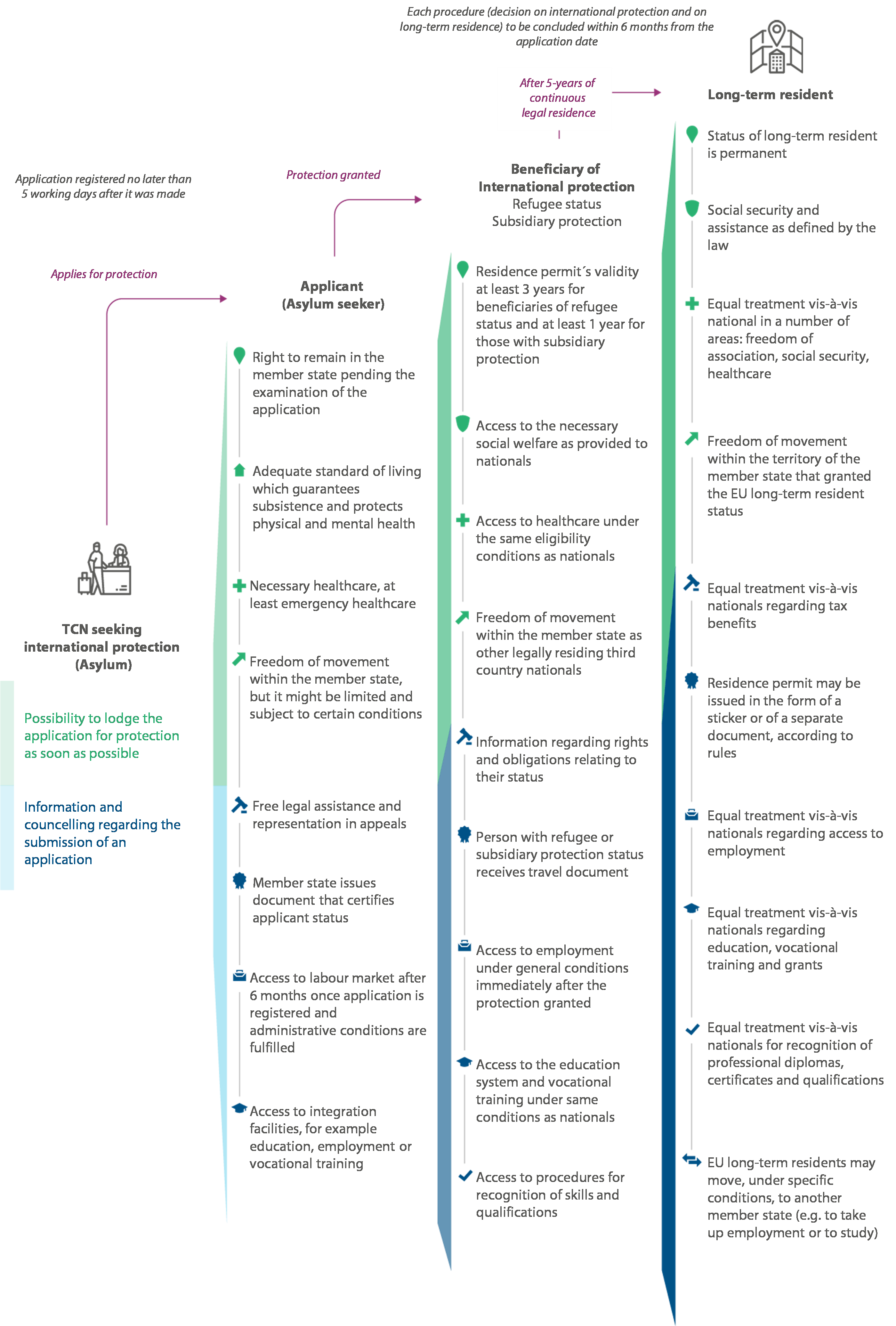
01 In this report, we refer to third-country nationals (TCNs) as people without EU citizenship who are legally residing in the EU. They fall into a number of different categories because they have come to the EU for many reasons. Some have come legally in order to work, study or undertake research, or for family reunification. Others may have entered the EU to seek protection as applicants for international protection (asylum seekers) or beneficiaries of international protection (refugees). TCNs thus have different rights, needs and obligations as regards integration. Figure 1 illustrates the rights and obligations of TCNs seeking protection in the EU.
Figure 1 – Rights and obligations of TCNs seeking protection
Source: ECA, based on Regulation (EU) 2024/1347, Regulation (EU) 2024/1348, Council Directive 2003/109/EC, and Directive (EU) 2024/1346.
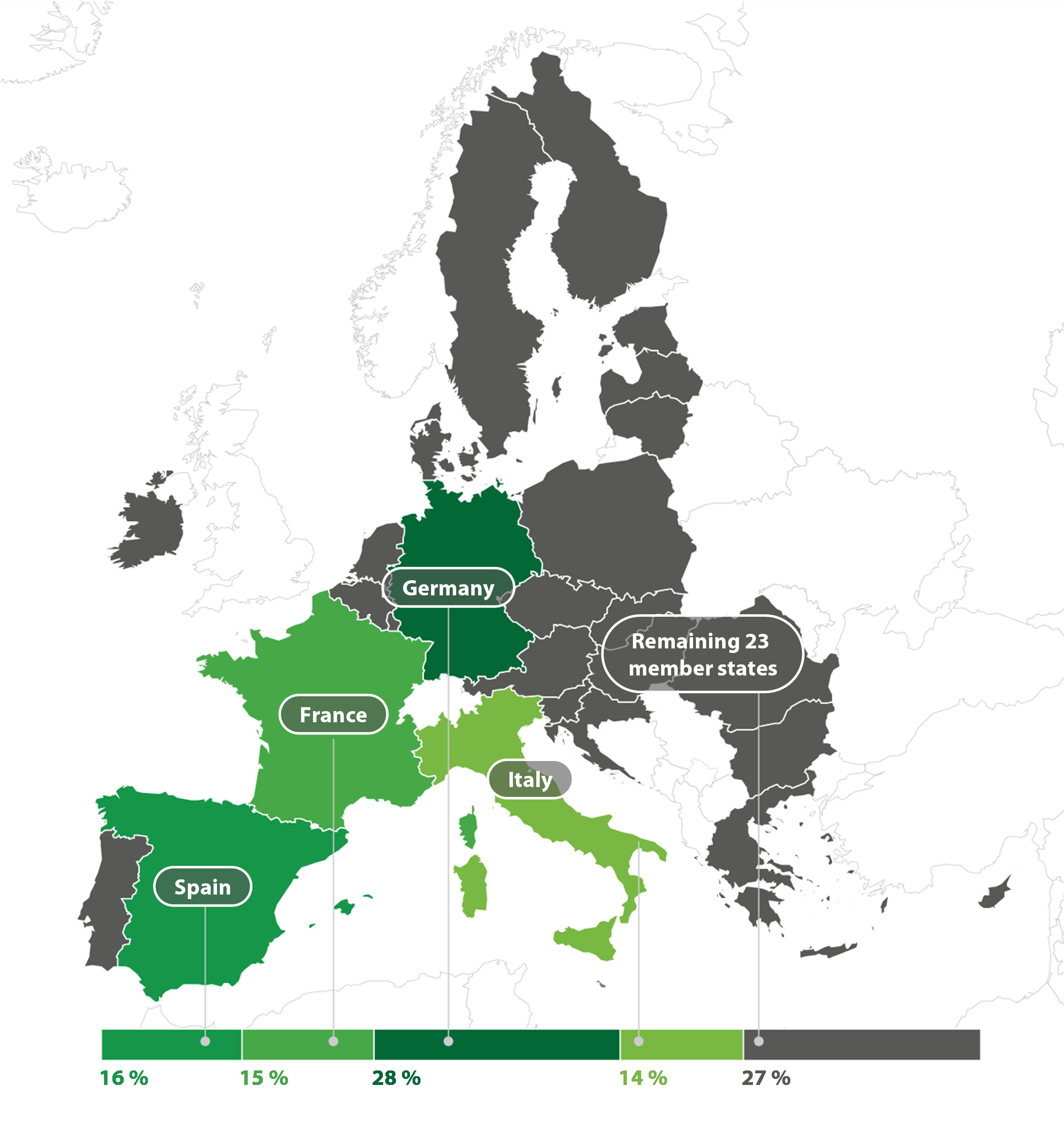
02 Data from 2023 show that after the Russian invasion of Ukraine in 2022, the number of TCNs in the EU rose to a total of 27.3 million, making up 6.1 % of the EU’s population1. In 2023, around 73 % of TCNs lived in just four EU member states (Figure 2).
Source: Eurostat, 2023 data.
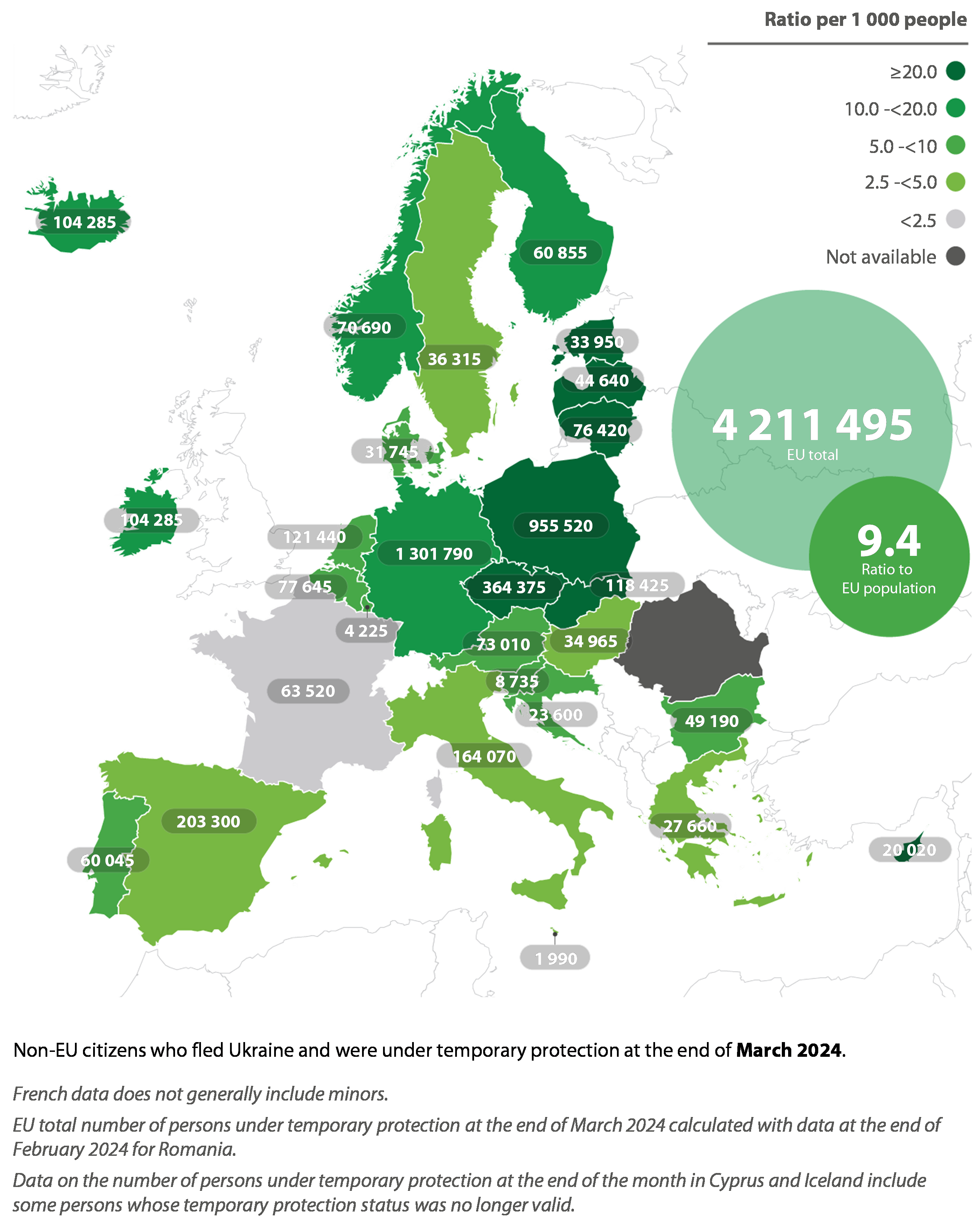
03 As of 29 February 2024, there were around 4.3 million TCNs2 benefiting from temporary protection who had fled Ukraine after the 2022 invasion. The main hosts of those with this status were Germany (31 % of the total), Poland (23 %) and Czechia (9 %) (Figure 3).
Figure 3 – Number of non-EU citizens who fled Ukraine with temporary protection status per EU member state
Source: Eurostat.
04 Integration has multiple definitions. One official (but not legally binding) EU definition is the following: “Integration is a dynamic, two-way process of mutual accommodation by all immigrants and residents of Member States”3. It is a long-term process (or “integration pathway”4) that requires participation not only by migrants but also by a host society.
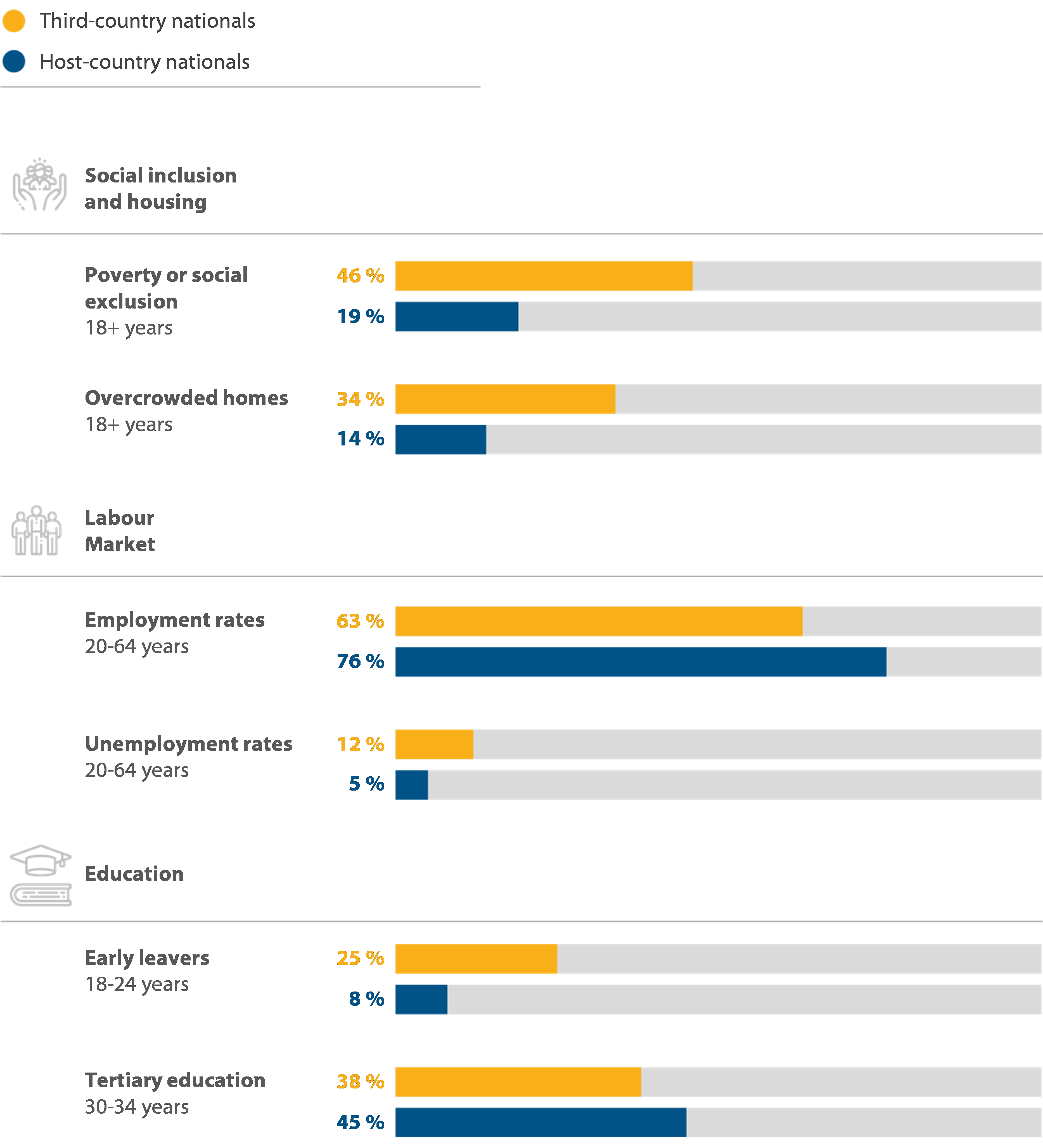
05 One policy challenge facing the EU in the field of home affairs is socio-economic gaps between TCNs and EU citizens5 (paragraph 18). Figure 4 shows the percentages of TCNs and host-country nationals experiencing different socio-economic conditions in the EU.
Figure 4 – Socio-economic gaps between TCNs and host-country nationals in the EU in 2023
Source: ECA, based on Eurostat data.
The main EU activities for integration of third-country nationals
06 Member states are responsible for setting up their own administrative systems and national rules for the integration of TCNs. It is within the member states’ remit to define their national strategies for the integration of TCNs. This means that EU support for TCN integration in member states applies to systems that may vary widely from one country to the next6.
The Asylum, Migration and Integration Fund is one of the financial instruments for integration
07 The Asylum, Migration and Integration Fund (AMIF) is one of the instruments used by the EU to support migrant integration measures (paragraph 16). The Fund has 26 participating member states as Denmark partly opted out from the EU’s justice and home affairs policy under the Edinburgh Agreement of 19927.
AMIF in 2014-2020
08 Two EU Regulations adopted in 2014 established AMIF for the 2014-2020 programming period8, setting out four specific objectives. Specific objective 2 was “to support legal migration to the Member States in accordance with their economic and social needs, such as labour market needs, while safeguarding the integrity of the immigration systems of Member States, and to promote the effective integration of third-country nationals”9. Box 1 lists some of the main national integration measures10 supported by AMIF in 2014-202011.
Main national integration activities supported by AMIF in 2014-2020
The main measures included:
- language training;
- improving institutional cooperation between relevant authorities and stakeholders in the member states;
- actions promoting civil and social orientation.
09 During the 2014-2020 programming period, the total resources earmarked for AMIF increased by 140 % (from an initial €3 137 million to €7 595 million under direct, indirect, and shared management) due to the increased number of TCN arrivals after 201512.
10 The 2014 AMIF Regulation laid down that at least 20 % of AMIF resources were to be allocated to integration and legal migration measures (specific objective 2)13. In AMIF national programmes for 2014-2020, €1 022 million, or 22.3 % of the programme total under shared management (€4 576 million) and thus slightly above the minimum percentage, was allocated to integration and legal migration. The AMIF accounts show that by the end of 2022, €787 million of those funds in national programmes for integration and legal migration had been used, meaning an implementation rate of 77 %. Figure 5 gives a breakdown of allocations and payments by AMIF specific objectives. Integration and legal migration (specific objective 2) is ranked second for allocations but fourth for payments.
Figure 5 – AMIF funding for specific objectives in national programmes, 2014-2020
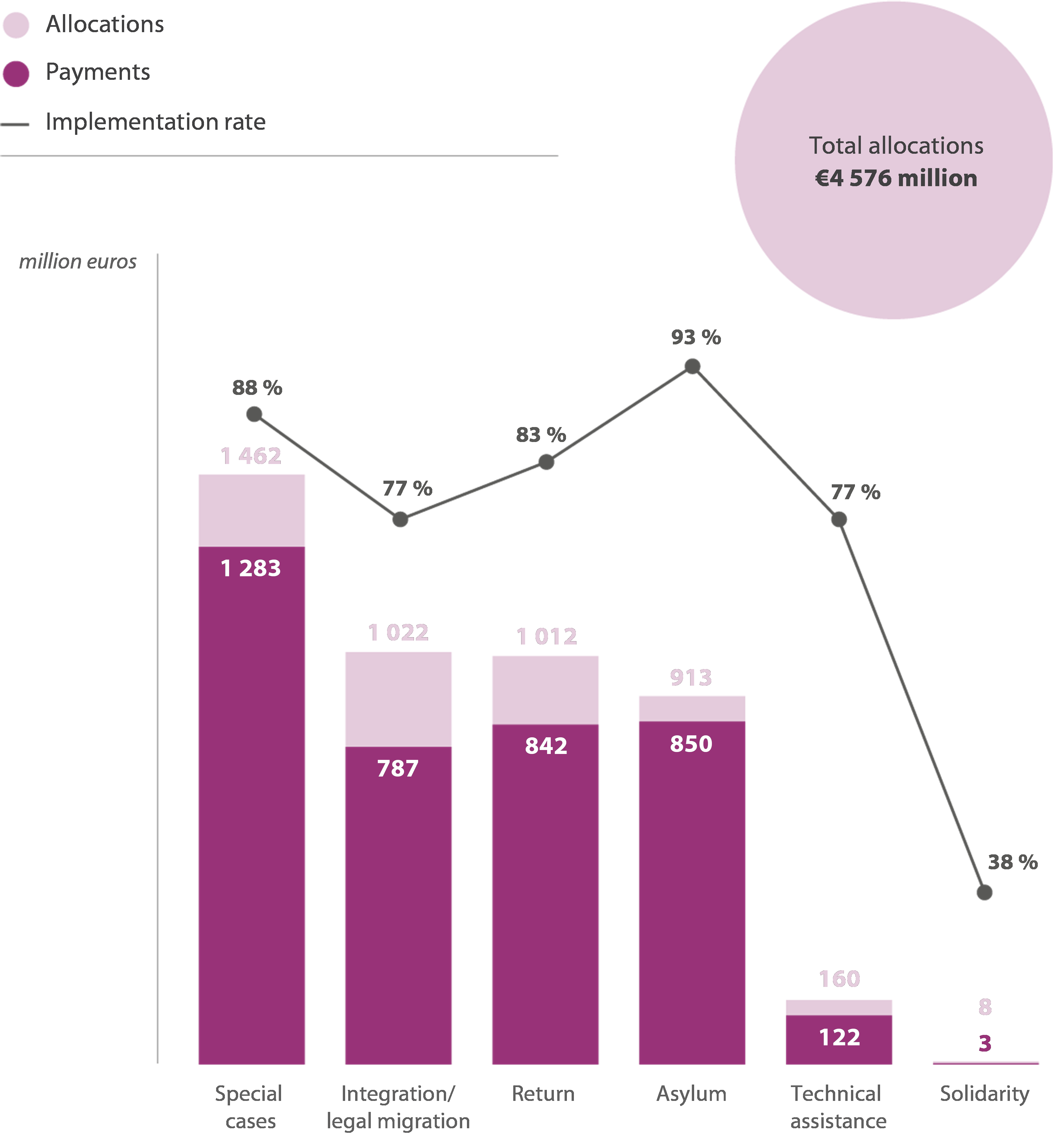
Note: The United Kingdom is included to give an overall picture of the expenditure as the United Kingdom will still receive AMIF funding until the closure of the 2014-2020 programming period.
Source: AMIF accounts 2014-2022 – data provided by the Commission.
AMIF in 2021-2027
11 AMIF was re-established for 2021-2027 by Regulation (EU) 2021/1147. AMIF also came under the scope of the Common Provisions Regulation14.
12 The 2021 AMIF Regulation laid down how AMIF would support integration15. The specific objective for integration remained in place for 2021-2027, only with minor changes16. While the integration activities supported by AMIF for 2021-2027 were largely similar to those in 2014-2020, they were designed to focus AMIF support on tailor-made activities in the early stages of integration (Box 2) as well as general measures supporting member state capabilities in this area17.
Key activities for the early stages of the integration process
- Pre-departure information packages and campaigns to raise awareness about legal migration procedures in the EU
- Integration programmes focusing on social and economic inclusion, counselling, education, language and other training, such as civic orientation courses and professional guidance, as well as active participation in, and acceptance by, the host society, with the involvement of relevant stakeholders
13 The 2021 AMIF Regulation allocated €9 882 million to AMIF. This was an increase of 30 % on the previous programming period (€7 595 million). A total of €6 270 million (63.5 %) was to finance AMIF programmes in the member states18, and the remaining €3 612 million (36.5 %) was allocated to AMIF’s “thematic facility” for emerging or unforeseen needs and developing EU priorities and challenges19 (Figure 6).
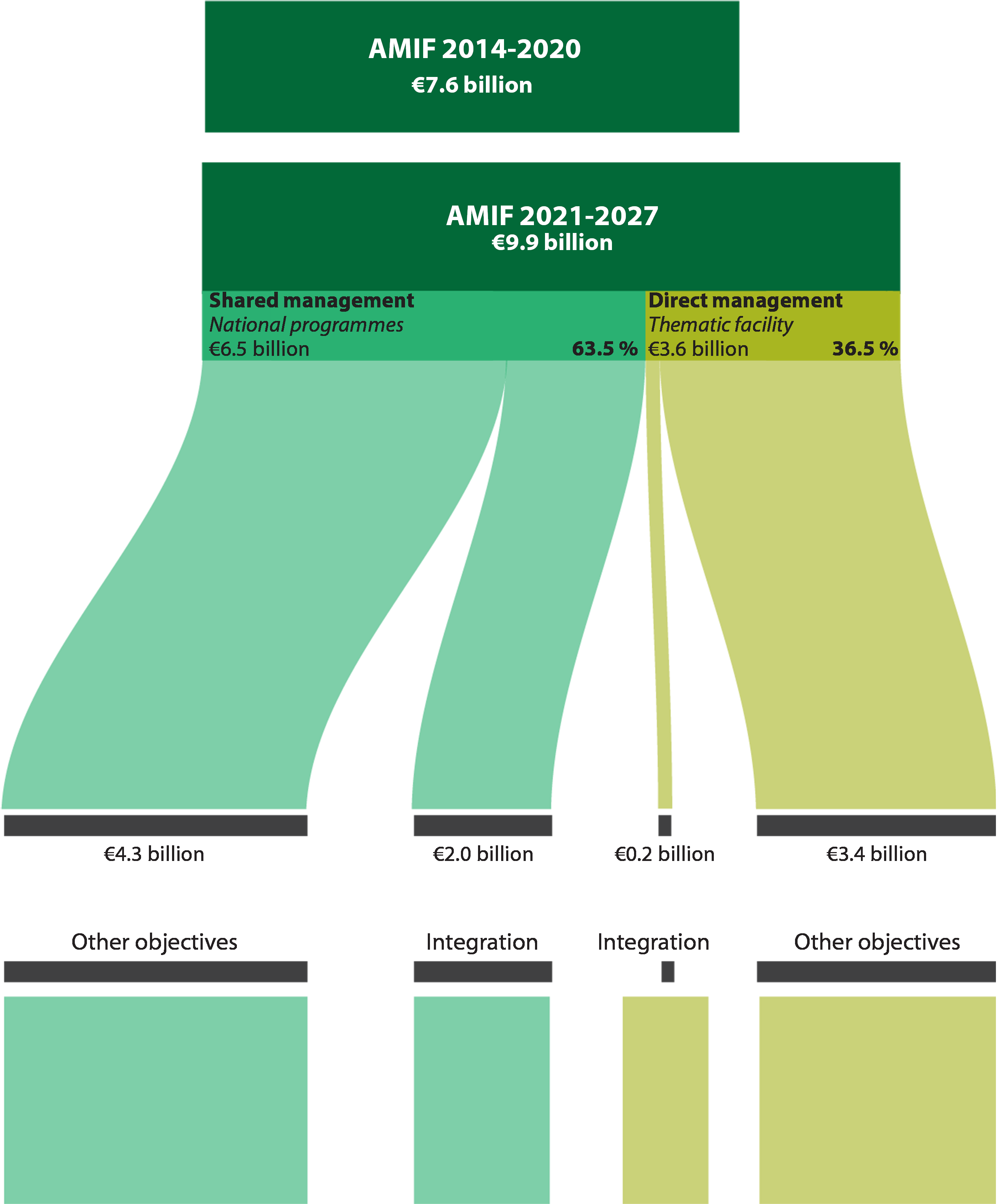
Source: ECA based on Commission data.
14 The 2021 AMIF Regulation stipulated that in 2024, as part of the mid-term budget review, the Commission was to allocate an additional €1 045 million to AMIF national programmes20.
15 The 2021 AMIF Regulation also stated that a minimum of 15 %21 of resources allocated to AMIF national programmes were to support the implementation of integration and legal migration measures (specific objective 2). In fact, the allocations for these measures, making up 34 % of the resources in the 2021-2027 national programmes, are higher than the required minimum percentage.
Other EU funds
16 Other EU funds, such as the European Social Fund (ESF), European Social Fund Plus (ESF+), European Regional Development Fund, or other programmes such as Erasmus+22, may also contribute to integrating migrants and persons with a migrant background. For both programming periods, the Commission published guidance in the form of “toolkits on the use of EU funds for the integration of people with a migrant background”23 to help stakeholders, describing the scope of intervention of these funds. For 2021-2027, member states have programmed €1.1 billion (total budget) under ESF+ for measures promoting the socio-economic integration of TCNs. This information is not available for 2014-2020 since the legal framework did not include a specific intervention field covering this target group.
EU policy documents on integration, and recent developments on migration
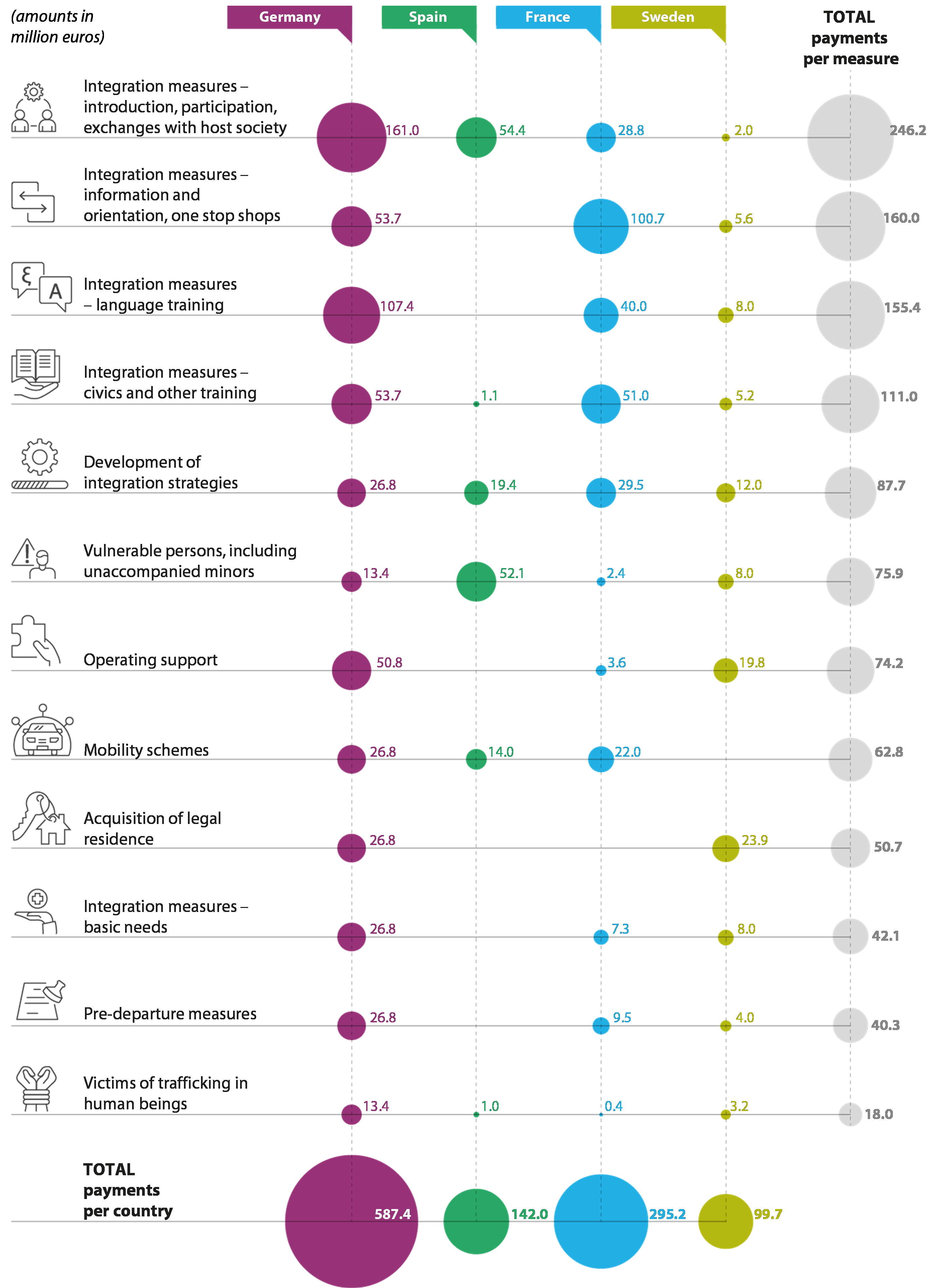
17 As early as 2004, the Council stressed the strategic importance of the orderly integration of migrants and set out 11 common basic principles for immigrant integration policy in the EU24. In 2016, the Commission adopted an Action plan on the integration of third-country nationals. This contained measures to support member states and other parties in their integration efforts.
18 In 2020, the Commission adopted a new Action plan on integration and inclusion (2021-2027) with additional action to address gaps in key areas (education, employment, access to health, etc.) between host-country nationals and migrants, and between different migrant communities. The 2021-2027 action plan covers both migrants and EU citizens with a migrant background. It is thus broader than the 2016 action plan, which targeted only TCNs. Figure 7 shows the timeline of EU policy documents in the AMIF framework.
Figure 7 – Timeline of EU policy documents in the AMIF framework
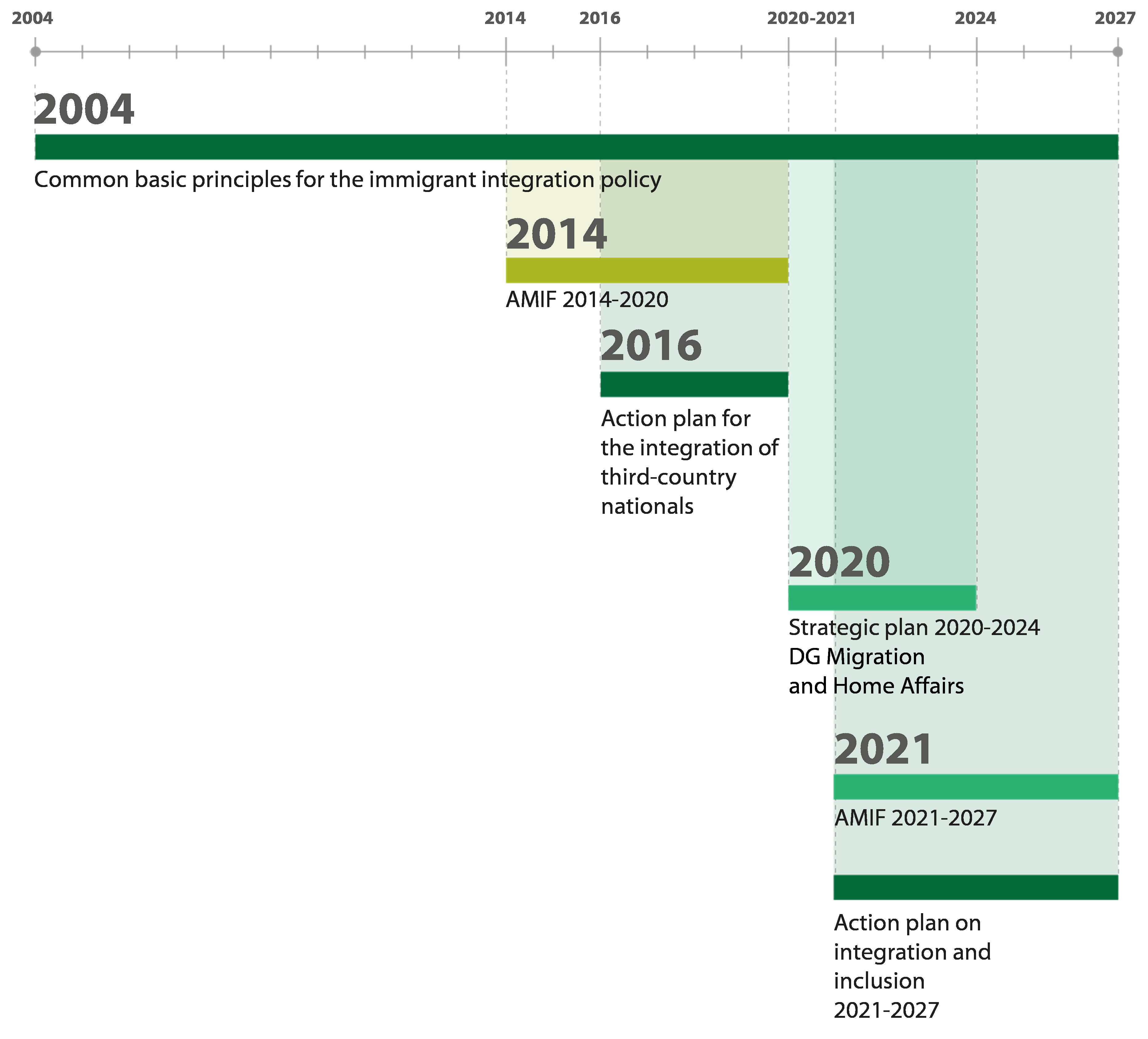
Source: ECA.
19 The European Parliament adopted the Pact on Migration and Asylum on 10 April 2024. The aim is to tackle challenges linked to migration in the EU in a comprehensive manner. Some parts of the Pact, such as the Qualification Regulation or the revised Reception Conditions Directive, include aspects which are relevant for the integration of beneficiaries of international protection.
Responsibilities of the Commission and the member states in managing AMIF
20 AMIF is implemented mostly under shared management (between 60 to 65 % of total AMIF funding). The Commission evaluates and approves the national programmes which have been prepared and submitted by member states. National programmes can include people fleeing the war in Ukraine (paragraph 03) as a group eligible for integration measures funded by AMIF. The member states adopt all the legislative, statutory, and administrative provisions required to ensure that funds are spent properly, including the appointment of a “responsible authority” to implement AMIF funding. For the purposes of this report, the term “responsible authority” applicable to the 2014-2020 multiannual financial framework (MFF) and the term “managing authority” applicable to the 2021-2027 MFF are equivalent. Beneficiaries of AMIF support measures (associations, local authorities, public bodies, etc.) enter into grant award agreements with the relevant member state authority and are responsible for actually applying the rules in accordance with the terms agreed.
21 Figure 8 illustrates the roles and responsibilities of the Commission and member states in the design, implementation, and evaluation of the AMIF-funded measures on migrant integration.
Figure 8 – Roles of the European Commission and member states
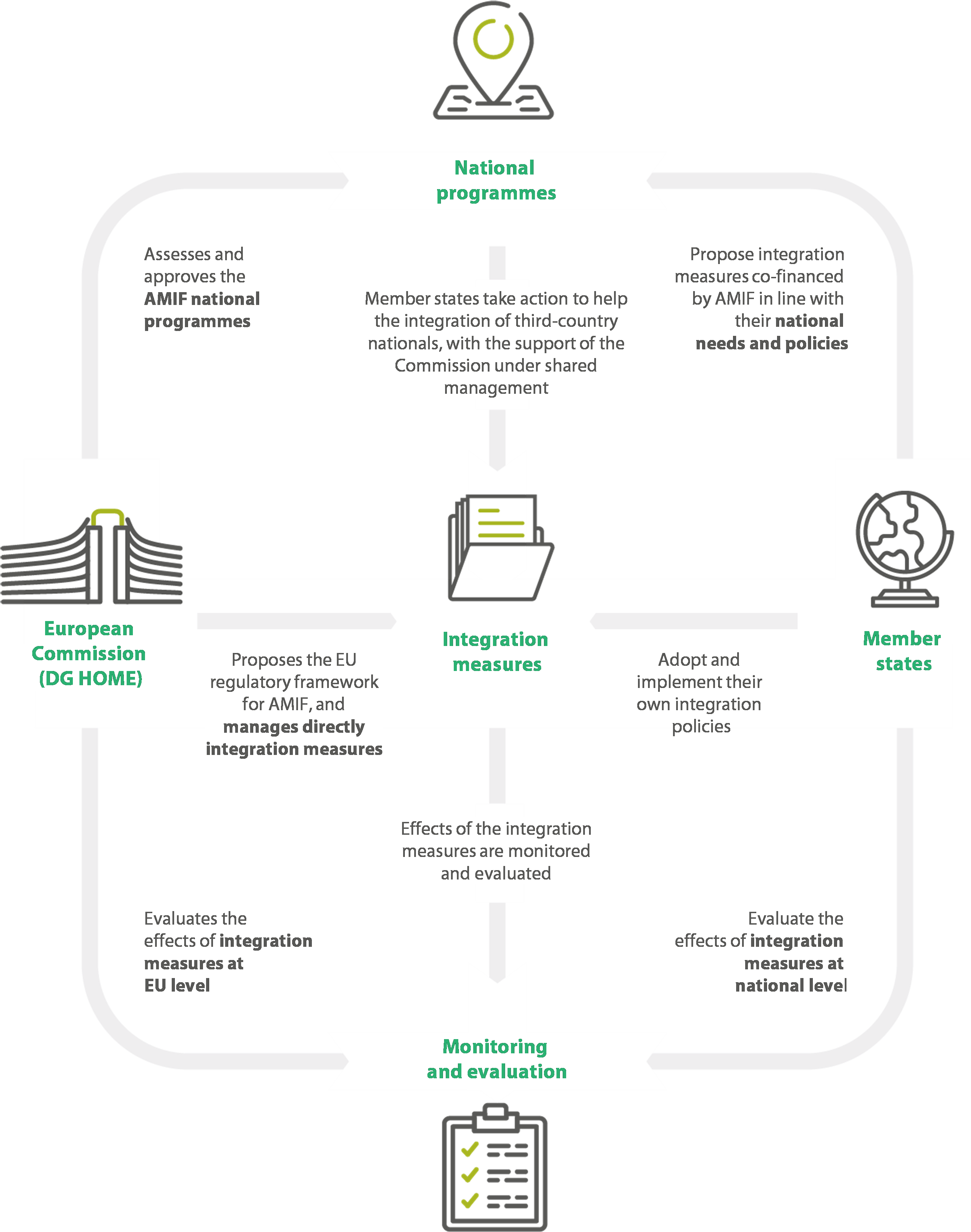
Source: ECA, based on applicable EU regulations.
Audit scope and approach
22 The purpose of this audit was to reply to the following overall audit question: had the Commission and the member states, within their remits, made sound and effective use of AMIF support for the integration of third-country nationals (TCNs). In particular, we examined whether:
- a clear framework was in place for using AMIF to support the integration of TCNs, and the added value of AMIF could be demonstrated;
- integration measures supported by AMIF were appropriately selected, and selected projects were adequately implemented;
- an effective system was in place for monitoring and evaluating AMIF integration measures.
23 Our scope relates to integration measures for TCNs of every category and legal status (paragraph 01) as defined under the specific objective on legal migration and integration (specific objective 2)25 for the programming periods 2014-2020 and 2021-2027. This report does not cover people residing in the EU illegally.
24 Our report complements previous ECA’s audits of EU migration policy26. The European Parliament has also expressed its interest in audits in this area. We chose to audit the integration of TCNs supported by AMIF given the importance of the topic and its financial materiality for the EU budget. We aim to provide valuable input for the Commission and the member states on improving the effectiveness of their implementation of integration measures funded by AMIF and the efficiency of projects supported by that funding. Moreover, our report should contribute to strengthening the relevant monitoring tools.
25 We carried out an audit of the management systems for AMIF-funded integration measures for both programming periods, and reviewed 22 projects from the 2014-2020 programming period, which were included in the AMIF accounts until 30 June 2023 (our cut-off date). We collected audit evidence through document and data analysis, and from interviews with representatives of the Commission and national authorities responsible for designing and implementing the AMIF measures.
26 We undertook audit visits in Germany, Spain, France, and Sweden. We took the financial amounts allocated to all member states for integration as a basis for selecting these member states (they represent 57 % of all AMIF allocations to specific objective 2 for 2021-2027). We also took account of criteria such as geographical location of member states within the EU and the number of people involved in integration measures.
27 We reviewed 20 shared management projects and 2 directly managed projects. We selected the projects based on the type of management (direct or shared), materiality, types of integration measures supported, and geographical location of the projects. The shared management projects we selected represented €34.7 million of AMIF payments, or around 11 % of the total AMIF support paid out under specific objective 2 by the end of 2022 in the four member states we visited.
Observations
Although it is clear how AMIF could be used for integration measures, there is a risk that its added value is limited by its administrative complexity
28 We examined whether EU policy documents and legislation provided a clear rationale and strategy for AMIF intervention. In the four member states we visited, we analysed the level of AMIF support for integration measures compared to other available funding sources, as well as the added value of AMIF support. We analysed the approaches taken by member states in implementing AMIF, taking account of the different circumstances in each member state we visited. Finally, we assessed whether EU funds were used in a coordinated way to finance integration pathways.
The legislative framework provides a clear rationale for AMIF intervention
29 The Council, the Parliament and the Commission have adopted key documents on the EU’s strategy on integration27 (paragraphs 17-18). The two action plans on the integration of TCNs adopted by the Commission in 201628 and 202029 set key principles and priorities for the work on integration and inclusion at EU level. They define measures for the Commission and encourage member states to develop their own actions. The 2021-2027 national programmes we reviewed included mostly general references to the 2021-2027 action plan.
30 The objective of AMIF for the integration of TCNs is clearly set out in EU legislation, as are the integration activities supported by the Fund (paragraphs 08 and 12). The inclusion of AMIF in the Common Provisions Regulation ensures the coordination and strategic alignment of the Fund with the other EU structural and investment funds.
31 EU legislation also clearly defines the roles and responsibilities of the Commission and the member states in managing AMIF (paragraphs 20-21). Grant agreements determine the level of AMIF support by defining an amount of eligible expenditure for which a share comes from AMIF. Known as the EU “co-financing rate”, this share varies from one project to the other, but is not supposed to exceed 75 % of the eligible expenditure (although 90 % or 100 % are possible in certain circumstances)30.
The level of AMIF support for integration measures is low in some member states compared to other available funding sources
32 In the four member states we visited, we analysed the level of AMIF support for integration in 2014-2020. These member states did not have a consolidated overview of all funds (national and EU) spent on the integration of TCNs which we could use. We therefore asked the responsible authorities of AMIF to provide us with details of the funding for integration for 2014-2020 that could be directly compared to AMIF spending in this area.
33 In Germany and France, we received data from the budgets of the interior ministries, as they were responsible for TCN integration. In Sweden, only information from the mid-term evaluation of the 2014-2020 AMIF programme was available, and its scope was less clearly defined. In Spain, the national authorities did not provide us information that enabled us to compare AMIF financing with other funding for integration.
34 Based on the data we received, in Germany, France, and Sweden, the AMIF support remained limited compared to other available funding sources. In France, our comparison of AMIF support for integration with funding made available to the ministry in charge of the integration policy of TCNs shows that AMIF integration measures amounted to a maximum of around 6 % of the other available funding in 2014-2020. The AMIF support in Germany and Sweden is estimated to be even lower.
For integration measures, there is a risk that the added value from AMIF is limited by the administrative complexity faced by member states
35 The legal framework for both 2014-2020 and 2021-2027 requires member states to allocate a certain percentage of AMIF funding to integration measures (20 % and 15 % respectively), unless they justify a lower percentage in their national programmes. This requirement is intended to ensure there are measures supported by AMIF in all areas of migration in the member states. However, the Commission’s 2018 interim evaluation report on AMIF during 2014-2020 indicated that the minimum percentages of funding per AMIF objective might need to be reconsidered31. This was to avoid fragmentation of national programmes under several AMIF objectives and increase flexibility.
36 AMIF has management requirements that involve a certain amount of administrative complexity for implementing authorities and beneficiaries, as indicated in the 2014-2020 AMIF interim evaluation reports for the member states we visited32. The Commission’s 2018 interim evaluation report also acknowledged that “In spite of simplification improvements, there is little evidence at this stage that the administrative burden has been significantly reduced”33.
37 We found that in France and in Spain, the authorities decided to check the financial soundness of potential beneficiaries before selecting the projects, to make sure that they could handle the administrative work needed to manage the EU funds (paragraph 43). In Sweden and Germany, the ability to fulfil the administrative management requirements was also taken into account when selecting projects under AMIF (paragraph 42).
38 There is, by default, a financial added value in receiving EU support from AMIF. However, as indicated in paragraph 34, in three of the member states we visited (Germany, France and Sweden), AMIF support for integration measures was limited compared to other available funding. At the same time, in these member states, both responsible authorities and beneficiaries had concerns about the administrative complexity of AMIF. Hence, we consider there is a risk that the added value from AMIF does not make up for its administrative complexity, i.e. programming, managing, checking and monitoring the integration measures funded by AMIF.
39 The Commission also noted that “Without the AMIF, some integration activities are unlikely to be implemented because of the unavailability of other funding sources to support this area of work”34 in the 2014-2020 programming period. The Commission told us during discussions on our audit that the risk of budget shortfalls applied particularly to projects seen as innovative. In fact, we found that project selection procedures generally took this feature into account, e.g. by granting additional scoring points to such projects. However, we did not find a standard definition either at EU or member state level of what would make a project “innovative”. Guidance has been provided on innovative approaches35, but the legal bases explicitly indicate only that AMIF should finance innovative projects under direct management36. There is no such indication for innovative projects under shared management.
The approaches adopted by member states reveal substantial differences
40 The use of AMIF is set out by the AMIF Regulations and member states propose priorities in their programmes, which are then approved by the Commission. Member states have the flexibility to choose how AMIF can be used to support national integration policies.
41 In each of the member states we visited, we found that national laws set out the general principles of TCN integration policy. The principles were similar across these member states, and mainly aimed to promote the economic, social, cultural and political participation of TCNs, such as through access to language courses and social services. We found similarities in the role of civil society organisations and local and regional authorities as beneficiaries of AMIF national programmes37.
42 However, member states incorporated AMIF into national policies in different ways. Three of the member states we visited (France, Germany and Sweden) decided to prioritise AMIF co-financing for projects deemed large enough to handle AMIF project management requirements. In Spain, the approach was different, with projects being selected that had 100 % AMIF pre-financing and were of a much smaller scale. The AMIF amount committed per project in 2014-2020 was around €78 000 in Spain versus around €700 000, €430 000, and €1 000 000 in France, Germany, and Sweden respectively.
43 For 2021-2027, the French and German authorities have continued to use AMIF to support larger-scale projects, for instance, by defining selection thresholds. In France, the threshold for a project to be supported by AMIF was that the project’s total costs should be higher than €500 000. In Germany, the authorities have continued (since 2014) applying a minimum threshold of €100 000 for co-financing from AMIF per year of project duration.
44 In Spain, as the available AMIF budget was not sufficient to cover all applications for funds, the responsible authority reduced the funding amounts for all eligible applicants proportionally, taking into account the selection score for each project. In Spain’s national call for AMIF funding applications in 2019 (from which we sampled four projects)38, the total amount of €26.1 million applied for by all 142 eligible projects was reduced by 40 %, to €15.7 million. This reduction in the grant allocated to each project also contributed to the relatively low average amount of AMIF support per project in Spain. However, the overall number of projects selected for AMIF support in Spain was high compared to the other member states we visited; at nearly 1 000 projects for 2014-2020, this was almost twice the number of projects selected in the three other member states combined.
45 Also in Spain, judicial proceedings about the division of institutional responsibilities between the federal state and the regions in 2014-2020 had declared the calls for funding of integration measures under AMIF in that period null and void. The ruling had to be taken into account when defining new activities supported by AMIF. This had an impact on the priorities identified in the national AMIF programme for 2021-2027, which were not permitted to impinge on the competences of the regions.
46 We also found that the way member states had incorporated AMIF in their national integration policies differed substantially. In Sweden, AMIF support was usually excluded from nationally funded integration measures. In Germany, if a TCN had a legal entitlement to an integration activity funded by national funds, this activity could not be co-financed by AMIF. In these two countries, core integration measures, such as language courses, remained exclusively financed by national funds. This was the case for the establishment programme in Sweden, and the programme of integration courses in Germany.
47 The French authorities adopted a different approach and decided to use AMIF to co-finance a core integration programme called “Contrat d’intégration républicaine” (CIR) (Box 3). The French authorities acknowledged that one of their objectives was to increase the AMIF’s absorption rate (i.e. the extent to which the funds have been spent on eligible projects). For 2014-2020, we estimated that the co-financing of this programme had represented around one third of the AMIF amounts planned for integration in France. We found that French authorities did not plan to lower the share in 2021-2027.
Core integration measure in France
The “Contrat d’intégration républicaine” is a 1-year contract between the French state and a TCN who has a residence permit for a shorter period than 5 years. The purpose is to provide language and civic orientation courses. This contract, signed by an average of around 100 000 people per year during 2014-2020, increasing to 127 000 in 2023, is complied with if the signatory has followed the prescribed training courses “seriously and assiduously” and has not rejected the essential values of French society.
Limited coordination between EU funds in 2014-2020 but better demarcation in 2021-2027
48 The ESF39 also plays a role in funding TCNs’ labour market integration and social inclusion. For 2014-2020, the member states could support the integration of migrants under the ESF, for example, under the investment priority “Socio-economic integration of marginalised communities such as the Roma” or the investment priority “active inclusion”, although the Fund did not have a specific objective for this area. Its successor, the ESF+40, is an important source of financing for medium to long-term integration measures41 (paragraph 16). Such measures would be expected to have a longer-term impact on access to inclusive, non-segregated and mainstream services in education, employment, housing, social care, healthcare and childcare. One of its specific objectives is now “promoting socio-economic integration of third-country nationals, including migrants”42.
49 We assessed whether there was coordinated use of AMIF (for which only TCNs are eligible) and the ESF (for which both TCNs and EU citizens are eligible) and whether these funds could provide continuity in integration pathways but avoid overlaps in the support provided. This is important to ensure the consistency of the EU’s response to the integration of third-country nationals43.
50 It would be possible under the legislation to have a type of early integration action funded by AMIF that would be continued by the ESF in the medium term. In the member states we visited, we were not provided with good practice of EU funds (AMIF and ESF) being used in 2014-2020 in a coordinated manner to finance full integration pathways. In practice, where there were administrative initiatives to ensure continuity in integration pathways, as we found in France and Sweden, this was done through nationally funded measures helping TCNs into employment.
51 For 2021-2027, the complementarity between AMIF and the ESF+ was better defined than for 2014-2020. The AMIF measures designed in the 2021 AMIF Regulation are generally implemented in the early stages of integration (paragraph 12). Measures for TCNs with a longer-term impact tend to come under the ESF+ (paragraph 48). The Commission provided guidance44 to member states to define areas of intervention for AMIF and the ESF+ and avoid overlaps when planning the support. For 2014-2020, this guidance45 was not produced until 2018, thus it did not add much value to the planning stage for AMIF support. The Commission was also coordinating its action between the directorates-general in charge of AMIF and other funds like the ESF/ESF+ and establishing mutual consultation during the programming phase of these funds.
52 In the four member states we visited, we also analysed whether the separate scope of the ESF+ and AMIF was clear. In 2014-2020, this was not specifically defined in programming documents. It was often left to implementing decisions from member states during the programming period. There was progress in 2021-2027, either because the national programmes were more precise or because national authorities clarified the scope at the beginning of the period.
53 Our sample of projects confirmed that the responsible national authorities implemented procedures to mitigate the risk of double funding from AMIF and the ESF for the same costs (Annex I – criterion 2). We found an effective practice to mitigate the risk of double funding in Spain (Box 4).
Calls for projects common to AMIF, the ESF and the state budget in Spain
In Spain’s AMIF programme for 2014-2020 the calls included projects to be financed either by AMIF, or the ESF, or the state budget. Entities could apply to receive support for projects with different types of activities financed by only one of the three sources of funds. This reduced the risk of double funding. The calls for applications also made it obligatory for the beneficiary to stamp the original documents with the identification of the project financed, the year of the call, the amount of the project and the reference to either AMIF or the ESF.
Integration measures were relevant but not systematically tailored to specific groups, while projects largely delivered on outputs
54 We assessed whether the member states made an appropriate selection of integration measures to be supported by AMIF. We took as a reference for relevant interventions the types of integration activities set out in the 2021 AMIF Regulation46. We examined the extent to which member states tailored the support from AMIF to specific groups and covered key areas for integration.
55 We also assessed whether the member states and the Commission ensured that selected projects were adequately implemented. We analysed a sample of 22 projects and looked at key steps in the project management cycle, such as selection of the project, and then the checks on implementation.
The activities supported were relevant to the integration needs
56 In the four member states we visited, we reviewed the integration measures planned for 2021-2027 programming period. We found that member states planned to support a wide range of activities, all of which were relevant according to the legislation (Figure 9). The data also shows that the member states we visited prioritised one or two intervention types over others.
Figure 9 – Types of integration activities in 2021-2027 in our selected member states (€ million)
Source: AMIF national programmes for 2021-2027.
57 The 22 projects we reviewed supported relevant integration activities for TCNs in areas such as civic and language training, as well as social orientation. There was also support for the development of online platforms and applications (Annex II). Our assessment aligns with the Commission’s 2018 interim evaluation report on AMIF, which drew positive conclusions on the relevance of the Fund to its specific objectives. Box 5 provides some illustrations of relevant projects.
Examples of integration projects
In Germany, teachers learnt how to work with migrant children who had suffered trauma. The aim was to improve their school results.
In Sweden, a project developed new e-application systems for work permits, visas, family reunification cases, students, unaccompanied minors.
Another project, directly managed by the Commission and co-financed at 90 % from AMIF (€1.6 million), developed a common framework for the integration of migrants and refugees in EU regions, so that regional policymakers could use evidence-based research to underpin policymaking on integration. The project was implemented by 10 beneficiaries from 6 member states.
Member states’ tailoring of integration measures for specific groups varied
58 Both AMIF Regulations called for tailored support from the Fund according to the needs of TCNs47. We assessed to what extent the member states we visited had used AMIF to support integration measures that were designed for specific groups of TCNs.
59 In Germany and Spain, we found such schemes for specific groups. In Germany, after four calls for proposals between 2014 and 2018, around 75 % of the budgets made available for integration measures were allocated to measures for specific groups. Examples were pre-integration measures in TCNs’ countries of origin or integration measures in Germany for young migrants. In Spain, there were measures focusing on victims of gender-based violence and human trafficking. Data provided by the Spanish authorities indicated that they planned to focus on vulnerable persons for 2021-2027, allocating 37 % of the AMIF budget to this category.
60 In Sweden and France, we found this degree of tailoring more limited in measures during the 2014-2020 programming period. In Sweden, the target group for AMIF funding applications was TCNs who resided in Sweden or wished to move there. In France, the national programme focused on dividing the integration measures between two main sub-groups: the beneficiaries of international protection and other TCNs, mainly for reasons of administrative organisation.
61 The 2021 AMIF Regulation set specific reporting categories for different areas of AMIF intervention48, with indicative AMIF amounts at the programming stage (Figure 9). We consider that this legislative change has contributed to improving the tailoring of integration measures in 2021-2027 compared to 2014-2020.
Although recognition of skills and qualifications of TCNs is increasingly important, AMIF support is marginal in this area
62 Since 2014, the assessment and recognition of skills and qualifications acquired in a third country, including professional experience, has been part of pre-integration49 or integration50 measures eligible for AMIF support. The 2021 AMIF Regulation reiterated the importance of assessment and recognition of skills and qualifications, dedicating to this topic one of the four core performance indicators51 for the specific objective on integration. The indicator is the “Number of participants who applied for the recognition or assessment of qualifications or skills acquired in a third country”.
63 The Commission confirmed during our audit that TCNs are at risk of experiencing higher degrees of underemployment and mismatch between their qualifications (and experience) and their integration into suitable jobs in the EU labour market. Recognition processes may often be slow and costly, thus limiting their effectiveness. Beyond the access to regulated professions through the formal recognition of qualifications, the Commission considers that improvement is needed regarding clarity about different qualifications and how they relate to similar qualifications in EU member states.
64 In 2023, the Commission recommended that the member states simplify and speed up the recognition of TCNs’ skills and qualifications52. This recommendation aimed to “facilitate [the] integration [of TCNs] into the labour market in line with the needs of the Union economy and society” and “use the potential of legal migration to attract skilled third-country nationals to address labour and skills shortages”53.
65 According to reports from both the public sector (Sweden’s supreme audit institution in 201554), and the private sector (a non-profit organisation in Spain in 202055), the need to have skills and qualifications recognised in a formalised procedure is a major obstacle to the integration of TCNs in the labour market.
Recognition of qualifications was excluded from AMIF funding in our selected member states
66 In the member states we visited, we found national systems to recognise qualifications or compare diplomas obtained in countries of origin with national diplomas. These systems were the responsibility of academic authorities or professional bodies (the latter being responsible for recognising professional qualifications which give access to regulated professions or to a particular grade or salary band), and therefore the member states did not consider them for AMIF support.
67 Nonetheless, we did find some specific provisions favourable to TCNs in the member states we visited. In France, for example, the recognition procedure was completely free of charge for beneficiaries of international protection and temporary protection. TCNs represented 85 % of the 354 946 requests for diploma equivalence received in France between 2014 and 202356. More than 80 % of these requests were accepted. In Sweden, the authorities did not charge fees for the recognition procedure. The only costs TCNs incurred were for the official translation of documents or for access to regulated professions57.
Member states provided marginal AMIF support for the assessment of skills
68 In all the member states we visited, the AMIF contribution to assessment of skills was marginal, although there were other EU tools that played a role in this area. For example, the Technical Support Instrument provides tailor-made technical expertise to EU countries to carry out reforms through calls for tenders; the multilingual Skills Profile Tool for Third-Country Nationals was developed in 2017 as part of the skills agenda for Europe. In Spain, there were no specific measures for assessing skills in either AMIF funding period because this area qualified for ESF support, and because of the separation of institutional responsibilities between the state and the regions. In Germany, the AMIF national programme for 2014-2020 did not mention the assessment of skills. The Commission reported to us that the ESF played an important role in this area, such as through the programme Integration through Qualifications.
69 In Sweden, we identified that two projects out of 55 AMIF-funded projects provided support during 2014-2020 for the validation of TCNs’ professional experience. However, the Swedish authorities reported a lack of interest for support from AMIF in this area. In France, the situation was similar, with only one project identified for 2021-2027 out of 28 projects so far approved.
Outputs broadly achieved but limited assessments of costs
70 AMIF grant award agreements lay down the terms and conditions for the payment of the grant. These include the submission of documents to the authorities confirming the implementation of the expenditure and the timetable for the project. We analysed how the authorities checked the eligibility of the activity, and how they examined the cost items.
Projects largely achieved their expected outputs
71 Our system audit reviewed documented procedures to check project implementation, including administrative checks at the grant payment stage and at the end of the project, as well as on-the-spot checks for a sample of projects.
72 National authorities were able to use the regular reporting from grant beneficiaries to assess whether the projects were implemented according to plan. Our review of the 20 selected projects under shared management (Annex I – criterion 4) and of the 2 directly managed projects found that the expected outputs were largely achieved.
Procedures to assess costs and benefits did not systematically use quantitative analysis or benchmarking
73 Article 17(2)(c) of the 2014 AMIF Regulation states that expenditure must be “reasonable and comply with the principles of sound financial management, in particular value for money and cost-effectiveness”. In this section, we examine to what extent these conditions were met.
74 In the member states we visited, we found procedures to ensure that only costs which were actually incurred were reimbursed by AMIF. Such control procedures are within the scope of the principles laid down in the AMIF legislation on the eligibility of expenditure58.
75 Moreover, the selection procedure for the AMIF projects we reviewed in our system audit included a cost-benefit analysis in three of the member states we visited (Germany, France, Sweden). We consider that, when correctly designed and implemented, this helps authorities to select projects according to their added value.
76 However, we found the procedures for cost-benefit analysis in our 20 selected projects were almost exclusively based on qualitative information and there was limited quantitative analysis (Annex I – criterion 1). Moreover, the national authorities did not systematically use tools like benchmarks, or average cost grids to assess whether project costs were reasonable (Annex I – criterion 3). This was an area for improvement identified by French authorities for 2021-2027. However, when projects were selected as being innovative, benchmarking was often not easily applicable because there were few similar projects.
77 We found that in one of the two directly-managed projects, the Commission had successfully used benchmarking to compare the project’s administrative costs with those in similar projects. Consequently, it had been able to highlight the project’s cost-effectiveness.
Monitoring of national programmes for AMIF funding was difficult despite being part of a structured system
78 We assessed whether the Commission and the member states had set up an effective system for monitoring and evaluating AMIF integration measures. Such a system should accurately reflect the activities undertaken and be regularly updated so it can provide reliable information on the effects achieved by integration measures supported by AMIF. The common monitoring and evaluation framework (CMEF) for 2014-2020 and the performance framework for 2021-2027 require AMIF programmes to be target driven. We examined to what extent such conditions were met.
The Commission reviews member state reporting within a structured system, but data quality remains a challenge
79 The Commission reviews the member states’ AMIF implementation reports under shared management within the structured reporting system of the CMEF or the performance framework. We found the Commission’s checklists to be based on plausibility and consistency checks and to be well-structured.
80 Article 69(4) of the Common Provisions Regulation indicates that “Member States shall ensure the quality, accuracy and reliability of the monitoring system and of data on indicators”. Consequently, the Commission does not have to validate the data reported by the member states as they are responsible for data quality.
81 The data used for the output indicators (both in 2014-2020 and 2021-2027) and for the result indicators (in 2021-2027) come from the project reports. Therefore, any flaws in data quality are likely to affect the quality of performance information, which is based on CMEF indicators and reported by the Commission to the European Parliament and the Council during the budgetary procedure59 (paragraph 93).
82 We found weaknesses in data provided by the project reports. In our review of the selected projects, we identified problems in the reliability of the indicators reported by the beneficiaries to the authorities in 11 projects. Box 6 describes examples of problems we encountered.
Examples of problems found in checks on reliability of indicators
In Spain, the underlying data on all integration projects showed a number of participants that was twice as high as the number actually reported to the Commission. We found that in one selected project out of five, people other than TCNs were counted in the indicators related to TCNs.
In France, we could not reconcile a specific output indicator that France had reported to the Commission (C2 – number of participants assisted by AMIF through integration measures) with the totals for all indicators in the data provided by all AMIF-supported integration projects in France.
Member states did not generally align their targets for participant numbers and results with 2021-2027 integration budget increases
83 Targets are a quantified expression of public policy objectives, and should also determine the financial resources and measures allocated to achieve them. The Commission scrutinises the progress made towards such targets in its review of the annual AMIF implementation reports submitted by member states.
84 The amount allocated from AMIF to specific objective 2 on integration increased from €911 million in 2014-2020 (excluding the AMIF funding to the UK) to €1 960 million in 2021-2027 (paragraph 15), i.e. by around 115 %. However, managing authorities forecast that participant target numbers in AMIF integration measures across all member states would fall from 9.7 million at the end of 2022 to 2.5 million by 202960, i.e. by around 75 %. According to the authorities in the member states we visited, the target setting for 2029 (as the end of the period when expenditure is eligible for AMIF support) relied largely on extrapolations based on historical participant numbers. This resulted in changes in participant targets which did not correlate with budgetary increases. The diversity of the actions and the evolution of their intensity can also explain a decorrelation between increases in budgets and decreases in the target group numbers.
85 In 15 of the 26 member states that participate in AMIF, an increase in budgets for integration measures between the two programming periods was accompanied by a fall in the target number of participants. In the 8 member states where both figures increased, they did not do so at the same rate (Figure 10).
Figure 10 – Change in legal migration and integration budget uncorrelated with change in participant targets (%)
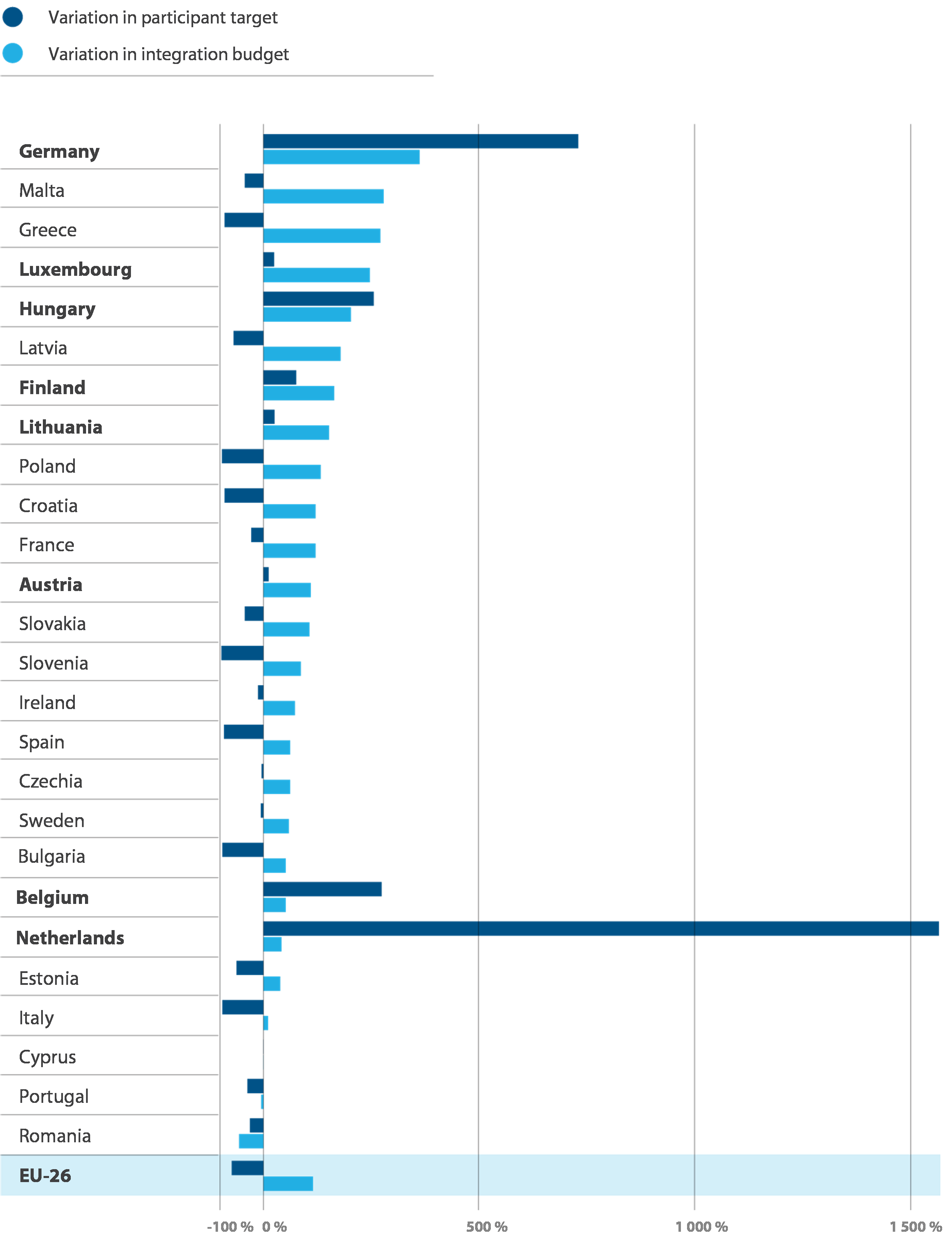
Note: Change in legal migration and integration budget compares 2021-2027 to 2014-2020. Change in number of participants compares the expected figure in 2029 to the actual figure at the end of 2022. Member states are ranked from the largest to smallest change in the legal migration and integration budget. In bold are the 8 member states where both figures increased.
Source: Commission data.
86 If budgets rise and participant numbers fall this might allow an increase in the AMIF support provided per participant. For instance, in France, the authorities confirmed they intended to increase the aid per participant for the “Contrat d’intégration républicaine” programme and expected to gain a better integration result. We found that average AMIF support per participant was expected to rise considerably between the two programming periods. It will increase from €92 to €789 for the 24 member states that have 2029 targets for the indicator “Number of participants who report that the activity was helpful for their integration”. On the other hand, the same member states expect that, on average, fewer than 50 % of participants will assess their integration activity as helpful. One of the reasons for this figure, which might even be seen as conservative, is that it is difficult to contact participants to measure their satisfaction once they leave a project.
87 We did not find any analysis, either at the Commission or in the managing authorities we visited, showing to what extent the increases in the budget for integration during 2021-2027 justified the targets for participant numbers and results. Historical data had already showed that these targets required justification, since there were significant deviations (paragraph 91).
AMIF’s contribution to integration is difficult to assess
88 The support study for the interim evaluation of AMIF 2014-2017 concluded that “In the area of short and medium-term integration, it is expected that the results will become more visible over the course of the second half of the programming period. It is therefore recommended that progress in this area form an area of focus for the ex-post evaluation of AMIF”61. This evaluation from the member states and the Commission is expected by 31 December 2024 and 30 June 2025 respectively 62. Our observations below confirm the validity of this recommendation.
Member states did not monitor integration pathways
89 In all member states we visited, once the TCNs leave a project funded by AMIF, there is no follow-up of their integration. While such a follow-up is not mandatory, it is important to analyse the effectiveness of the intervention. The report cited above had already underlined that there was no consistent monitoring in the longer-term63.
90 Only in France did we identify a survey that was monitoring migrants’ integration over time (ELIPA, Box 7), although it did not specifically monitor TCNs supported by AMIF.
Long-term monitoring of integration pathways in France
The first ELIPA study covered 2010-2013. In 2018, ELIPA received a payment from AMIF of €1.5 million. A new study published in January 2024 covers 2019-2022. The aim is to assess the migrants’ integration pathway in France for the 4 years after they have received their residence permits. The survey provides data on newcomers’ plans for migration, their progress in understanding French, their overall physical and mental health and their first years in France as migrants.
Output data on AMIF participants provides only partial information
91 We found that monitoring was largely based on outputs, such as the number of participants in integration measures funded by AMIF, or the number of integration projects supported by AMIF. The AMIF outputs per member state varied significantly as they were largely dependent on the national models chosen to implement AMIF (paragraphs 42-47). In France and Spain, high numbers of participants were recorded under AMIF measures in 2014-2020 (971 478 and 709 758 people respectively). In France, this was because the core integration measure (Contrat d’intégration républicaine) involved a large number of people (around 100 000 per year), who were all counted towards AMIF output. In Sweden and Germany, however, excluding such core measures from AMIF co-financing limited the number of participants assigned to AMIF during the same period (22 331 and 49 343 people respectively). In Sweden, we also identified large projects to equip the authorities with new electronic systems and upgrade their capacity. These projects did not mention participant numbers, but they still received significant AMIF funding. Figure 11 shows the variability of participant data per member state.
Figure 11 – Variation in number of persons in integration measures compared with targets for 2014-2020
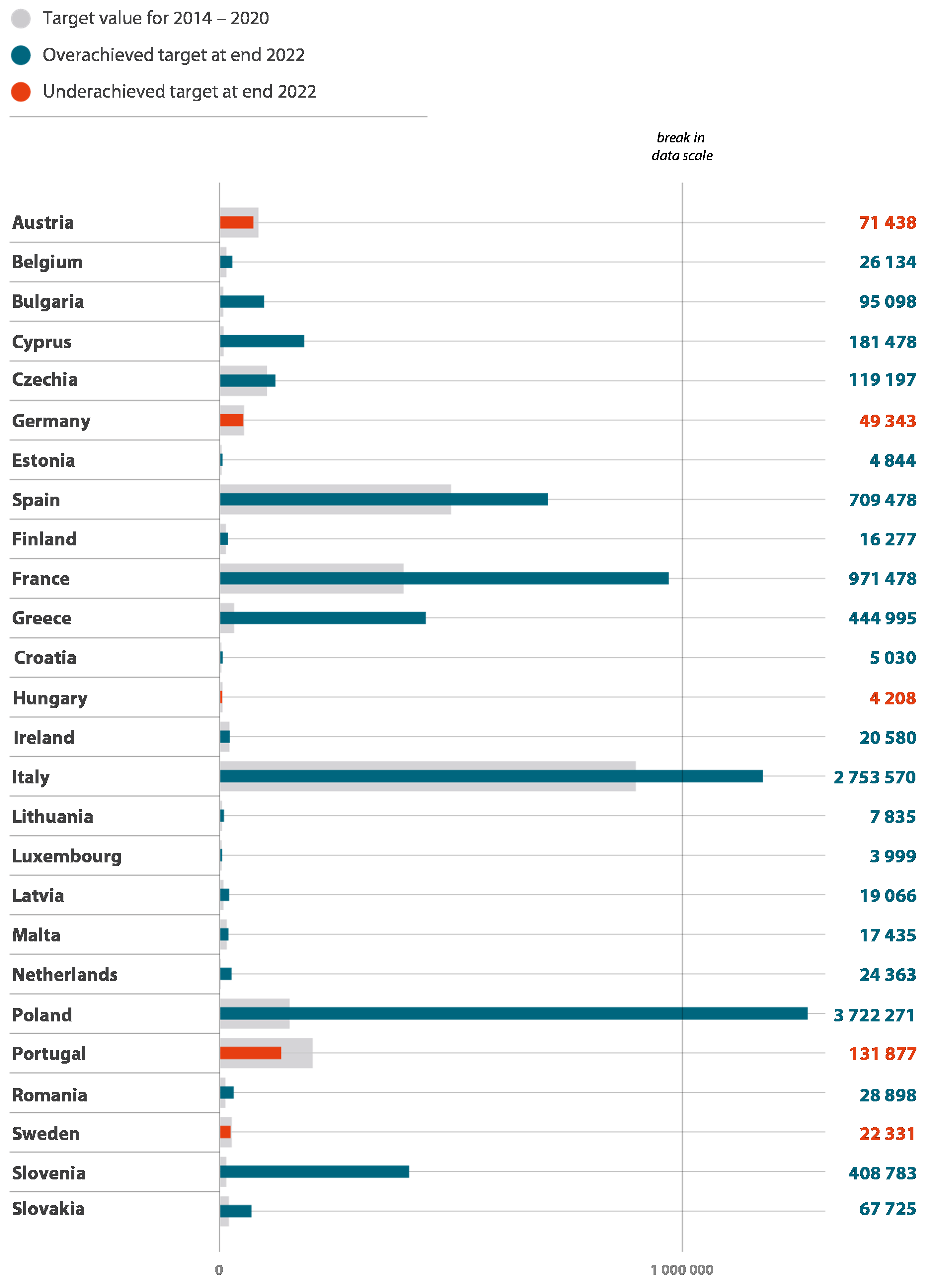
Source: Commission data available at the end of 2022.
92 An analysis of the aggregation, comparison and interpretation of budget and output data at EU level is important and requires care, given the differences in types of interventions and in socio-economic conditions between the member states. In Poland, for instance, there were 3 722 271 people counted as being in integration measures at the end of 2022 for an available budget of €60.7 million64. In Germany, there were 49 343 people for an available budget of €127.1 million65.
93 We thus found the value of the information provided by output indicators to be limited. The Commission nevertheless used the “Integration of non-EU nationals – number of beneficiaries” as one of its key performance indicators66, reporting simply that the “progress to target” was 100 % at the end of 2023. Taking the figures only from Poland or Italy would mean that the initial EU target for 2014-2020 of 2 576 062 people would have been achieved for this indicator.
Result indicators for 2014-2020 were affected by shortcomings
94 For 2014-2020, most of the result indicators focused on six socio-economic factors to monitor the gaps between host-country nationals in the EU and TCNs (paragraph 05)67, (Box 8).
Result indicators for 2014-2020 monitoring the gaps between host-country nationals in the EU and TCNs
The indicators below monitor the gap between the two populations for the following:
- employment rate;
- unemployment rate;
- activity rate, i.e. percentage of population in work;
- percentage of early leavers from education and training;
- percentage of 30 to 34-year-olds with tertiary educational attainment; and
- percentage of population at risk of social poverty or social exclusion.
95 We found that the result indicators made it possible to record the trends in integration in the member states and the EU over a number of years. For instance, the share of early leavers from education and training for TCNs increased between 2014 and 2023 in Germany (from 24.2 % to 29.5 %), unlike the trend in the EU overall (28.5 % versus 25.3 %).
96 However, we also found that it was not possible to accurately measure the specific effects of the integration measures supported by AMIF using the result indicators for 2014-2020. This was because integration trends were also influenced by external factors or other national measures. It was also difficult to separate out the effects of AMIF support because AMIF budgets were small compared to national integration policies (paragraph 34).
97 Other than the outputs achieved, we also assessed whether project monitoring provided information about the results of AMIF-funded projects on the integration of TCNs. In France, we found that the responsible authority had commissioned an external service provider to carry out evaluation visits to at least 50 % of the project promoters to assess progress towards the objectives. However, our review of a sample of 20 projects under shared management in the member states we visited showed that monitoring by the authorities (Annex I – criterion 5) mainly focused on outputs, without clear reference to the results, which were sometimes intangible and thus difficult to assess.
Monitoring of results was strengthened for 2021-2027
98 As one of the main lessons learnt during the 2014-2020 programming period, the Commission identified a “need to strengthen the quality of performance monitoring, with more regular and reliable data for the result indicators”68.
99 For the four result indicators applicable to AMIF for 2021-202769, we found some progress in tackling the shortcoming described in paragraph 96. Our work in the member states we visited revealed that these indicators were more easily linked to AMIF activities (Box 9) than the indicators for 2014-2020. The new indicators were included in the approved national programmes at the beginning of the programming period and the data came from the projects supported by AMIF. This new reporting framework underscores the shortcomings in the reliability of 2014-2020 project reporting identified in paragraph 82.
Result indicators for 2021-2027 linked to AMIF activities
- Number of participants in language courses who have improved their proficiency level by at least one level
- Number of participants who report that the activity was helpful for their integration
- Number of participants who applied for their qualification or skills acquired in a third country to be recognised or assessed
- Number of participants who applied for long-term residence status
Conclusions and recommendations
100 Overall, we conclude that the support from the Asylum, Migration, and Integration Fund (AMIF) which we audited played a relevant role in the integration of third-country nationals (TCNs) in the EU, but that its impact could not yet be demonstrated.
101 We found that the legislative framework provided a clear rationale for AMIF intervention (paragraphs 29-31). The level of AMIF support for integration measures was low in some member states compared to other available funding sources (paragraphs 32-34). There is a risk that the added value from AMIF is limited by its administrative complexity (paragraphs 35-39). In the member states we visited, there were similarities in the general principles of integration policy for TCNs and types of beneficiaries addressed by AMIF. At the same time, these member states used the flexibility offered by AMIF to support national integration policies in quite diverse ways (paragraphs 40-47).
102 We found that there was limited coordination between AMIF and the European Social Fund (ESF) in 2014-2020. We did not find good practice of EU funds (AMIF and the ESF) being used in a coordinated manner in 2014-2020 to finance full integration pathways, such as an early integration measure funded by AMIF being continued by the ESF in the medium term. However, we found progress in the demarcation between these two funds in 2021-2027 (paragraphs 48-53).
Recommendation 1 – Analyse how to identify the financing gaps and streamline the programming of AMIF support for the integration of third-country nationals
The Commission, in cooperation with the member states, within their remits, should analyse how to:
- identify financing gaps and possible synergies between funding sources available for the integration pathways of third-country nationals;
- streamline the programming of AMIF support for the integration of third-country nationals to address those gaps in a targeted way.
Target implementation date: by end of 2026
103 We found that integration measures supported by AMIF were relevant to integration needs, but the measures were not systematically tailored to specific groups (paragraphs 56-61). Although recognition of skills and qualifications is increasingly important for labour market integration, AMIF support was marginal in this area (paragraphs 62-69). We found that projects largely delivered on outputs, but with limited assessments of costs (paragraphs 70-77).
Recommendation 2 – Collect, analyse and disseminate best practice on AMIF support for integration measures
In cooperation with the member states, the Commission should:
- collect, analyse and disseminate information both on best practice and on the challenges in tailoring AMIF support for integration of relevant specific groups, as well as on other increasingly important topics in the field of integration;
- identify and disseminate best practice for analysing and documenting whether project costs are reasonable, by checking, for example, whether costs are in line with relevant benchmarks or market prices.
Target implementation date: by end of 2026
104 The Commission reviewed member state reporting within an existing structured system, but that data quality remained a challenge (paragraphs 79-82). Member states did not generally align their targets for participant numbers and results with 2021-2027 integration budget increases (paragraphs 83-87). AMIF’s contribution to integration was difficult to assess (paragraphs 88-99), and output data on AMIF participants provided only partial information (paragraphs 91-93). The result indicators for 2014-2020 were affected by shortcomings (paragraphs 94-97), although monitoring of results was strengthened for 2021-2027. The four new result indicators were easier to link to AMIF activities than the indicators for 2014-2020 (paragraphs 98-99). Lastly, we found that member states did not monitor integration pathways (paragraphs 89-90).
Recommendation 3 – Improve the reliability of project data, and of monitoring and reporting on AMIF support for integration
In cooperation with the member states, the Commission should:
- further support member states in improving the reliability of reported project data to strengthen overall performance information, e.g. by systematically requiring relevant external parties (such as audit authorities) to check the reported project output indicators and promoting data quality checks (on data completeness, consistency and plausibility) by external reviewers;
- disseminate examples of good practice for monitoring and evaluating AMIF support for integration both to and within the member states.
Target implementation date: by end of 2026
Recommendation 4 – Analyse how to improve the reporting framework to enable the assessment of the performance of AMIF support for integration pathways of third-country nationals
The Commission should analyse how to improve the reporting framework so it can obtain relevant data to assess the performance of AMIF interventions on the integration pathways of third country nationals as part of its subsequent evaluation of AMIF implementation.
Target implementation date: by end of 2026
This report was adopted by Chamber III, headed by Mrs Bettina Jakobsen, Member of the Court of Auditors, in Luxembourg at its meeting of 22 October 2024.
For the Court of Auditors
Tony Murphy
President
Annexes
Annex I – Results of our review of the selected projects under shared management from 2014-2020
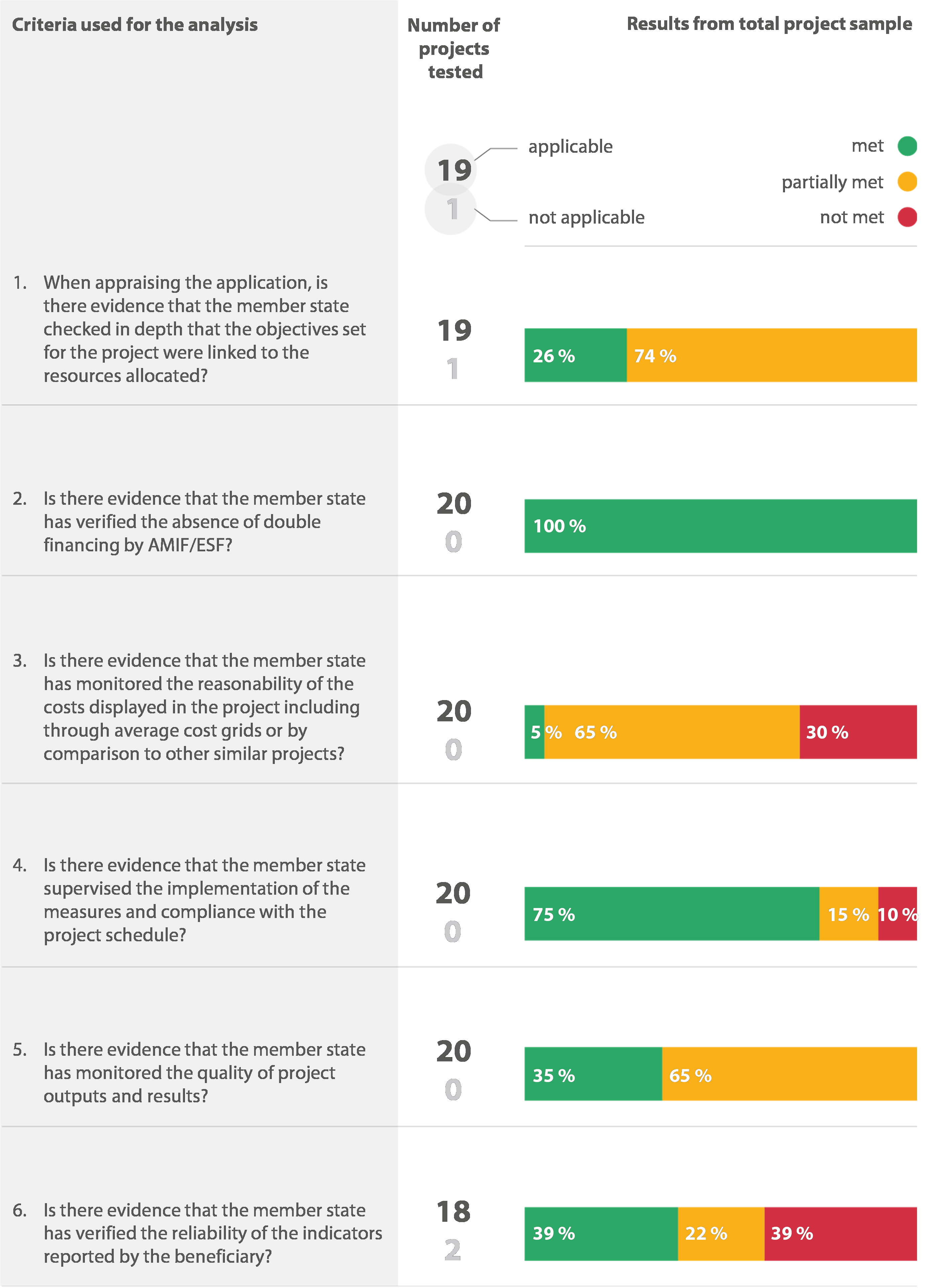
Note: The criteria are numbered according to the order of the project management cycle.
Source: ECA assessment, based on project data from national authorities.
Annex II – Projects selected from 2014-2020
| Member state - European Commission | Type of beneficiary | Purpose of the project | AMIF payment (euros) |
|---|---|---|---|---|
Shared management | ||||
#1 | Germany | Association | Training for migrant organisations, so that they can also qualify other migrant organisations (multiplication effect). | 366 036 |
#2 | Association | Training teachers how to educate children with trauma, to improve the refugee children’s school results. | 629 764 | |
#3 | Association | Developing an online platform for migrants, providing information about everyday life in Germany (job-search etc.). | 859 795 | |
#4 | Association | Supporting legal migration of labour force from Kosovo to Germany by easing the recognition of skills and qualifications. | 159 887 | |
#5 | Local authority | Intercultural training and communication for administrators of a big German city to identify gaps in the employment of migrants. | 386 530 | |
#6 | Spain | Association | Creating spaces where the migrants can meet with the relevant stakeholders in the school system (teachers, pupils, families). | 72 568 |
#7 | Association | Creating local networks with associations and social agents to help migrants and host community live alongside each other. | 128 937 | |
#8 | Association | Supporting networks fighting against prejudices. An interdisciplinary team of professionals acted in situation of direct and indirect discrimination. | 143 255 | |
#9 | Association | Individual and group discussions with migrant women to increase their awareness about their own health and prevent gender-based violence. | 65 532 | |
#10 | Ministry | Permanent Observatory on Immigration: obtaining immigration statistics from public registers and publish them on the web, to improve knowledge of migration. | 288 657 | |
#11 | France | Association | Developing courses and materials on the rights of foreigners in France to increase the skills of social workers supporting TCNs. | 159 059 |
#12 | Association | Integration measures for 7 000 beneficiaries of international protection to facilitate their access to employment and housing. | 1 172 907 | |
#13 | State agency | Civic orientation courses for TCNs (CIR): teaching of the values and institutions of the French Republic, as well as informing on life and access to employment, to around 100 000 TCNs per year. | 15 597 140 | |
#14 | City council | Creating a day centre and a night shelter, and outreach work in the neighbourhood helping young migrants to access services for child protection and childcare. | 1 837 424 | |
#15 | State agency | Language training for TCNs (CIR) with the aim to reach language skills of A1 level of the European framework for Languages. | 3 831 256 | |
#16 | Sweden | Local authority | Training of newly arrived parents by leaders of the same culture speaking the same language. | 185 140 |
#17 | Trade association | The industry’s skills validation tool has been translated into 5 different languages to facilitate the validation of TCNs’ skills and help TCNs meeting the requirements for various professional roles. | 652 248 | |
#18 | Local authority | An administrative board cooperated with around ten municipalities, civil society and the employment service to help TCNs integrating the labour market. | 1 041 248 | |
#19 | State agency | Four government agencies developed a digital solution to simplify the process for TCNS who want to work in Sweden. | 2 121 287 | |
#20 | State agency | The project modernised existing and developed new e-application systems for work permits, visas, family reunification cases, students, unaccompanied minors... | 5 005 338 | |
TOTAL |
| 34 704 008 | ||
Direct management | ||||
#21 | European Commission | Consortium of 7 associations from France and Italy | The project aimed to develop access to international protection. The project facilitated the exchange of good practices and enhanced capacities of organizations involved. | 725 302 |
#22 | European Commission | Consortium of 10 beneficiaries from Belgium, France, Italy, Portugal, Spain, and Sweden | The consortium built a network of regions from different European countries, developed practices to facilitate knowledge transfer, and developed a set of indicators. | 1 614 787 |
Source: Project data from national authorities and the European Commission.
Abbreviations
AMIF: Asylum, Migration and Integration Fund
CIR: Contrat d’intégration républicaine (French integration contract for immigrants)
CMEF: Common monitoring and evaluation framework
ELIPA: Enquête longitudinale sur l'intégration des primo-arrivants (Longitudinal survey on the integration of newly arrived immigrants)
ESF: European Social Fund
ESF+: European Social Fund Plus
MFF: Multiannual financial framework
TCN: Third-country national
Glossary
Asylum: Protection granted by a state to people from another country who are fleeing persecution or serious danger.
Commitment: Amount earmarked in the budget to finance a specific item of expenditure, such as a contract or grant agreement.
Common monitoring and evaluation framework: Rules and procedures for evaluating the performance of the Asylum, Migration and Integration Fund.
Common Provisions Regulation: Regulation setting out the rules that apply to eight EU funds, including the four cohesion policy funds. The current regulation covers the 2021-2027 period.
Integration pathway: Coordinated action in various policy areas, taken by local, regional and national authorities and funded by member states and the EU, to help non-EU migrants overcome barriers on the way to integration.
Managing authority: National, regional or local authority (public or private) designated by a member state to manage an EU-funded programme.
Multiannual financial framework: The EU’s spending plan setting priorities (based on policy objectives) and ceilings, generally for 7 years. It provides the structure within which annual EU budgets are set, limiting spending for each category of expenditure.
Output indicator: Measurable variable providing information for assessing a project’s products or achievements.
Performance framework: Milestones and targets defined for a set of indicators for each specific objective of a national programme.
Refugee: Person benefitting from international protection, having been forced to flee their country because of persecution, war or violence.
Result indicator: Measurable variable providing information for assessing the immediate effects of supported projects on the targeted population.
Supreme audit institution: Independent national body responsible for auditing public revenue and expenditure.
Temporary protection: Right to reside, work and access basic services in an EU member state, granted for a limited period to displaced persons who cannot return to their non-EU country of origin.
Audit team
The ECA’s special reports set out the results of its audits of EU policies and programmes, or of management-related topics from specific budgetary areas. The ECA selects and designs these audit tasks to be of maximum impact by considering the risks to performance or compliance, the level of income or spending involved, forthcoming developments and political and public interest.
This performance audit was carried out by Audit Chamber III – External action, security and justice, headed by ECA Member Bettina Jakobsen. The audit was led by ECA Member Viorel Ştefan, supported by Roxana Banica, Head of Private Office and Dan-George Danielescu, Private Office Attaché; Pietro Puricella, Principal Manager; Bertrand Tanguy, Head of Task; Erik Kotlarik, Paolo Rexha and Alexandre Si Serir, Auditors. Jennifer Schofield, Hakan Hellstrom, Janina Schmidt Maximo and Pablo Lledo Callejon provided linguistic support. Dunja Weibel provided graphical support.
COPYRIGHT
© European Union, 2024
The reuse policy of the European Court of Auditors (ECA) is set out in ECA Decision No 6-2019 on the open data policy and the reuse of documents.
Unless otherwise indicated (e.g. in individual copyright notices), ECA content owned by the EU is licensed under the Creative Commons Attribution 4.0 International (CC BY 4.0) licence. As a general rule, therefore, reuse is authorised provided appropriate credit is given and any changes are indicated. Those reusing ECA content must not distort the original meaning or message. The ECA shall not be liable for any consequences of reuse.
Additional permission must be obtained if specific content depicts identifiable private individuals, e.g. in pictures of ECA staff, or includes third-party works.
Where such permission is obtained, it shall cancel and replace the above-mentioned general permission and shall clearly state any restrictions on use.
To use or reproduce content that is not owned by the EU, it may be necessary to seek permission directly from the copyright holders.
Figures 1, 4, 8 and 9 – Icons: these icons have been designed using resources from Flaticon.com. © Freepik Company S.L. All rights reserved.
Software or documents covered by industrial property rights, such as patents, trademarks, registered designs, logos and names, are excluded from the ECA’s reuse policy.
The European Union’s family of institutional websites, within the europa.eu domain, provides links to third-party sites. Since the ECA has no control over these, you are encouraged to review their privacy and copyright policies.
Use of the ECA logo
The ECA logo must not be used without the ECA’s prior consent.

| ISBN 978-92-849-3362-4 | ISSN 1977-5679 | doi:10.2865/0470040 | QJ-01-24-012-EN-N | |
| HTML | ISBN 978-92-849-3361-7 | ISSN 1977-5679 | doi:10.2865/0610832 | QJ-01-24-012-EN-Q |
Endnotes
4 Toolkit on the use of EU funds for the integration of people with a migrant background 2021–2027 programming period, p. 19.
5 SEC(2011) 1358, p. 13.
9 Article 3(2)(b) of Regulation (EU) No 516/2014.
10 Articles 8 to 10 of Regulation (EU) No 516/2014.
11 Follow the Money II report, p. 37.
12 Programme statement for 2023 draft budget, pp. 857-859.
13 Article 15(1)(a) of Regulation (EU) No 516/2014.
15 Annexes II and III to Regulation (EU) 2021/1147.
16 Ibid., Article 3(2)(b).
17 COM(2020) 758, Action Plan on Integration and Inclusion 2021-2027, p. 18.
18 Article 10 of Regulation (EU) 2021/1147.
19 Ibid., Article 11.
20 Ibid., Articles 13(1)(b) and 17(1).
21 Ibid., Article 16(2)(b).
25 Article 3(2)(b), Articles 8 to 10 of Regulation (EU) No 516/2014; Annexes II and III of Regulation (EU) 2021/1147.
26 Special report 06/2017: “EU response to the refugee crisis”, special report 24/2019: “Asylum, relocation and return of migrants”, special report 17/2021: “EU readmission cooperation with third countries”
30 Article 16 of Regulation (EU) No 514/2014, and Article 15 of Regulation (EU) 2021/1147.
31 COM(2018) 464, section 5.8.
32 Evaluation report France, p. 7; Evaluation report Germany, p. 6; Evaluation report Spain, p. 68; Evaluation report Sweden, p. 58.
33 COM(2018) 464, section 3.5.
34 Toolkit on the use of EU funds for the integration of people with a migrant background 2021–2027 programming period, Chapter 3, p. 11.
36 Recital 48 of Regulation (EU) 2021/1147, and Article 20(2)(b) of Regulation (EU) No 516/2014.
37 Follow the Money II report, p. 22.
38 Projects number 6 to 9 in Annex II.
39 Article 2(3) of Regulation (EU) No 1304/2013.
40 EU funds for migrant integration 2021-2027, European Commission (26 June 2024).
41 Recital 15 of Regulation (EU) 2021/1147.
42 Article 4(1)(i) of Regulation (EU) 2021/1057.
43 Recital 22 of Regulation (EU) No 516/2014.
44 Toolkit on the use of EU funds for the integration of people with a migrant background 2021–2027 programming period, chapter 4, pp. 12-19.
45 Toolkit on the use of EU funds for the integration of people with a migrant background, 2014-2020.
46 Annex VI to Regulation (EU) 2021/1147.
47 Articles 9(2) and 19(1)(b) of Regulation (EU) No 516/2014; Annex III. 3(h) to Regulation (EU) 2021/1147.
48 Annex VI, Table 1, section II. to Regulation (EU) 2021/1147.
49 Article 8(b) of Regulation (EU) No 516/2014.
50 Annex III 3(d) to Regulation (EU) 2021/1147.
51 Ibid., Annex V.
53 Ibid., p. 10.
55 Estudio sobre las necesidades de la población inmigrante en España: tendencias y retos para la inclusión social. Informe ejecutivo, December 2020, p. 19.
56 Data from the ENIC-NARIC centre in France.
58 Articles 17 and 18 of Regulation (EU) No 514/2014.
59 Programme statement of draft budget 2023, pp. 880-881.
60 Commission data from national AMIF programmes.
62 Article 1(5) of Regulation (EU) 2022/585 amending Regulation (EU) No 514/2014.
67 Annex III 1(b) to Regulation (EU) 2017/207.
69 Annex VIII to Regulation (EU) 2021/1147.