Main messages
Why this area is important
01Innovation capacity and economic performance have a strong, two-way link: innovation drives economic growth through productivity gains, new markets and competitiveness, while economic strength leads to the investment and demand needed for further innovation, creating a virtuous cycle of sustained prosperity. A firm’s ability to innovate (“innovation capacity”) boosts its output, creates high-value jobs and enhances global competitiveness, making it crucial for long-term development.
02Horizon 2020 (H2020) was the EU’s flagship research and innovation programme for the 2014-2020 period. Its overall objective was to contribute to the development of a knowledge and innovation-based society and economy across the EU by leveraging additional investment in research and innovation (R&I), and supporting the achievement of the EU’s research and innovation targets1.
03Regulation (EU) No 1291/2013 (H2020 Regulation) set out three programme priorities: “excellent science”, “societal challenges” and “industrial leadership” whose aim was to better exploit Europe’s industrial potential through research, innovation and technological development across a wide range of sectors.
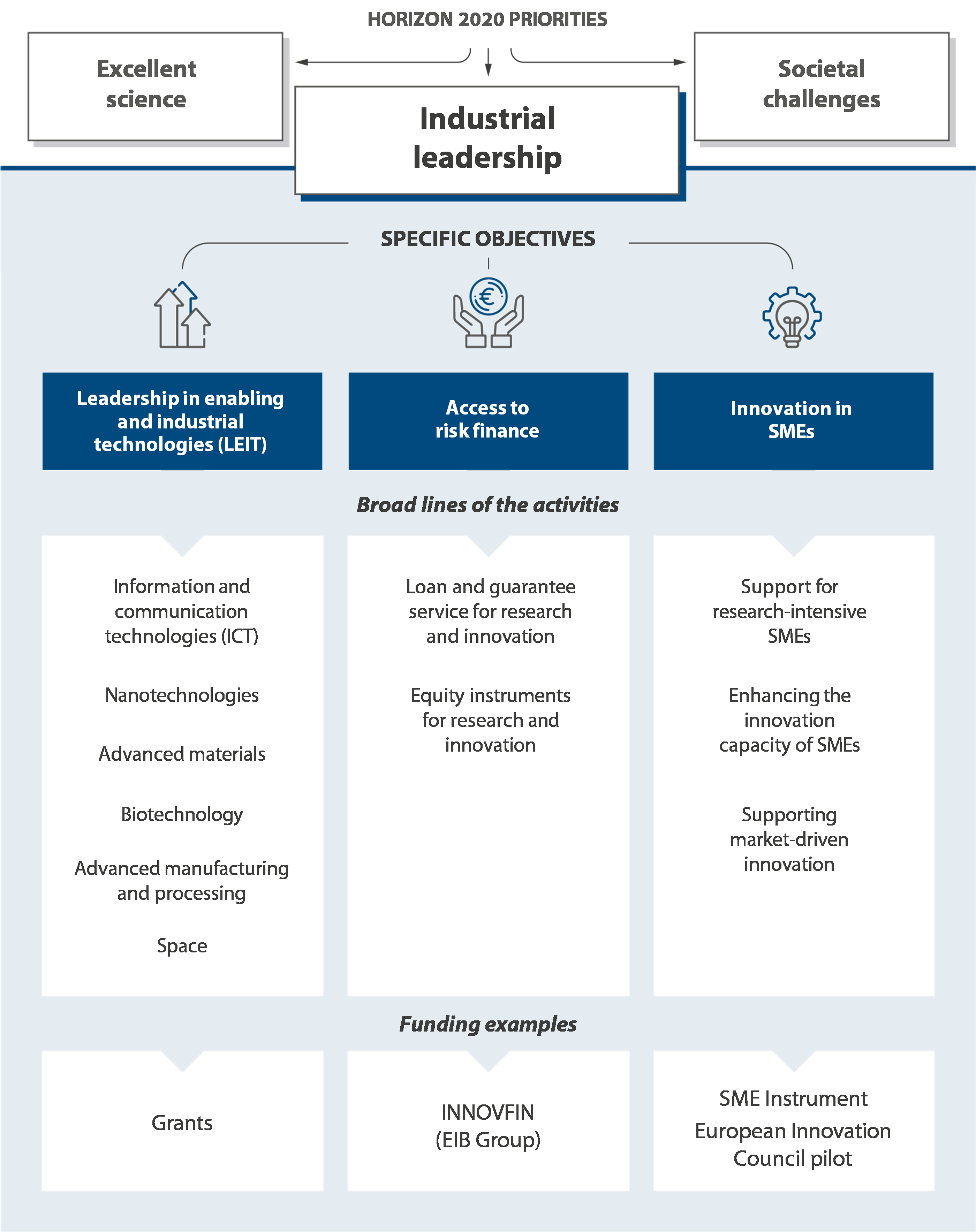
04With a total budget of €79 billion (comprising €77 billion in baseline funding plus additional funding for nuclear research under the Euratom programme2), H2020 accounted for 54 % of the multiannual financial framework (MFF) heading “Competitiveness for growth and jobs”. The “industrial leadership” priority had a budget of around €17 billion (or 22 % of the total H2020 budget). This priority was pursued through a set of three specific objectives. Almost 80 % of the budget under this priority was allocated to the specific objective of attaining leadership in six enabling and industrial technologies (LEIT). This is also the area most likely to provide funding for close-to-market research and innovation measures (Figure 1).
Figure 1 | “Industrial leadership” priority – specific objectives
Source: ECA, based on the H2020 Regulation.
05According to the Draghi report on European competitiveness, research and innovation play a central role in the EU’s strategy for competitiveness, growth and jobs. The report underlines the need to strengthen Europe’s technological leadership, improve the conditions for private R&I investment and enhance the uptake and visibility of research results in the wider economy. It identifies the innovation gap with the United States and China, particularly in advanced technologies, as a key challenge.
06In response, and as part of its legislative proposals for the 2028-2034 MFF, the Commission intends to set up a European Competitiveness Fund (ECF) and, closely linked to but separate from this Fund, a continuation of the upcoming Horizon Europe as a separate programme.
07The ECF, together with Horizon Europe, is meant “to operate as an investment capacity to bolster European competitiveness in technologies and strategic sectors critical to the EU competitiveness from collaborative research to scaling up, innovation, industrial and infrastructure deployment and manufacturing, including skills, and in support of projects and companies including SMEs, start-ups, larger companies, universities and research entities, while acting as a leverage tool employing budgetary instruments to attract private, institutional and national investments”3. Taken together, the ECF and Horizon Europe have a planned budget of around €409 billion (€362 billion in 2025 prices), representing around 21 % of the total proposed 2028-2034 MFF budget of €1 984 billion (€1 763 billion in 2025 prices). By closely linking the “competitiveness” component of Horizon Europe with the ECF, the Commission is also seeking to ensure a more seamless progression from research to innovation, start-up and scale-up.
08In the 2014-2020 period, the main aim of H2020’s “industrial leadership” priority was to fund research and innovation measures that helped companies, and particularly SMEs (small and medium enterprises), to strengthen their innovation and growth potential. It is therefore essential to assess its effectiveness in supporting European undertakings in bringing innovative products and services to market so that lessons could be learnt for the implementation of the ECF and relevant parts of Horizon Europe in 2028-2034.
09In the first quarter of 2026, we issued opinions on the Commission’s proposals for both the ECF and Horizon Europe, and on its proposal to implement a horizontal performance framework (opinion 01/2026, opinion 02/2026, and opinion 10/2026). We refer to these opinions in our report where appropriate.
10Annex I provides more background information and details on the audit scope and approach.
What we found and recommend
11The Commission appropriately reflected the EU strategic priorities in the H2020 work programmes for the “industrial leadership” priority. However, the extent to which participant’s needs, insights from consultations or feed-back from executive agencies were translated into the preparation of work programmes or the call design remained unclear. This concern was also echoed by the stakeholder feedback reported in the Commission’s interim evaluation of H2020. Taken together, these factors may have limited the Commission’s ability to identify topics which could have addressed better the specific needs of innovative participants (and in particular SMEs) (paragraphs 23–24).
12Overall, under the “industrial leadership” priority, only around half of the financial support was for close-to-market actions with higher levels of technological development. Moreover, around half of the funding went to non-profit organisations, thereby limiting private-sector leverage. While for-profit entities including SMEs accounted for more than three quarters of all participants, we observed that the funding for LEIT technologies and for “innovation in SMEs” was concentrated on a few hundred participants. However, these were mainly non-profit organisations in multiple collaborative projects, research organisations and higher or secondary education establishments. These organisations often benefited from the highest funding rate (up to 100 %), meaning that this support lacked any incentive effect to leverage private investment (paragraphs 25–29).
13We also found that many calls defined in the work programmes under the “industrial leadership” priority targeted mid technological readiness levels (TRLs), focusing on validation and demonstration in relevant industries. Consequently, H2020’s overall impact on commercialisation and scale-up was limited already at the programming stage. This situation has not significantly changed under the current Horizon Europe. Meanwhile, to support later-stage innovation, the Commission has introduced new schemes which complement grant funding with equity investments, covering mainly higher TRLs. The main instrument in this regard is the European Innovation Council (EIC), and particularly its main venture capital investment arm, the EIC Fund. However, these instruments operated separately and were not systematically linked to grant-funded H2020/Horizon Europe projects, limiting the ability of even technically successful mid-TRL projects to progress from mid-stage development to market-ready commercialisation (paragraphs 30–34).
14The Commission applied the criteria required by the legal basis when evaluating proposals and assessing outputs during project implementation; in our sample, we noted that the “impact” criterion was not consistently used in the selection process. However, we found that SMEs rarely acted as project coordinators in collaborative projects (which account for nearly 80 % of the H2020 funding), thus limiting their influence over project direction, intellectual property ownership or creation and commercial exploitation. Moreover, more than a third of the SMEs in our sample mentioned networking with key industry players rather than innovation as their primary motivation to apply and participate. Finally, neither the H2020 Regulation nor the work programmes specified any eligibility requirements linked to the participants’ innovation capacity. As a result, funding was not necessarily allocated to those participants or projects with the strongest innovation potential. This situation remains unchanged under the current Horizon Europe programme (paragraphs 35–40).
15One of the specific objectives of the “industrial leadership” priority was to strengthen SME access to risk finance as a driver of EU level innovation. In this regard, H2020 established the “access to risk finance” financial instrument. This instrument was implemented through the InnovFin product family and comprised a broad set of debt, guarantee, equity and advisory products. However, the extent to which these European Investment Bank (EIB)-managed funding instruments effectively supported innovation and commercialisation outcomes remains unclear. Our audit showed that SMEs did not receive most of the funding disbursed through the InnovFin instruments managed by the EIB (paragraphs 41–49).
16The SME Instrument provided effective support for technology transfer, but it had only limited results in terms of market uptake due to funding issues, weak exploitation planning, regulatory obstacles, and limited technology transfer capacity. These persistent barriers continued to reduce the programme’s long-term impact. The Commission also implemented tools such as Intellectual property rights, Cordis, websites, Innovation Radar to support the dissemination and exploitation of project results, particularly for SMEs. However, dissemination activities were affected by limited visibility, reducing opportunities for beneficiaries to exploit project results and hindering wider uptake of innovations, and were not always well documented. We also found that the effectiveness of the tools used to encourage dissemination and exploitation of technology transfer and market uptake of EU-funded research results had not yet been assessed by the Commission (paragraphs 50–60).
| Recommendation 1 Promote technological transfer, strengthen the market uptake of innovative solutions and support dissemination activities | |
|---|---|---|
For the 2028-2034 Horizon Europe programme and the European Competitiveness Fund, where joint calls for close-to-market measures will be used the Commission should:
Target implementation date: Q1 2028. | ||

17For “industrial leadership”, as for other parts of the H2020 programme, the Commission did not assess the results of EU-funded research activities at project closure. Participants did have to submit a final project report, which had to include dissemination and exploitation plans, but the Commission neither systematically assessed their research outputs nor followed up on these plans. We also found no evidence that the Commission had attempted to assess the potential for commercialisation and scale-up of EU-funded research during or after project completion. As a result, the Commission lacked any evidence base to decide whether to provide follow-up funding to projects with commercial or scale-up potential. Under the proposed Horizon Europe programme for 2028-2034, the Commission plans to continue verification exclusively at project closure, without systematically assessing research outputs or carrying out a structured follow-up after project completion (paragraphs 78–88).
| Recommendation 2 Target funding to support market entry and scaling up |
|---|---|
For the 2028-2034 Horizon Europe programme and the European Competitiveness Fund, for close-to-market measures under each common policy window, the Commission should:
Target implementation date: 2027. | |
18The design of the objectives and indicators used by the Commission to monitor H2020’s “industrial leadership” priority was weak. There were no operational objectives to measure progress towards specific H2020 objectives. Indicators were related to outputs rather than results or impact, and did not monitor supported entities’ economic performance. In the Commission’s draft performance framework for the next MFF, most proposed indicators for the post-2027 Horizon Europe programme that are relevant to “industrial leadership” still have the same weakness (paragraphs 63–73 and 78).
19Under H2020, the Commission did not collect data on participants’ innovation capacity or economic performance. This may have limited its ability to assess whether EU funding translated into economic value for firms, particularly SMEs. Although methodological changes were made under the current Horizon Europe programme compared to H2020, this situation persists. Moreover, no data is available on whether the European Investment Fund’s (EIF) InnovFin financial products contributed to SME innovation. We consider that it is not possible to perform a comprehensive and meaningful assessment of the effectiveness of EU-funded research in supporting innovation and growth based on incorrect and incomplete monitoring data (paragraphs 74–78 and 89–94).
| Recommendation 3 Restructure and streamline the monitoring system for the Horizon framework programmes |
|---|---|
For the 2028-2034 Horizon Europe programme, the Commission should restructure and streamline its monitoring system so that data suitable for a meaningful assessment of the impact of EU research funding over several programming periods is collected and recorded. More importance should also be given to monitor the long-term effects for participants. This should include the innovation capacity of supported entities and the economic performance of for-profit entities. Target implementation date: 2027. | |
20In 2024, the Commission carried out its ex post evaluation of H2020, in line with its better regulation guidelines. We found that the evaluation assessed that participation in the programme enhanced firms’ economic performance only to some extent based on a sample and not at all the effects on firm’s innovation capacity. Instead, the evaluation focused on H2020’s effects on growth and competitiveness at EU level, mainly using macro- and microeconomic models. The absence of a firm-level perspective limits the evaluation’s usefulness for improving the design of future programmes. Finally, assumptions and methodological issues in these models and in the underlying data for several indicators reduced the robustness of the analysis and may have contributed to an overly positive evaluation result (paragraphs 95–112).
| Recommendation 4 Evaluate the impacts of EU research funding on participants’ economic performance and innovation capacity |
|---|---|
For the current Horizon Europe programme, the Commission should further develop its methods to assess the impact of EU research and innovation funding, with a particular focus on participants’ economic performance and innovation capacity. Target implementation date: 2031. | |
A closer look at our observations
Funding allocations did not systematically target projects with the highest innovation and scale-up potential
21The H2020 Regulation requires the Commission to identify specific innovation barriers faced by SMEs4, to foster industrial leadership to support business, including micro, small and medium-sized enterprises (SMEs) and to attract strong participation from industry, while being open to new participants. User needs must be taken into account in all these fields5. The work programmes set out the priorities and corresponding calls. Projects were then selected through specific calls for proposals, based on pre-defined selection criteria.
22This section examines to what extent the Commission’s work programmes and calls for proposals addressed the needs and specific barriers faced by participants, particularly SMEs, under the “industrial leadership” priority. It also looks at how projects with economic and scale-up potential were identified and whether the right priorities were set to fund such projects.
The Commission’s needs analysis of innovators, including SMEs, did not adequately inform work programme design
23In preparing H2020 work programmes for the “industrial leadership” priority, the Commission used portfolio analysis, studies on technology and market trends, evaluation and impact assessments and project monitoring results, complemented by consultation with member states. It also carried out internal brainstorming sessions and priority-setting meetings and consulted contractual public-private partnerships through the respective partnership boards. Additionally, advisory bodies, technology platforms, stakeholders’ associations, specific Commission experts and experts in member states were consulted. Final thematic priorities were adopted by a committee composed of the responsible Commission directorates-general together with member state representatives.
24Overall, this resulted in H2020 work programmes which adequately reflected the EU strategic priorities for the “industrial leadership” priority. However, we found the following:
- The extent to which participant needs, particularly those of SMEs, were systematically analysed and translated into call design was not evident from the documentation we examined during our audit. In particular, it remained unclear how insights from consultations, market trends analysis or demand analysis studies informed decision-making, or how SME feedback influenced the final content of work programmes.
- The Commission’s reporting on the implementation of calls focused mainly on procedural aspects of the evaluation process and provided recommendations and action plans. The Commission also provided examples illustrating how recommendations from the advisory groups had been reflected in subsequent work programmes. However, no documentation was provided, on how priorities for calls are identified and translated into call design.
- Fragmented governance between the Commission and implementing agencies further limited the effective use of evidence in work programme preparation. While the Commission was responsible for policy design and implemented a large part of the programme directly, the implementation of some activities was delegated to executive agencies. These agencies were not directly involved in the adoption of work programmes by the abovementioned committee, meaning their valuable insights may not have fed into programme design.
- Stakeholder feedback reported in the interim evaluation of Horizon 20206 indicated that they did not perceive the process of preparing work programmes as uniformly transparent or inclusive, due to uneven consultation practices across thematic areas, and a perception that larger players exerted greater influence over call topics.
“Industrial leadership” funding only partially supported innovation activities close-to-market by for-profit participants
“Industrial leadership” covered the full spectrum of research activities rather than focusing on close-to-market activities
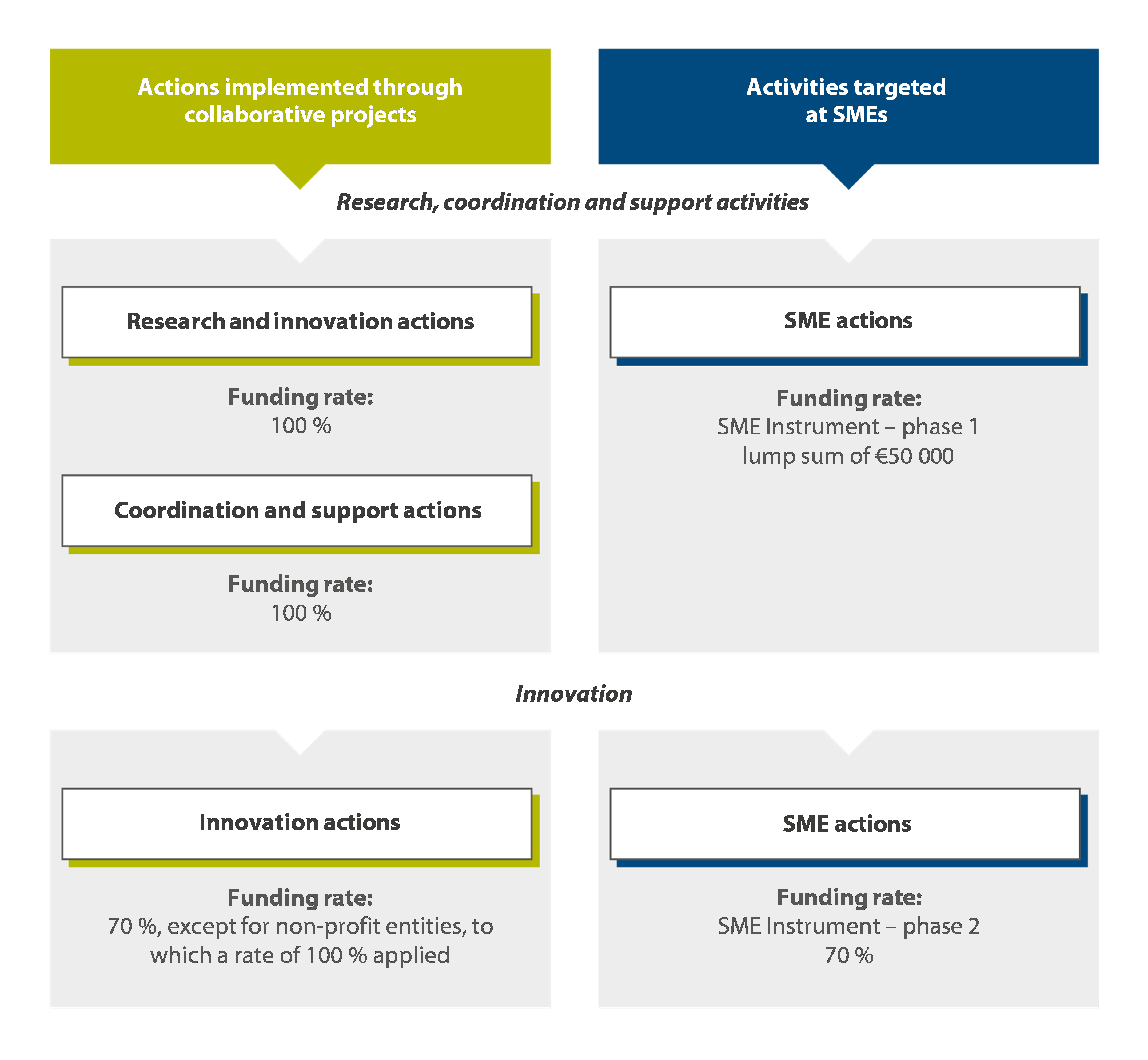
25H2020 aimed to cover the full spectrum of activities from research and technological development to demonstration and innovation, including all stages in the research and innovation chain. Research and innovation activities and funding rates differed by action type, depending on factors such as the maturity and purpose of the action, and beneficiary profile. This reflects the principle that activities closer to the market should attract a larger share of additional funding from other, mainly private funding sources (Figure 2).
Figure 2 | Main types of H2020 actions and beneficiaries’ funding rates
Source: ECA, based on information provided by the Commission.
26Our analysis of funding for LEIT activities, in particular nanotechnologies, advanced materials, biotechnology, advanced manufacturing, and processing (NMBP) and information and communication technologies (ICT) under the “industrial leadership” priority shows that slightly more than half of funding (around 54 %) has been allocated to “research” and “coordination and support” actions. Such measures typically address earlier stages of the innovation cycle. A closer look at NMBP activities also reveals that innovation activities were more prominent for advanced manufacturing and processing, while research and coordination activities were more predominant in the area of nanotechnologies, advanced materials, and biotechnology. Similarly, around half (52 %) of financial support under “innovation actions” and “SME actions” was for close-to-market activities with higher levels of technological development.
Around half of “industrial leadership” funding went to non-profit organisations
27Under H2020, any legal entity, regardless of where it was established, could participate in an action, provided that the conditions in the H2020 Regulation and relevant work programmes were met7. For grants, the standard eligibility condition required at least three independent legal entities established in different member states or associated countries. However, some actions (e.g. SME Instrument or H2020 co-fund actions, or in other duly justified cases8) required only one legal entity. These are referred to as “mono-beneficiary actions”.
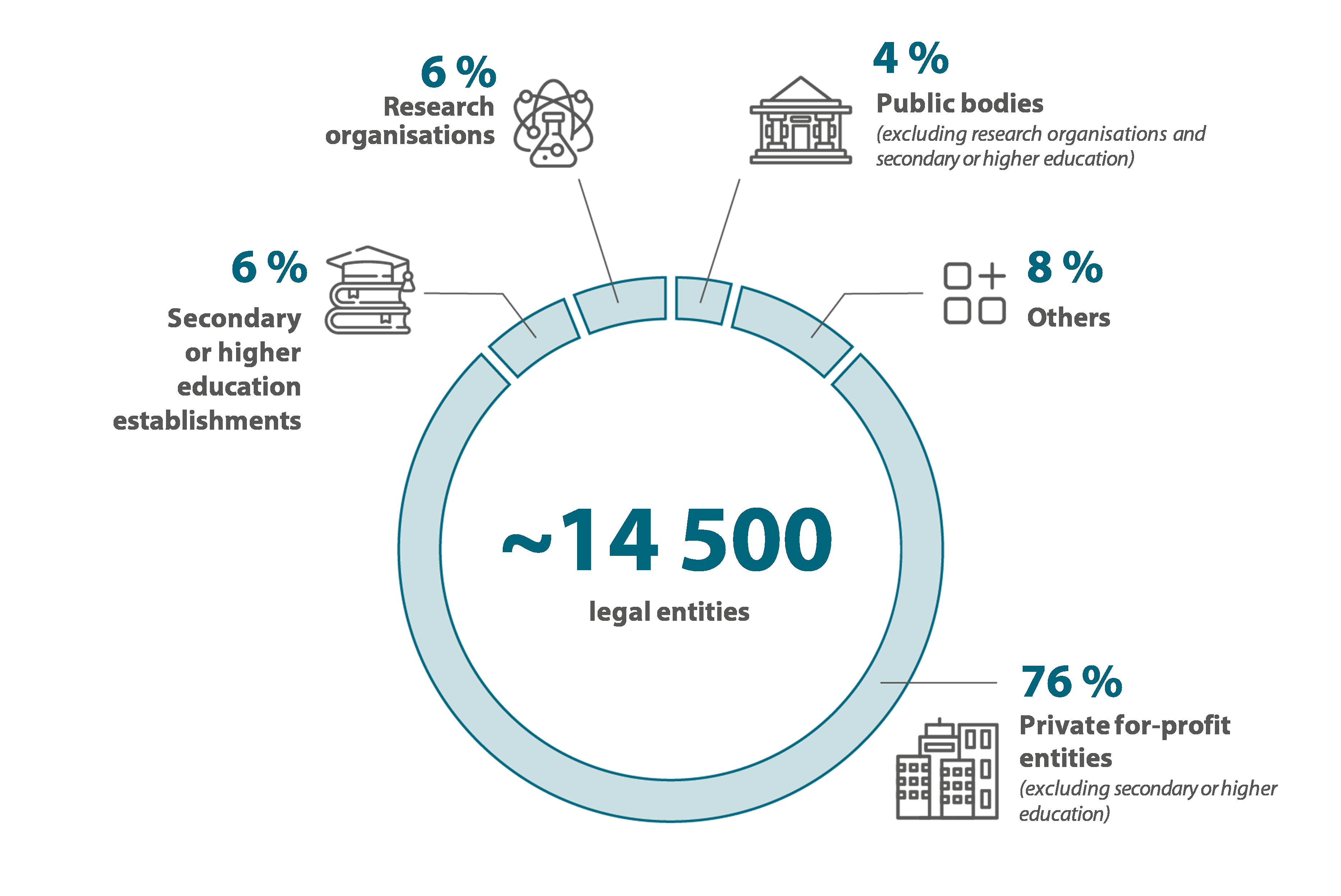
28Around 14 500 legal entities participated in projects for LEIT technologies (NMBP and ICT) and “Innovation in SMEs”. Overall, for-profit entities (including SMEs) accounted for around three quarters (76 %) of all participants (Figure 3).
Figure 3 | Types of participants in projects under “LEIT” and “Innovation in SMEs”
Source: ECA, based on Commission information.
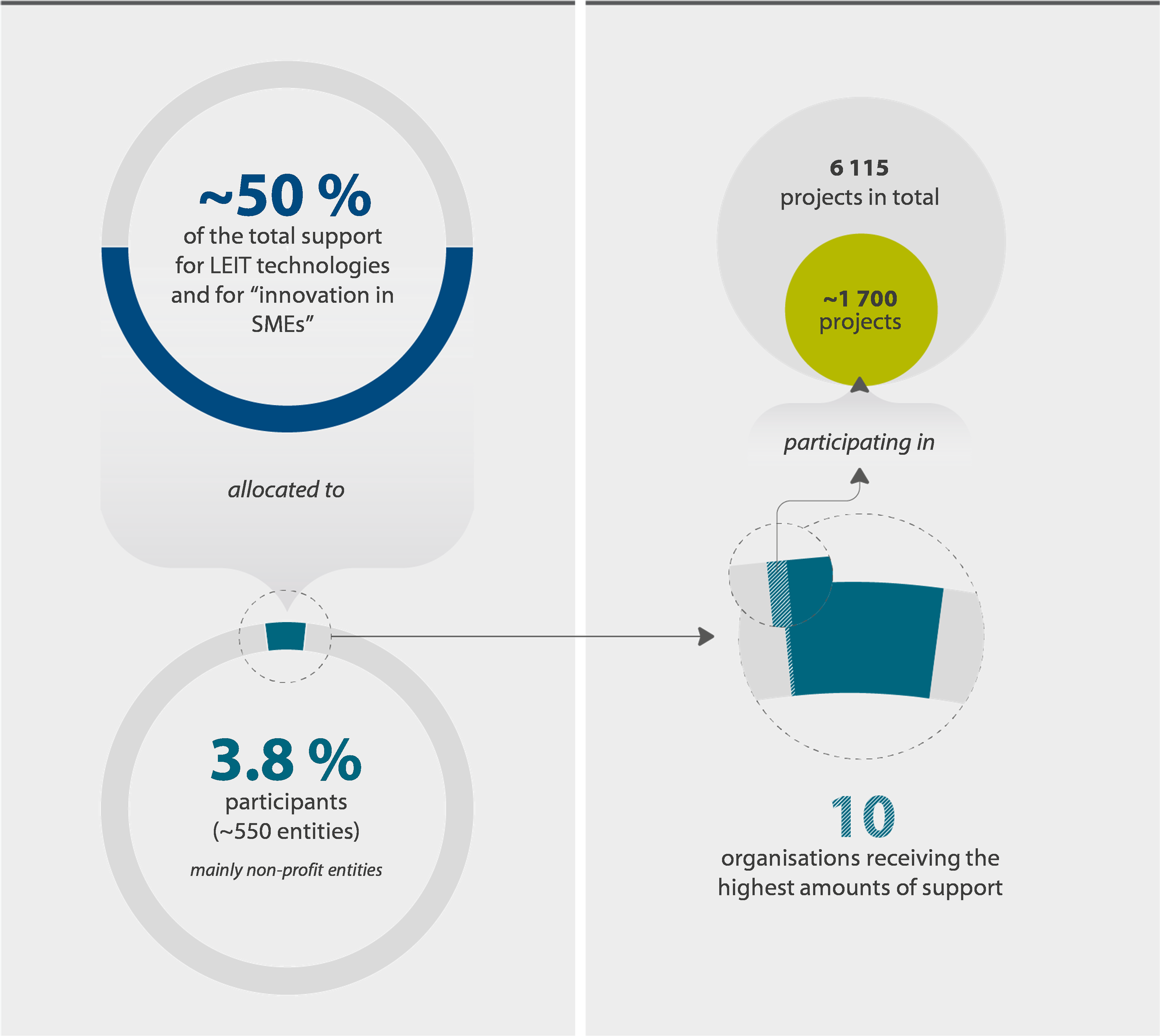
29However, we observed a concentration of funding, with half of the total support for LEIT technologies and for “innovation in SMEs” awarded to about 550 entities (3.8 % of participants). These were mainly non-profit organisations in multiple collaborative projects, research organisations and higher or secondary education establishments. For example, the 10 research organisations receiving the highest amounts of support participated in more than 1 700 projects out of 6 115 projects (28 %). These organisations often benefited from the highest funding rate (up to 100 %), meaning this support lacked any incentive effect to leverage private investment in R&I (Figure 4).
Figure 4 | Concentration of support within LEIT and “innovation in SMEs”
Source: ECA, based on Commission information.
Focusing on low-maturity innovation was not conducive to fostering market deployment or scale-up
30The H2020 Regulation9 requires the Commission to support SMEs throughout the innovation cycle, using a range of funding instruments including grants, prizes, procurement and financial instruments. It specifies that under H2020, financial instruments should be the main form of EU support for activities close-to-market.
31“Technology transfer” is a systematic process of moving technology from laboratory environments to operational settings. To classify the maturity of technologies, the Commission uses a scale of technology readiness levels (TRLs). Generally, the maturity level of an innovation evolves from conceptual research (TRL 1-4) through prototype development (TRL 5-7) to pre-commercial and commercial deployment (TRL 8-9) (Figure 5).
Figure 5 | Measuring the maturity level of a technology
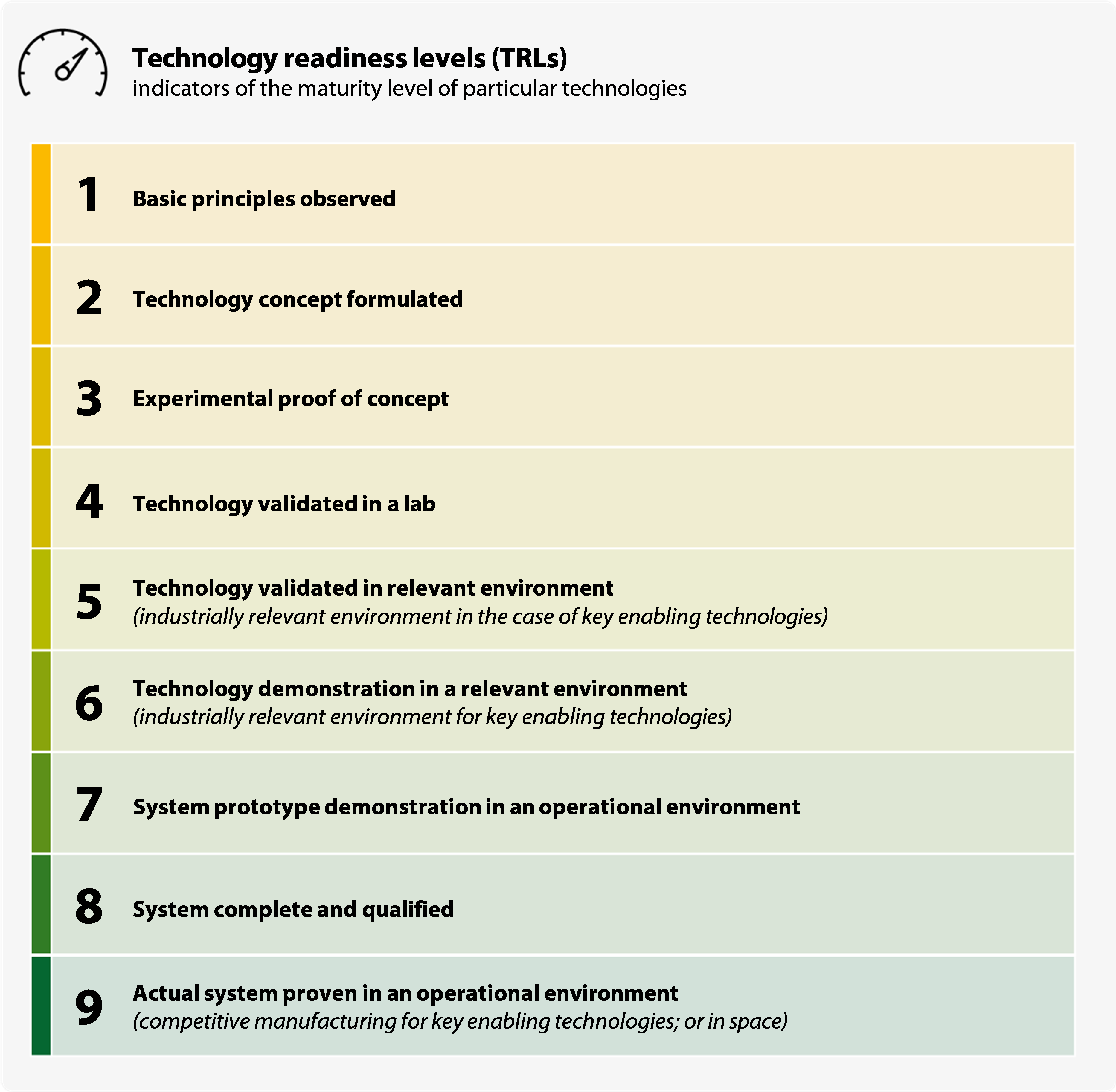
Source: ECA, based on Commission’s information.
32Many calls defined in the work programmes under the “industrial leadership” priority targeted mid-TRL technologies (those with TRL 5-6), focusing on validation and demonstration in relevant industries. While such actions supported technological development, they generally did not extend to activities close to commercial deployment.
33We found that some actions included in the work programmes partially addressed this gap by supporting SMEs at more advanced stages of the innovation cycle. However, many others, including planned collaborative projects, tended to focus on early or mid-TRL development. In our sample of 18 collaborative projects, 13 explicitly indicated target TRLs in their grant agreements. Of these, 3 projects stated that their activities had their main thrust in TRLs 4-8, while 10 indicated that activities were expected to focus on TRLs 5-7 and to be centred around TRL 6. Consequently, H2020’s overall impact on commercialisation and scale-up was limited already at the programming stage.
34Looking ahead, we also found that the current Horizon Europe remains predominantly focused on mid-TRL activities (TRLs 5-7). Meanwhile, to support later-stage innovation, the Commission has introduced new schemes which complement grant funding with equity investments, covering mainly TRLs 7-9. The main instrument in this regard is the European Innovation Council (EIC) pilot, and particularly its main venture capital investment arm, the EIC Fund. However, these instruments operated separately and were not systematically linked to grant-funded H2020 projects, limiting the ability of even technically successful mid-TRL projects to progress from mid-stage development to market-ready commercialisation.
The “impact” criterion was not consistently applied to select projects with economic and scale-up potential
35Under H2020, project proposals are evaluated against three award criteria10: excellence, impact, and quality and efficiency of implementation. These criteria are reflected in the work programme and call conditions. We examined how the Commission used the “impact” criterion to identify projects with economic and scale-up potential, and how this was assessed during project evaluation. To this end, we reviewed most (30) of the “evaluation summary reports” for a selection of topics linked to our sample of 33 projects (Annex II).
36The analysis of the “impact” criterion in our sample showed the following:
- project evaluators did not systematically assess the impact against the requirements set out in the work programme and call; instead, they relied on alternative checklists that did not fully reflect prescribed criteria, which may have led to suboptimal funding decisions and weaker alignment with policy priorities; and
- the level of detail and length of the evaluators’ comments varied considerably. Large variation in evaluators’ comments reduces the credibility and audit trail of the assessments and may increase the likelihood of disputes, resubmissions or complaints.
37We found that the expected economic impact (i.e. turnover and employment to be achieved by the end of the project) and scale-up potential of projects had only been rarely assessed (in 3 of the 30 reports). For half the projects in our sample (15 of the 30 reports), the scores awarded were also based on turnover and the number of employees, but without any explanation of how these scores were determined. For another 12 reports, a score for the overall “impact” had been awarded but without any justification of the score awarded for each individual indicator or explanation as to how the overall score for that criterion had been computed. In the absence of a clear audit trail demonstrating how evaluators assessed the expected impact and validated proposals, scores may appear arbitrary and their reliability doubtful.
38“Impact” remains an award criterion under the current Horizon Europe and continues to guide the evaluation of research and innovation actions. For the 2028-2034 Horizon Europe programme11, the Commission proposes that EU research and innovation funding will be based on considerations of excellence and that the award criteria should also take account of potential impact and efficiency of implementation aspects. According to our opinion on Horizon Europe, the proposal should state more explicitly that Horizon Europe funding will be based on the following principles: the excellence or quality of the proposed measures, their expected impact, and considerations related to their implementation. It should also further clarify how the principle of excellence would be applied across all four pillars.
SMEs rarely led collaborative projects, and eligibility criteria were not designed to promote innovation capacity
39H2020 aimed to foster industrial leadership and support business innovation, including in micro, small and medium-sized enterprises12. Collaborative (i.e. multi-beneficiary) projects accounted for nearly 80 % of H2020 funding. We observed that some calls for collaborative projects were designed to encourage the participation of innovative SMEs. However, most SMEs generally participated as non-leading consortium members. In other words, they rarely acted as project coordinators, thus limiting their influence over project direction, intellectual property ownership or creation and commercial exploitation. This limited their ability to translate innovation into market uptake and economic value creation. Evidence from early Horizon Europe implementation suggests that this pattern still persists.
40Finally, “industrial leadership” aimed to support innovative companies. However, 5 of the 13 participating SMEs in our sample mentioned networking with key industry players as one of the main benefits and motivations for participating. In fact, neither the H2020 Regulation nor the work programmes specified any eligibility requirements linked to the participants’ innovation capacity. We identified in our sample such a non-innovative SME, participating in multiple collaborative projects funded under the “industrial leadership” priority (Box 1).
Example of a non-innovative SME participating in multiple collaborative projects
This Hungarian SME acted exclusively as a service provider to the other project partners, performing tasks such as proposal preparation, market analysis and financial forecasting. These activities cannot be regarded as improving innovation capacity.
This SME was involved in at least 12 projects, and only for the purpose of providing such services.
Source: ECA, based on information by visited SMEs and CORDA.
H2020 introduced specific market-uptake instruments, but with limited success
41The H2020 Regulation13 also introduced several new instruments to support technology transfer and market uptake, including InnovFin – EU Finance for Innovators and the SME Instrument (which was replaced by the European Innovation Council (EIC) pilot in October 2017 as part of the 2018-2020 work programme). Both instruments were managed by the EIB Group and specifically aimed at funding breakthrough, disruptive innovations and the scaling-up of European high-growth innovative companies (Figure 6).
Figure 6 | Instruments to support SMEs
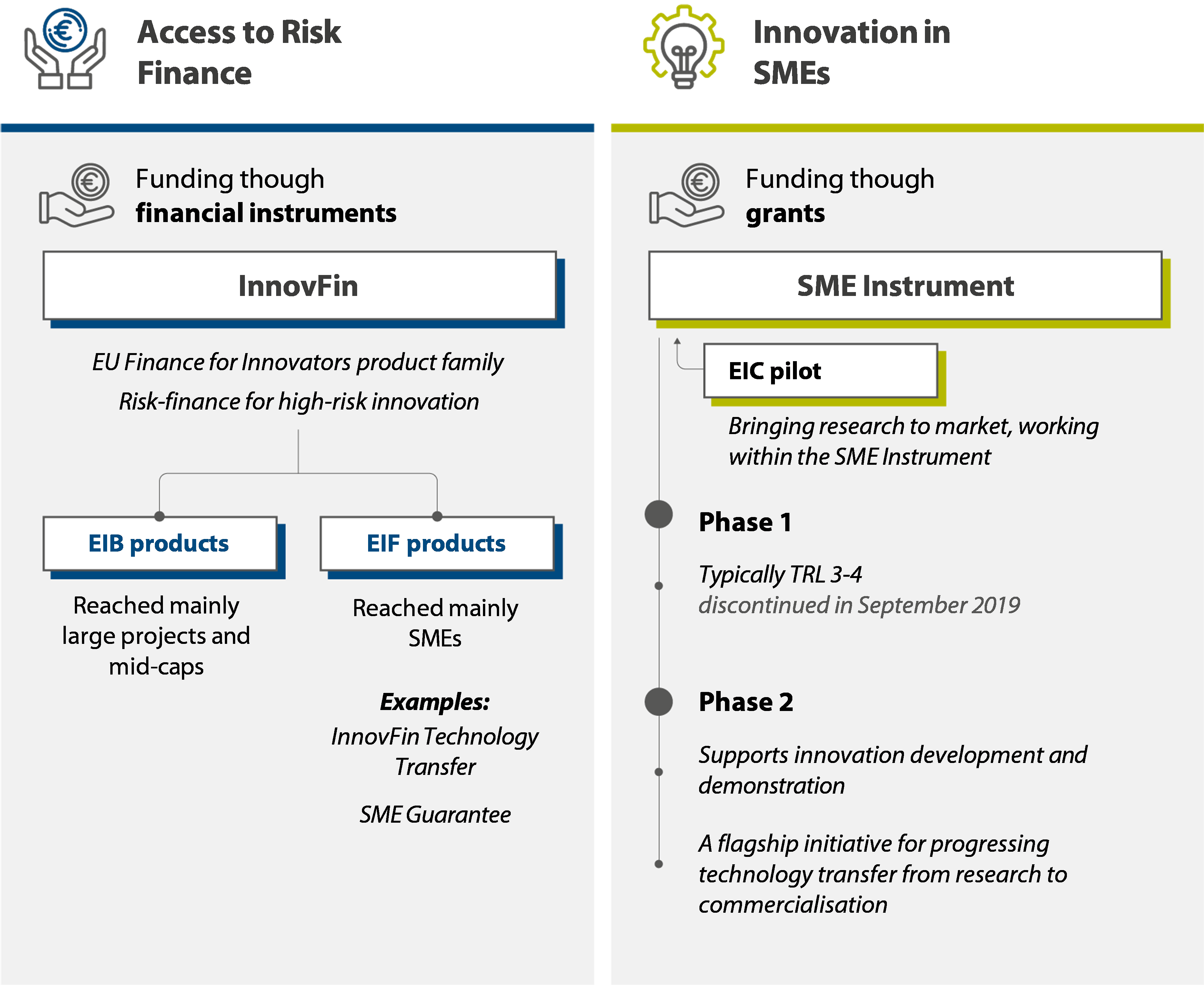
Source: ECA, based on Commission information.
42This section examines whether these instruments were effective in supporting innovation and commercialisation outcomes.
The extent to which the EIB Group-managed funding instruments effectively, and supported innovation and commercialisation outcomes remains unclear
43One of the specific objectives of the “industrial leadership” priority was to strengthen SME access to risk finance as a driver of EU level innovation. In this regard, H2020 established the “access to risk finance” financial instrument. This instrument was implemented through the InnovFin product family and comprised a broad set of debt, guarantee, equity and advisory products.
44To implement these instruments, the Commission signed a delegation agreement with the EIB Group (the EIB and the European Investment Fund – the EIF), which acted as the key partners responsible for deploying the financial products and overseeing their operational delivery. The agreement14 required the collection of structured data on SME applications, approvals and rejections.
Most InnovFin funding managed by the EIB did not reach SMEs
45These EIB-managed InnovFin instruments which were meant to provide SMEs with access to risk finance had to be implemented in line with general principles set out in the H2020 Regulation, one of which is that financial instruments should be demand-driven. However, this requirement was not implemented in practice. In addition, no product-level dataset existed, thus preventing the systematic analysis of demand among SMEs for risk finance and preventing the assessment of whether InnovFin had been successful in targeting innovation-driven SMEs. As a result, although the instrument was intended to operate on a demand-driven basis, there is no evidence that this principle was applied in practice.
46Moreover, the data was not broken down by participant, meaning innovation outcomes, technology transfer pathways and dissemination of results could not be tracked. Lastly, the delegation agreement included indicators to measure the performance of InnovFin, such as the volume of commitments by financial intermediaries and the number of operations. However, these indicators differed from those used for the rest of H2020 and, more importantly, were not suitable to capture the innovative outputs of the companies supported or the scale-up effects achieved.
47InnovFin was specifically designed to improve the availability of risk finance for innovative SMEs, mid-caps, research organisations and other R&I-intensive players, mainly for close-to-market activities where traditional grant funding is less suitable. However, the EIB-managed InnovFin financial products mainly reached large projects and mid-caps because minimum loan thresholds (often €25 million) excluded many smaller firms. As a result, most of these products were not specifically tailored to SMEs. According to the EIB operational report of December 2024, SMEs accounted for nearly half (47 %) of final recipients, but received only 14 % of all InnovFin financing (€1.42 billion out of €10.5 billion).
No data is available on whether the EIF’s InnovFin financial products contributed to SME innovation
48InnovFin products managed by the EIF — primarily equity and guarantee products — were tailored to the needs of innovative SMEs and startups. Within the EIF’s product portfolio, the instrument most directly targeting technology transfer was InnovFin Technology Transfer. According to the 2018-2020 H2020 work programme, the product aimed to support early-stage enterprises’ technology transfer funds and promote the exploitation and commercialisation of intellectual property in key enabling technologies. However, the interim evaluation of Horizon 2020 reported that it mainly supported funds linked to universities and research organisations. While SMEs may have been created as spin-offs from these EIF-funded research projects, such data has not been collected, and the number of spin-offs is unknown. Nor is data available to assess whether the supported SMEs achieved market uptake of their innovations.
49The EIF channelled most SME support through the SME Guarantee, an uncapped and demand-driven guarantee instrument that encouraged financial intermediaries to lend to SMEs engaged in high-risk rese arch and innovation activities by reducing their risk exposure, reaching 37 440 final recipients. However, only around 42 % of this financial support was used – by 41 % of final recipients – to develop SME innovative products, processes or services, meaning less than half of the support targeted SMEs’ innovation capacity. While the participant’s innovation capacity was included in the eligibility criteria, it was not the focus. Moreover, the criteria were broadly defined and lacked specific thresholds. Therefore, it is not possible to assess the support’s actual innovation impact or to compare outcomes across participants. The absence of clear parameters for these criteria reduces the effectiveness of innovation tracking and weakens alignment with H2020’s strategic objectives (Annex III).
The SME Instrument provided effective support for technology transfer, but it had only limited results in terms of market uptake
50On the positive side, our audit showed that the SME Instrument provided effective support for technology transfer. More than three quarters mono-beneficiary SMEs visited (10 of the 13 participants in this category, or 77 %) successfully transferred technology and progressed from concept to validated innovation (Box 2).
Examples of successful technology transfer in our sample
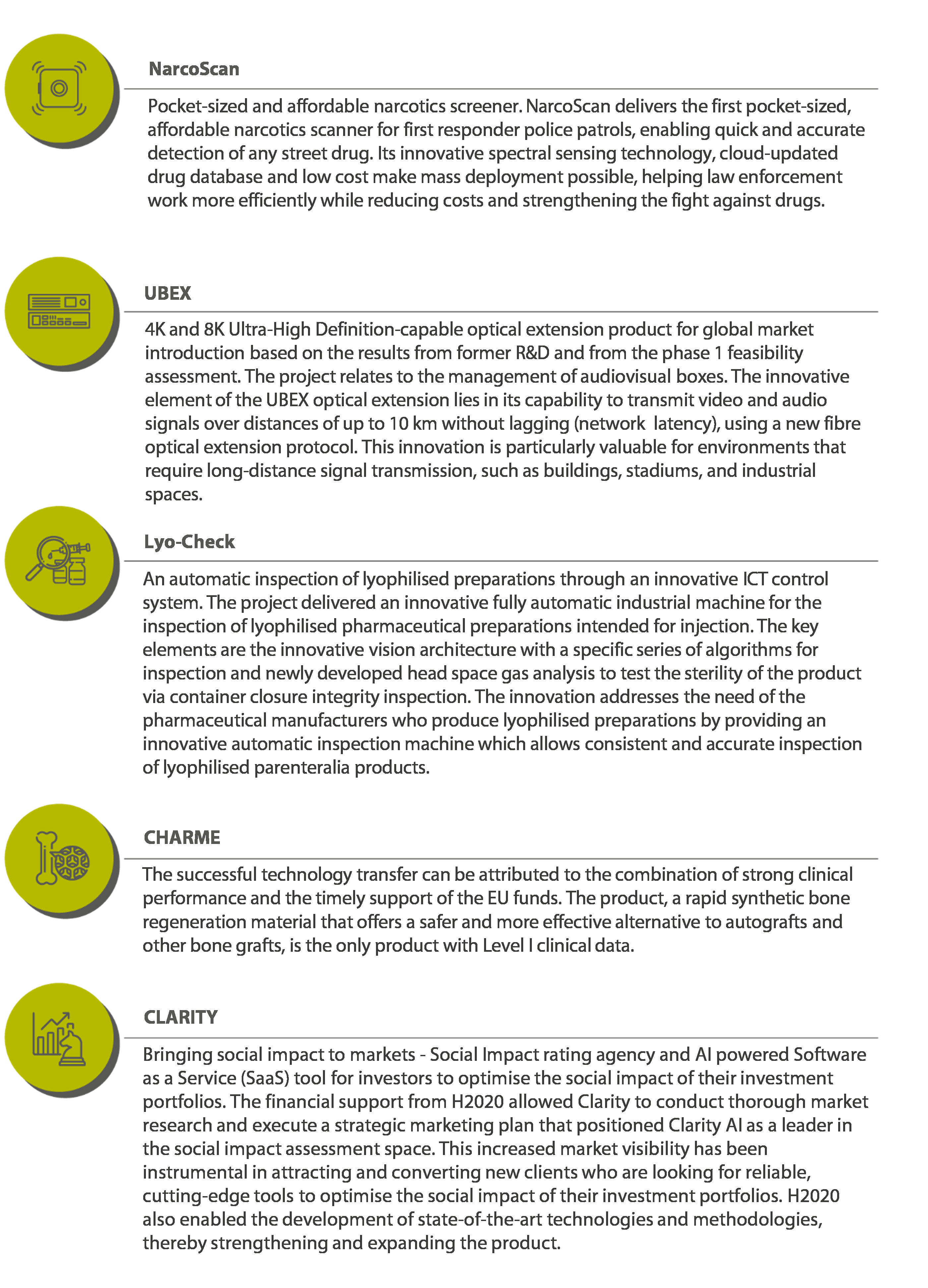
Source: ECA, based on information provided by the SMEs visited.
51However, we also found cases where, although technology transfer activities were successful, market uptake was discontinued following company acquisition or insufficient market demand. These cases showed the need for stronger safeguards, such as ensuring that innovation continues after funding ends, even in situations such as acquisitions or market difficulties, by guaranteeing access to key results, so that technology transfer outcomes can be protected and sustained (Box 3).
Examples of discontinued technology transfer in our sample
An SME project in Finland in the area of ICT (under the Open Disruptive Innovation scheme) with potential for scale-up was stopped following the sale of the company, after which the technology transfer process was halted.
An SME project in Hungary in the area of nanotechnologies (designed to accelerate their uptake) was terminated after completion due to a lack of demand. By the end of the project, the user industries had withdrawn their orders.
Source: ECA.
52Although the SME Instrument was intended to provide commercialisation support, market uptake was weak. We found that 2 of the 13 mono-beneficiary SMEs visited which had received grant funding had zero growth and could not receive any additional type of financing. Another 7 out of 13 visited SMEs had reached the commercialisation stage but did not achieve market uptake of their technological outputs. While these SMEs demonstrated technological progress and innovation capacity, commercialisation was hindered by multiple factors such as financial constraints, market-related obstacles, staffing limitations, regulatory barriers, technological barriers or other external factors (Figure 7).
Figure 7 | Factors limiting market uptake for SMEs (mono-beneficiaries) visited
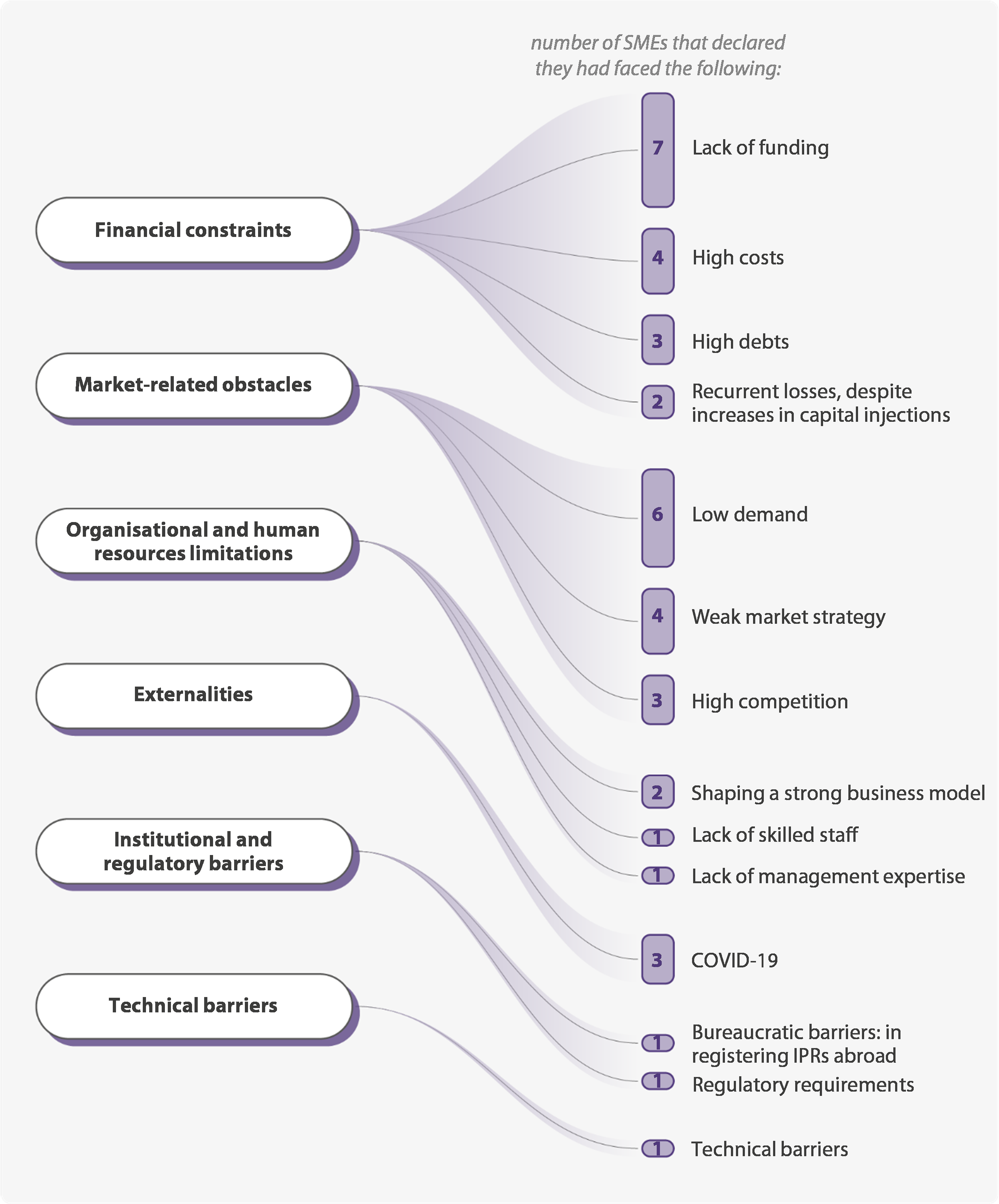
Source: ECA, based on information provided by the visited SMEs.
53Lastly, within the SME Instrument, the Commission complemented grant support with services to facilitate market uptake, including coaching to refine business models and improve investor readiness and participation in networking events to increase visibility. In our sample, three SMEs that successfully commercialised their outputs had also received coaching services (Box 4).
Example of an SME with successful market uptake and receiving coaching and acceleration services
EU support enabled an SME to develop an innovative fully automated industrial machine to inspect lyophilised pharmaceuticals (or freeze-dried products, are materials—often pharmaceuticals, biologicals, or foods—dehydrated via a low-temperature process (sublimation) where frozen water turns directly from solid to vapour).
Commercialisation was achieved through successful sales and exports, patenting and strategic partnerships. The innovative product became part of the company’s product portfolio, generating revenues and strengthening Europe’s leadership in pharmaceutical inspection technologies. The SME grew into a large company.
Coaching enabled the company to refine its investor readiness and commercialisation strategy.
Support for networking and visibility helped the company grow its exports of the product and integrate it into its portfolio.
Source: ECA, based on information provided by the SMEs visited.
54However, these were isolated cases, and the programme did not systematically track whether coaching contributed to improved exploitation outcomes. As a result, the extent to which coaching services supported market uptake across the wider SME population remains unclear.
The Commission’s initiatives and tools supporting knowledge transfer had limited visibility and impact
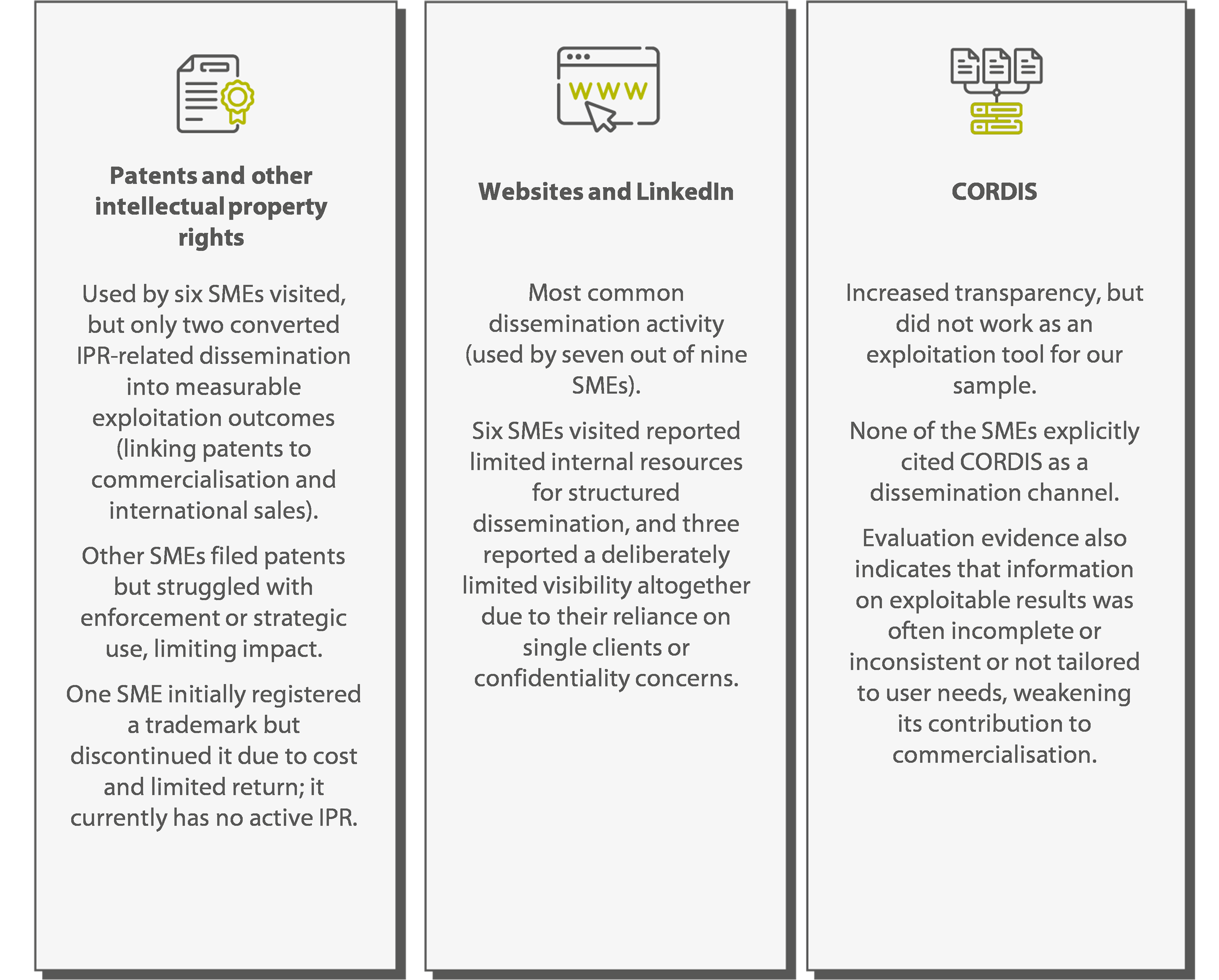
55Dissemination and exploitation for SME-related innovation actions relied on several tools intended to increase visibility and support knowledge transfer. As was also the case for previous research programmes, key channels included CORDIS (project summaries), intellectual property rights (IPRs), project websites, events and networking, and coaching to support communication and business model development.
56However, our visits to the SMEs revealed that effectiveness varied, and dissemination and exploitation was not consistently tailored to investors. SMEs used differing approaches, including patents and demonstrators, peer‑reviewed publications and clinical demonstrations, websites and advertising networks, and investor communications (Box 5).
Dissemination and exploitation channels: mixed effectiveness and weak linkage to exploitation.
Source: ECA, based on information provided by the SMEs visited.
57Finally, H2020 introduced the Innovation Radar initiative to support technology transfer by identifying high-potential innovations and highlighting those closest to market readiness. However, according to the ex post evaluation of H2020, over half of beneficiaries were reportedly unaware of this tool.
The effectiveness of new tools introduced under Horizon Europe has yet to be demonstrated
58Under the current Horizon Europe, the Commission expanded and redesigned the toolbox of H2020 (e.g. EIC Pathfinder, EIC Transition, EIC Accelerator, Horizon Results Platform, Horizon Results Booster and strengthened Policy Support Facility (PSF) services). Based on available documentation and evaluation reports, we compared the intended purpose of the H2020 instruments with those introduced or redesigned under the current Horizon Europe, focusing specifically on their support for technology transfer, market uptake, and dissemination and exploitation (Annex IV).
59The Commission did not assess the effectiveness of the H2020 tools. Moreover, our analysis at the time of the audit showed that the key weaknesses of the tools, in terms of their capacity to support technology transfer and to strengthen market uptake and dissemination, persist under the current Horizon Europe programme. The Commission is preparing and delivering new initiatives in this respect.
60For the 2028-2034 MFF, the Commission intends to set up the ECF and, closely linked to but separate from this Fund, a continuation of the upcoming Horizon Europe programme. The proposal for the ECF forms part of a broader approach to strengthen EU competitiveness, technological sovereignty and resilience and will support innovative start-ups and SMEs. In our opinion on the ECF, we highlight the benefits of combined and cumulative funding and welcome the proposal to set up a single gateway to ease access, in particular for SMEs.
Horizon 2020’s monitoring framework did not track participants’ economic performance or innovation capacity effectively
61In the H2020 impact assessment, the Commission identified Europe’s “innovation gap” as a key weakness underlying low productivity and declining competitiveness. It stressed the importance of generating breakthrough technologies and translating them into innovations (new products, processes and services) taken up by the wider economy. It also highlighted the link between firms’ capacity to innovate and their returns on investment, export performance and employment15.
62This section examines whether the Commission put in place an adequate framework for monitoring the way in which H2020 and its “industrial leadership” priority contributed to participants’ economic performance and innovation capacity.
Programme objectives and indicators were neither designed to nor measured participants’ economic performance and innovative capacity
Objectives were defined too broadly to allow overall performance measurement
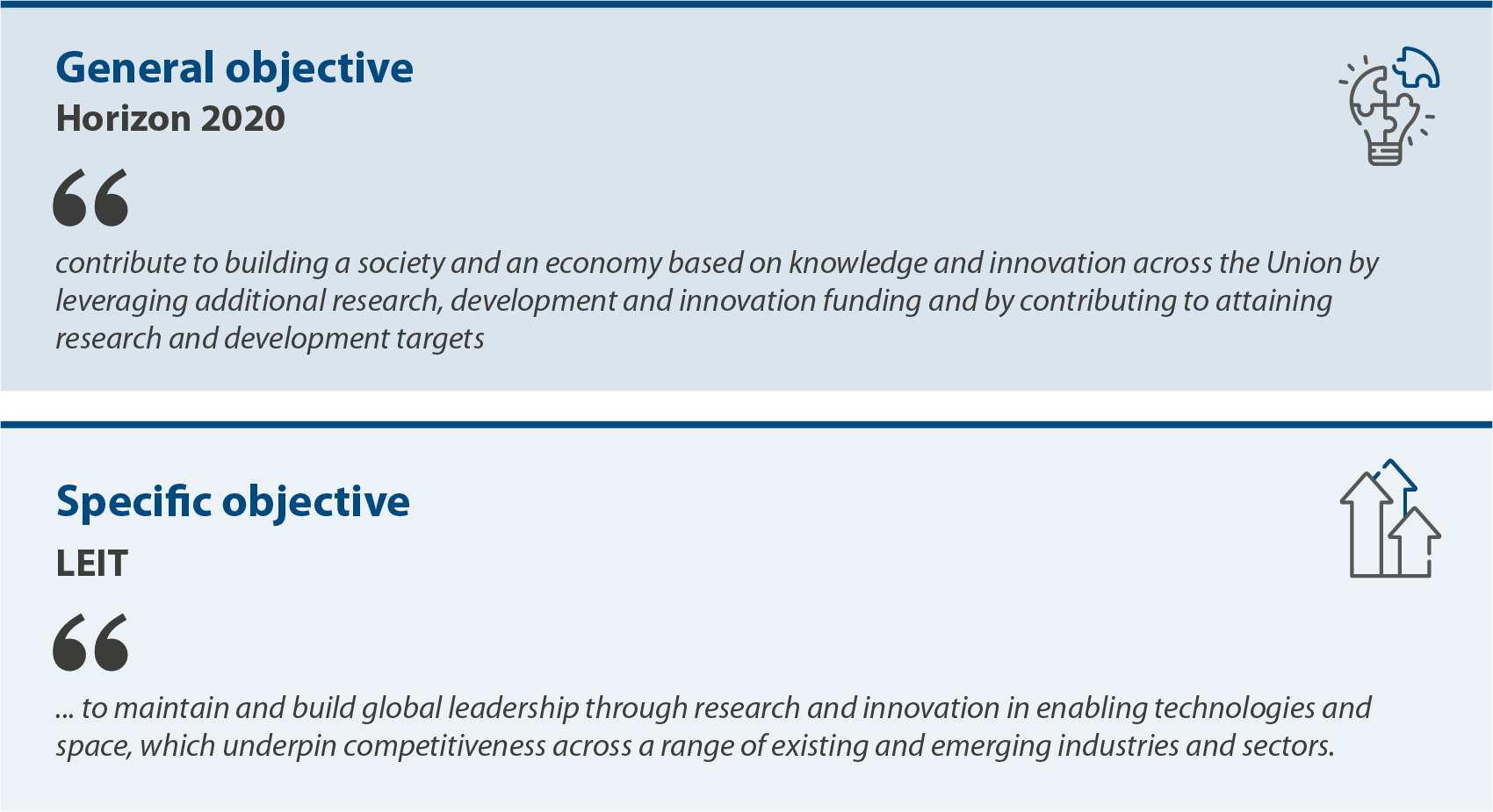
63Our analysis showed that the programme objectives specified in the H2020 legal framework were not sufficiently granular to measure progress towards their achievement. Both the general and the specific objectives set out in the H2020 Regulation were defined in strategic terms and were broad in nature. This was also the case for the additional objectives for the main thematic areas such as ICT, nanotechnologies, advanced materials, biotechnology, advanced manufacturing and processing, and innovation in SMEs specified in the annexes of the legal base (Figure 8).
Figure 8 | H2020 programme: general and specific objective for LEIT
Source: H2020 Regulation, Article 5 and Annex I.
64For the current Horizon Europe, the Commission likewise did not define operational objectives corresponding to each specific thematic area but rather for the programme as a whole. This stands in contrast with other EU programmes supporting research and innovation. For example, we note that the Digital Europe programme16 has operational objectives under each of its five specific thematic areas.
The indicators used for Horizon 2020 were not suited to monitoring firms’ economic performance or innovation capacity
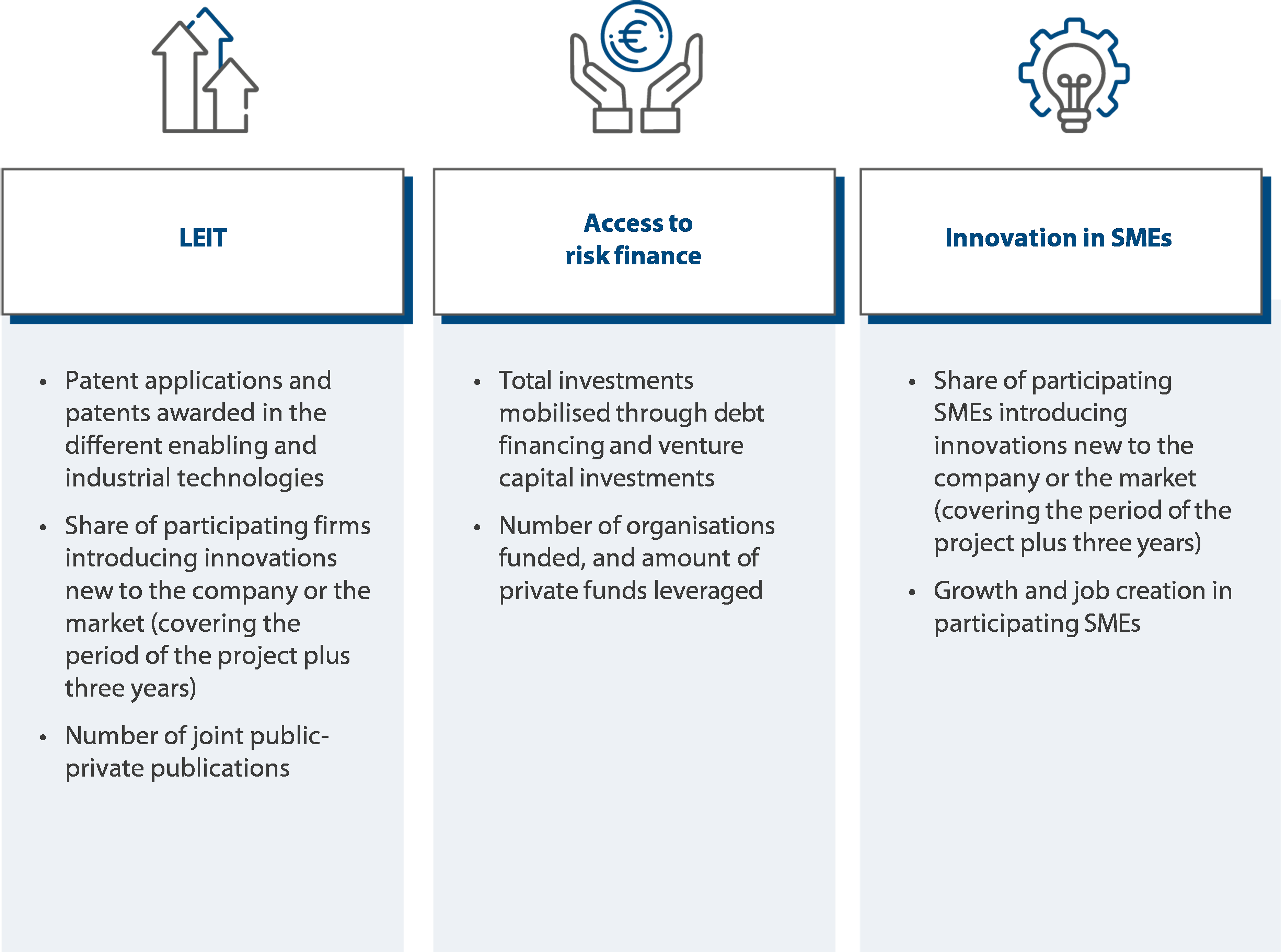
65The EU Financial Regulation requires EU spending to be performance-oriented and the achievement of objectives to be monitored through performance indicators17. The H2020 Regulation18 required time-bound indicators that were realistic, reflected the intervention logic, and were aligned with the programme’s hierarchy of objectives and activities. In addition, the H2020 Implementing Decision set out seven compulsory performance indicators19 for “industrial leadership” (Figure 9).
Figure 9 | “Industrial leadership” priority performance indicators
Source: ECA, based on Council Decision 2013/743/EU.
66The Commission subsequently established monitoring arrangements, including definitions of each indicator, data requirements, baselines and targets. H2020 was to be assessed in terms of results and impact, measured against these indicators.
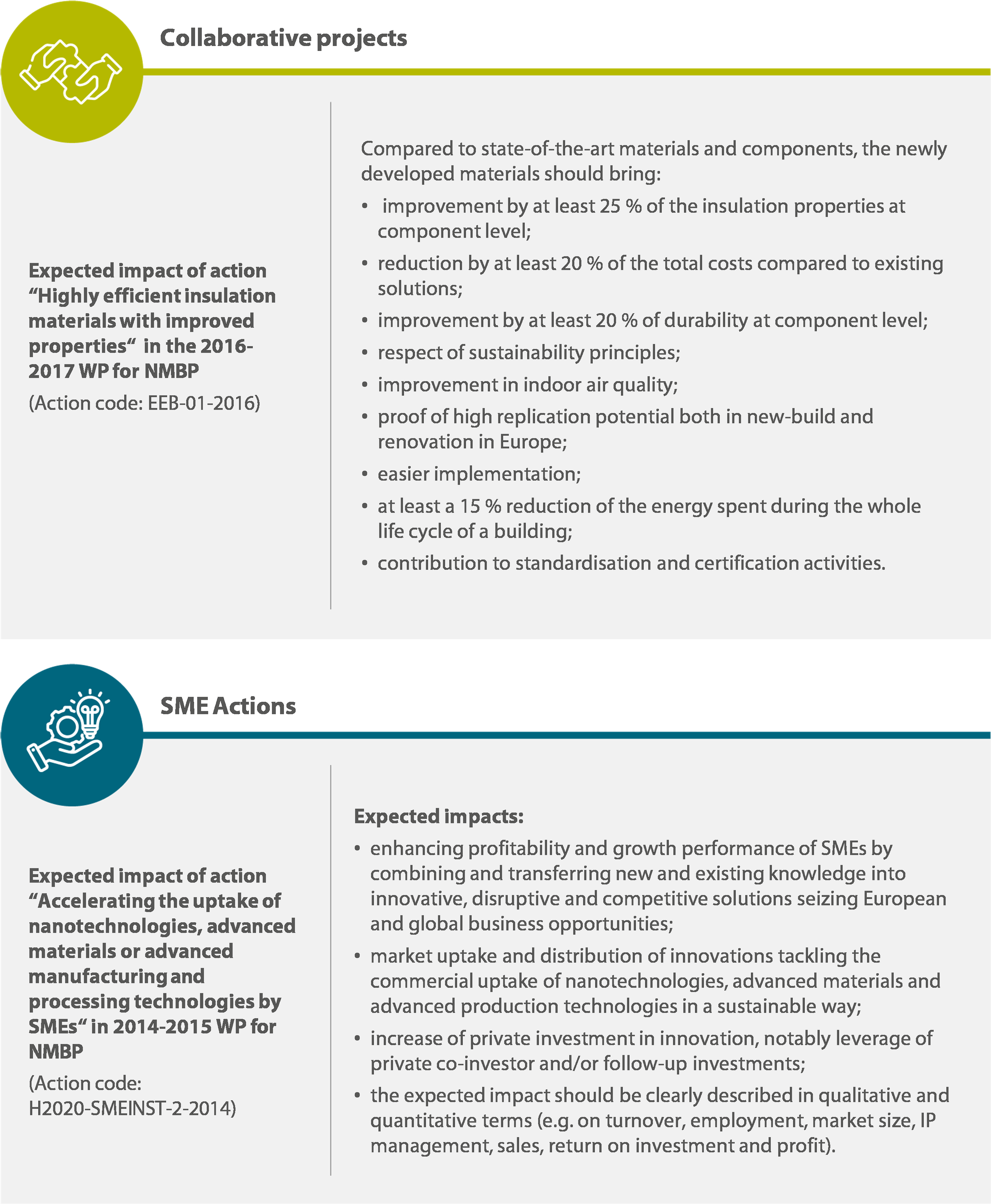
67We found significant differences in the way expected impacts were defined for collaborative and SME actions in the work programmes for the thematic areas of ICT, NMBP and SME innovation. For collaborative actions, expected impacts covered a wider range of objectives beyond economic performance. For SME innovation actions, it focused more clearly on economic effects for the supported companies (Figure 10).
Figure 10 | Examples of description of expected impact in work programmes
Source: ECA, based on Commission information.
68Furthermore, we found that the Commission defined indicators on “growth and job creation”, namely changes in turnover and number of employees, for which there is not necessarily a causal link between project outputs and economic performance. In addition, under the “industrial leadership” priority, the Commission collected data for these indicators only for SMEs, even though other for-profit company types also participated in collaborative projects.
69We also found inconsistencies in the definition of similar indicators across specific objectives. For example, the indicator for measuring innovations introduced to the market under LEIT (“share of participating firms introducing innovations new to the company”) differed from the corresponding indicator under the SME Instrument (defined as the “number and share of participating SMEs that have introduced innovations to the company or to the market”)20. Despite being similar indicators, the way in which they were defined was not consistent (the latter also included the number of participants), meaning they were not comparable. In addition, both definitions were ambiguous because they were based on beneficiary self-reporting on whether innovations had been introduced or were planned (during the project lifetime or the following three years).
70Moreover, the Commission only collected data during project implementation and did not cover the post-project commercialisation phase. The information was captured through periodic reporting at the end of each project phase21 and the Commission did not request any information after the projects ended.
71Finally, a baseline was defined for only one out of the seven compulsory indicators (“number of organisations funded, and amount of private funds leveraged”) and baseline values were not provided for six of the seven compulsory performance indicators defined for “industrial leadership”.
More suitable indicators for monitoring firms’ economic performance or innovation capacity are used by some national agencies
72We also compared the indicators used for H2020 to those used by national innovation agencies in the five member states visited. In three member states (Finland, the Netherlands and Spain), national innovation agencies used more suitable indicators than those defined by the Commission to measure expected and actual economic returns. For example, the Spanish agency used the share of company sales and exports attributable to technological innovations from financed projects at different points in time (expected share at project end and actual share after commercialisation). In the Netherlands, for mission-oriented innovation policy and National Growth Fund projects, the agency monitored companies’ economic performance. In Finland, the agency closely monitored company growth and export performance.
73Additionally, the agencies we visited tracked companies’ economic performance not only during project implementation but also after completion. For example:
- in the Netherlands, the agency monitored companies’ economic performance during and after project completion;
- in Spain, the agency’s monitoring system gathers information upon completion of projects and two years after results are introduced into the market;
- in Finland, the public agency also assessed funded projects after their completion;
- in Italy, the public agency monitored results both during implementation and after project completion; and
- the Hungarian public agencies monitored the results of some calls after their completion and during the “grace period” (three years), but not beyond this.
The Commission’s monitoring is neither entity-focused nor long term
The Commission’s monitoring does not focus on impact on supported entities
74The Commission’s Horizon2020 monitoring was not explicitly aimed at collecting information from participants over several framework programming periods or using such data for longitudinal studies. Such an approach would require a unique identifier for each entity to be defined and tracking changes to its legal structure over time (such as mergers, spin-offs, or termination of activities); which exists for all grant agreements in the Commission’s E-grants system.
75Nevertheless, the Commission’s monitoring and the structure of the database was focused on projects rather than on participating entities. Detailed data on innovations such as IPR per participant, was not available, except in mono-beneficiary projects, where there was one participant per project. Moreover, the Commission’s and the EIB-Group monitoring systems are not integrated. This makes it impossible to generate entity-based data across the entire range of H2020 funding instruments.
76Additionally, information on the participants’ financial situation was not available in CORDA, the Commission’s monitoring database. This prevented any meaningful monitoring of participating firms’ economic performance over time. From 2023 onwards, according to the Commission, financial data from Orbis has been uploaded into CORDA in some cases.
77Also under the current Horizon Europe programme the Commission’s monitoring system does not provide all the necessary data to carry out a long-term, participant-specific analysis in a comprehensive manner. As a result, the return on public investment and longer-term firm-specific effects cannot be reliably monitored or assessed.
78Finally, we noted in our opinion on the Commission’s proposal for the next 2028-2034 Horizon Europe that the proposed indicators would not easily allow for the collection of firm-specific data; consequently, the limitations identified in this context will continue to apply.
The Commission’s end-of-project assessment did not consistently verify dissemination results or business plan achievement
79At the end of each reporting period participants must encode monitoring data (such as number of IPRs, turnover or number of employees) to CORDA. However, we found that not all intellectual property types resulting from innovations were captured in the database as trade secrets and software licences were not covered by the data requests. Meanwhile, only 9 of the 25 SMEs visited protected their innovation outputs through patents whereas 7 did so through trade secrets or software licenses. This situation is also confirmed by the replies to our survey: 29 SMEs (representing around 34 % of replies) indicated that their results from H2020 projects had led to an application for new patents. At the same time, another 52 projects (or 61 % of the replies) had produced innovation results other than patents.
80Some participants, particularly in mono-beneficiary projects, included information about trade secrets or software licenses in their final business plans. However, as this type of IPR data is not included in the Commission’s database it is also not covered in the monitoring.
81At the same time, as regards the indicator for patents, we identified methodological issues which led to a systematic overreporting because the indicator also covered “background patents”, i.e. patents that were filed before the start of the project. These IPRs were entirely unrelated to the H2020 funding but accounted for a substantial part of the indicator values. For the LEIT projects funded under H2020, only 147 of the 642 patent applications reported by the Commission until 2025 (around 23 %) and 62 of the 261 patents awarded (around 24 %) were filed after the projects started.
82We also compared selected business plan estimates with actual economic outturn to examine the extent to which the estimates reported by participants in their business plan had been realistic. For at least 3 of the 13 visited mono-beneficiary SMEs that provided financial statements for at least some of the years, we found that their initial business plans had overestimated significantly (i.e. by at least a third) their potential increase in economic performance in terms of either employment or revenue (Box 6).
Some examples of overoptimistic business plans
For an Italian SME included in our sample, comparing the estimates in its final business plan delivered at end-of-project with its financial statements:
- the actual number of employees corresponded to 54 % of the estimate in 2021, 57 % in 2022, 37 % in 2023 and only 25 % in 2024:
- actual revenue fell significantly short of the estimates, representing around 15 % of the initial estimates for 2021, 4 % for 2022 and 2023 and only 1 % for 2024.
A Spanish SME had total assets of €1.5 million in 2015, according to its financial statements. Its business plan, included in the grant agreement in 2015, projected total assets of €80 million by 2019. However, at the end of 2019, the same company’s financial statements reported total assets of only €4 million.
Source: ECA, based on information provided by the Commission and the visited SMEs.
83Finally, we observed cases where applicants under different calls had presented overly optimistic estimates in their business plan for an earlier call, which were subsequently revised downwards in their grant applications under later calls. A systematic end-of-project assessment by the Commission could strengthen the incentive for participants to prepare more robust and realistic proposals and business plans and so project a more realistic estimate of how participating in the EU research and innovation programmes may affect their economic performance.
Limited post-project follow-up prevented assessment of SME commercialisation and scale-up
84In response to our survey, SMEs highlighted strong expertise (around 46 %) as well as innovation maturity and market demand (around 52 %) as key drivers of their market activity. However, evidence gathered from the SMEs visited during our audit suggested that these factors did not systematically result in scaling up.
85More than half of the visited SMEs participating in collaborative projects (7 out of 12 SMEs) did not commercialise their output. This was mainly due to the absence of any such intention (three cases), limited competitiveness relative to other market solutions (one case), and the obsolescence of the solution (two cases) or business decision (one case). Similarly, more than half of the visited SMEs participating as mono-beneficiaries (7 out of 13 SMEs), also reported a need for additional support after project completion. We also observed two cases in which the SME ceased operations or discontinued R&I activities either because they had failed to obtain further funding or as the result of a business decision. While returns on R&I are inherently uncertain, we consider that these figures reflect shortcomings in the way the Commission identifies the most promising projects and subsequent financing needs at project end.
86In this regard, we noted a good practice initiative by the European Union Agency for the Space Programme (EUSPA) and partly funded under the current Horizon Europe programme which supports the market development of the EU Space downstream sector and the uptake of space-based solutions (CASSINI). Under this initiative, participants’ project results are closely monitored and follow-up funding is allocated so that project results can be developed further in view of their market access.
87We also assessed post-project impact on the economic performance of the 25 SMEs visited as this information is not available in the Commission’s monitoring framework. Nearly all the 12 SMEs in collaborative projects in our sample mainly acted as technology developers. While grants increased their revenues during the implementation phase, at least nine of them did not achieve market exploitation of project outputs. We therefore could not establish a causal link between project technological outputs and companies’ economic performance.
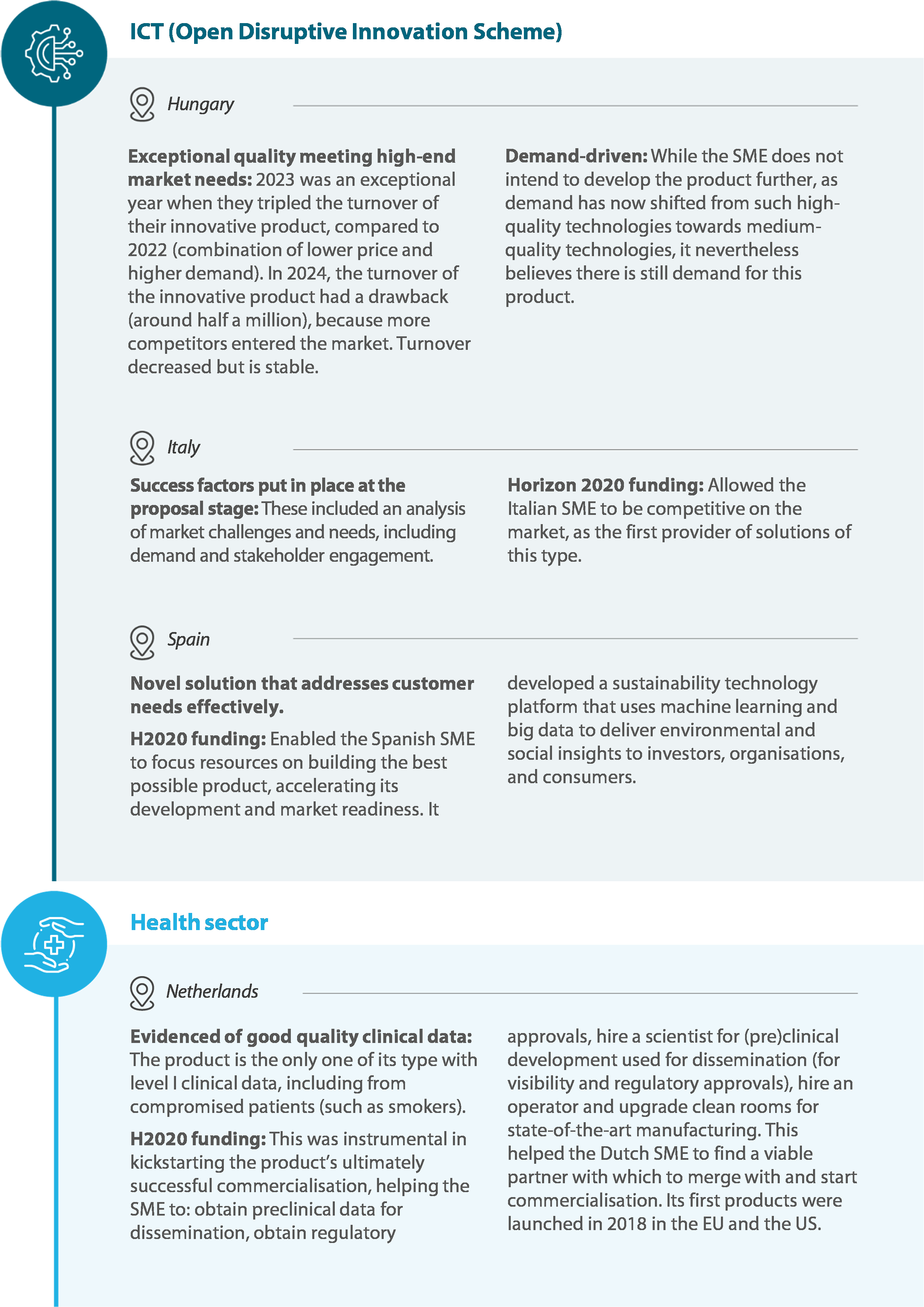
88On a positive note, for the four cases where participants succeeded in translating technological development outcomes into market uptake, we identified key factors driving these success stories (Figure 11).
Figure 11 | Key factors driving economic success stories
Source: ECA, based on information provided by the SMEs visited.
Inaccurate or incomplete data undermined the Commission’s ability to monitor H2020
89The Commission’s monitoring of H2020 use data from several sources, including beneficiaries’ self-reported data (patents, innovations, publications, turnover and jobs) and data from entrusted entities, such as the EIB Group.
90Our 2024 annual report22 already highlighted weaknesses in the reliability of reported H2020 data. This was corroborated by our on-the-spot audit visits in the five member states where we found instances of incomplete and inconsistent reporting for 22 out of the 33 projects in our sample. This includes the case of two SMEs for which the reported data (on their financial situation or the number of employees) was incorrect. In another project, annual data on actual and expected turnover and number of employees were not completed by all members of the consortium every year. This is attributable to the fact that the monitoring data is self-reported and not systematically verified by the Commission.
91Based on the data included in CORDA, the Commission calculated indicator values for patents, innovative companies, publications, turnover and jobs, which cover H2020, as a whole. These values were calculated at different times and reported in the different contexts. Since the data sources were not archived, we were unable to verify reported indicator values.
92For the projects in our sample, we found other inconsistencies in the CORDA database. For example, for 5 out of 18 collaborative projects, the number of innovative companies reported by beneficiaries exceeded the number of participating companies and SMEs in the consortia. Moreover, for 3 out of 15 mono-beneficiary projects we found that the single SME in the project was counted twice due to incorrect self-reporting.
93Lastly, the EIF did not monitor whether supported SMEs successfully commercialised research outputs, or disseminated results, despite such monitoring being envisaged in the delegation agreement. This undermined any possibility of assessing the SME Guarantee’s long-term impact on innovation by participants.
94These shortcomings in the way programme objectives and indicators had been defined and in the quality and reliability of the monitoring data also affected the Commission’s ex post evaluation (see also paragraphs 63–71).
H2020 ex post evaluation did not assess the programme’s contribution to participants’ economic performance or innovation capacity
95Under the H2020 Regulation23, the Commission had to carry out an interim evaluation (by the end of 2017) and an ex post evaluation (by the end of 2023) of the programme. For the ex post evaluation, the Commission was required to evaluate the programme, covering its rationale, implementation and achievements, as well as longer-term impacts and sustainability, in order to inform decisions on subsequent measures24. The evaluation was to be carried out in line with the Commission’s better regulation guidelines.
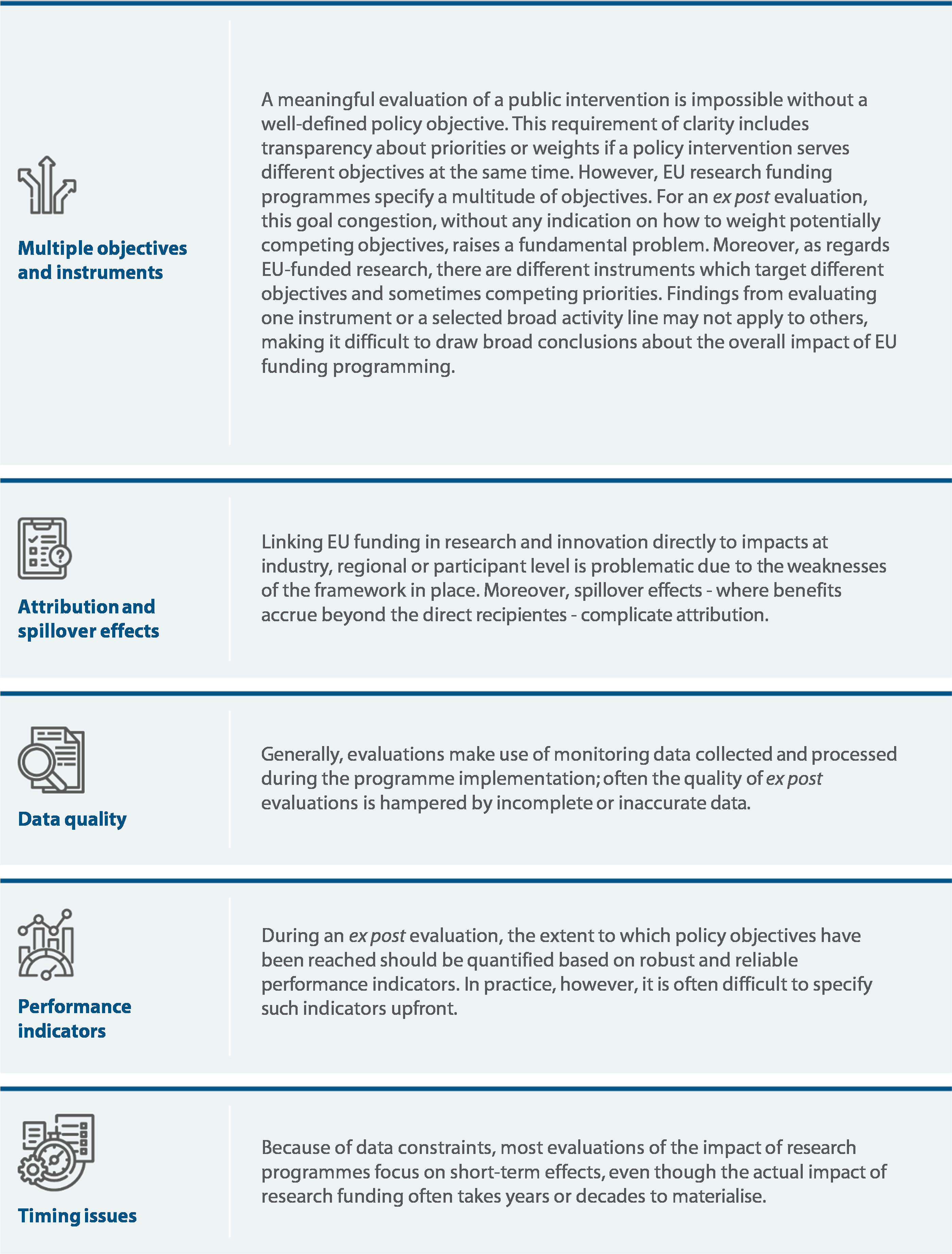
96When it comes to evaluating the impact of EU-funded research programmes, and in particular their contribution to economic performance and innovation capacity, some specific challenges stand out (Figure 12).
Figure 12 | Challenges in evaluating the impact of EU-funded research and innovation programmes’ contribution to economic performance and innovation capacity
Source: ECA.
97This section examines to what extent the Commission addressed these challenges when evaluating the H2020 programme’s contribution to participants’ economic performance and innovation capacity.
The H2020 Regulation did not require an evaluation of impact on participants
98According to the H2020 Regulation25, the ex post evaluation was inter alia meant to assess the longer-term impacts of the programme and aspects relating to the dissemination and exploitation of research results. Longer-term impacts can be measured at different levels, such as that of society, the economy or individual programme participants.
99In this regard, we note that the H2020 Regulation did not specifically require the Commission to assess such impacts on participants. Consequently, the Commission’s ex post evaluation did not focus on this dimension. For example, “enhancing participants’ economic performance” was not one of H2020’s general objectives. Similarly, the specific objectives of the LEIT sub-priority referred to R&I underpinning “competitiveness” at large rather than at the level of participants. Therefore, the Commission’s ex post evaluation likewise did not reflect economic performance.
The Commission’s ex post evaluation of Horizon 2020 mainly drew on macro- and microeconomic models to assess economic impacts
100The Commission’s s ex post evaluation of Horizon 2020 which was published in January 2024 combined several approaches to evaluate whether H2020’s general and specific objectives had been met (Figure 8). Firstly, it analysed the data reported by participants for the indicators specified in the H2020 Regulation. Secondly, it used macroeconomic models to estimate effects on EU ‘Gross Domestic Product’ (GDP) and employment and a microeconomic model to assess impacts on participants. Finally, the ex post evaluation assessed the extent to which the programme had facilitated access to risk capital.
101In addition, for the LEIT sub-priority, the Commission’s ex post evaluation mainly drew on three different studies: the first on activities for the digital and industrial transition, the second on Innovative Europe (covering SME innovation and access to risk finance programmes) and the third on the EIC pilot (paragraph 41). Based on a sample, these studies assessed – to some extent – the effects of firms’ participation in the programme on their economic performance. However, there was no study examining the effects on firms’ innovation capacity.
The indicators used to measure H2020’s contribution to economic performance were neither programme- nor participant-specific
102The H2020 Regulation specified three indicators for progress in relation to the general objectives (Figure 8):
- an R&D spending target (3 % of GDP) for the Europe 2020 strategy;
- the “innovation output indicator”26 developed in the context of the Europe 2020 strategy; and
- the share of researchers in the active population.
103We found that the ex post evaluation reported economy-wide values and did not quantify Horizon 2020’s specific contribution. Moreover, none of these indicators measured the H2020 programme’s impact on participants.
104Based on our analysis of the H2020 Regulation, we noted that baseline values were lacking for all three indicators and only one had a quantified target (i.e. R&D spending of at least 3 % of GDP). Moreover, the innovation output indicator, calculated by the Commission’s Joint Research Centre and used by the Commission for its ex post evaluation, also had conceptual limitations as it:
- covered EU-funded projects rather than H2020 projects only;
- mainly measured the number of IPRs, such as patents and trademarks, but not other forms of protection (e.g. trade secrets, software licensing) used in innovation;
- measured outputs rather than impacts; and
- provided information on R&I carried out in economies rather than on H2020’s impact on participants’ innovative capacity.
The H2020 Regulation also did not specify any indicators, baseline values or targets to specifically measure to the extent to which “industrial leadership” contributed to the achievement of the overall objective. The Commission assessed innovation outputs for H2020 as a whole using those performance indicators that measured progress towards the specific objectives. In practice, this meant that the only indicator in connection with innovation and economic impact under LEIT was the number of patents. No indicator values were reported for the specific objective of “innovation in SMEs”.
105Lastly, our analysis also showed that there was no indicator specifically measuring the impact of the H2020 programme, or any of its priorities, on the economic performance of participants.
Assumptions and methodological issues in the Commission’s ex post evaluations may have led to overly optimistic outcomes
106The Commission’s microeconomic analysis relied on findings from different research studies covering SMEs participating in H2020 in the 2013-2021 period. We found that one such evaluation study on activities for the digital and industrial transition had a limited scope and assessed only part of H2020 funding:
- Firstly, it focused on mono-beneficiary SMEs and excluded those participating in collaborative projects. Inactive firms (due to dissolution, bankruptcy, liquidation or merger), large companies and non-profit organisations were also excluded. Finally, the Orbis database (a global database containing data on private companies) did not allow innovation-related revenue or employment to be isolated for firms benefiting from multiple products.
- Secondly, it excluded a substantial number of signed but not yet completed projects from the assessment. Specifically, it covered only 59 % of projects, corresponding to the overall project completion rate at the time of the evaluation. Under “industrial leadership”, and more specifically the LEIT sub-priority, around 75 % of projects (2 438) had concluded their activities by the end of 2021, representing 53 % of funding.
107Another study on “The Horizon effect”, carried out in 2023 and covering all participating firms, showed a causal link between H2020 spending and employment effects (with an estimated average increase of 20 % in employee numbers), as well as economic performance (with increases of around 30 % in assets and revenues following receipt of the first grant).
108We also identified several shortcomings in the microeconomic models that may have contributed to overly positive conclusions (Box 7).
Examples of weaknesses in the digital and industrial transition study
- The indicators used were not necessarily the most appropriate to assess economic performance and innovation capacity: for example, “earnings before interest and taxes, depreciation and amortisation” (EBITDA) was used as a measure of profitability even though other indicators would have been better. Companies’ turnover and number of employees were used not because they were the most appropriate indicators, but because alternatives were unavailable. Other relevant indicators commonly used, such as gross value added, output or exports, were not considered. In addition, the capitalisation of innovations (i.e. the monetary value of related patents), a key variable for assessing economic impact, was not measured.
- The models did not take into account of the GDP27 principles needed to assess impacts on growth, jobs and economic performance and innovation outputs. The valuation of innovation outputs is based on the market value of the related IPRs. In the absence of such market values, it can be based on the sum of production costs plus an appropriate mark-up28. In subsequent years, because it is an intangible asset, the relevant capital consumption value should be inserted.
Source: ECA, based on Commission information.
109Moreover, non-profit organisations may also commercialise R&D and innovation results, generating economic as well as societal impacts. However, the above microeconomic assessments included no information on these organisations’ economic impacts.
110For its macro-economic analysis, the Commission used three models: NEMESIS, QUEST 2 and the Regional Holistic Model (RHOMOLO). All three models indicated that H2020 funding would have positive impacts on GDP and employment by 2040.
111We also identified shortcomings with the macroeconomic models used for the H2020 evaluation:
- they assumed the complete commercial success of supported innovations, despite the absence of information on participants’ post-funding outcomes;
- the calibration of knowledge stocks in the NEMESIS model relied on patent citations; these do not capture most non-patent innovations, which vary significantly across sectors; and
- the total H2020 funding was used without excluding amounts not directly linked to innovation activities, such as administrative payments and funding for non-innovative beneficiaries.
Some of these shortcomings may have contributed to overly positive conclusions drawn from these macro-economic models.
112These models are also expected to be used in the ex post evaluation of the current Horizon Europe programme, which risks carrying forward the same methodological weaknesses.
This report was adopted by Chamber IV, headed by Mr Petri Sarvamaa, Member of the Court of Auditors, in Luxembourg at its meeting of 16 September 2026.
For the Court of Auditors
Tony Murphy
President
Annexes
Annex I – About the audit
Scope of Horizon 2020
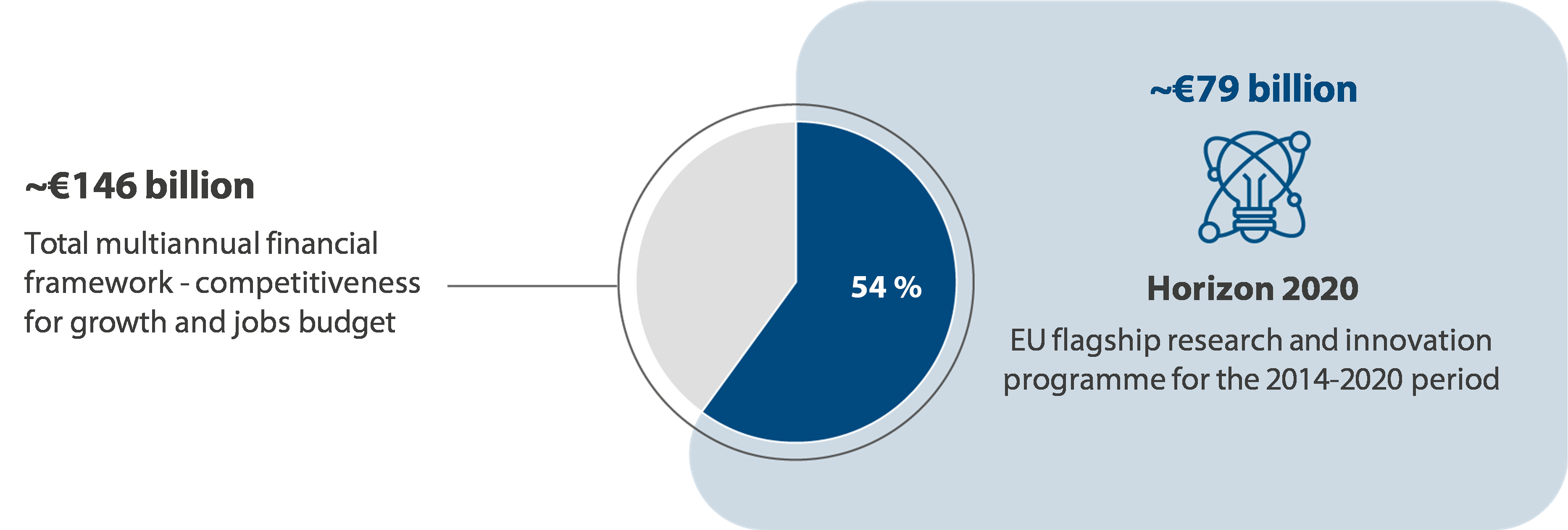
01Horizon 2020 (H2020) was the EU’s eighth framework programme for research and innovation. It provided EU funding for research and innovation activities in the 2014-2020 period, with a budget of around €79 billion (comprising €77 billion in baseline funding plus additional funding for nuclear research under the Euratom programme1). It was the largest programme under the MFF heading “Competitiveness for growth and jobs”, representing around 54 % of the total budget for that heading (Figure 1).
Figure 1 | Importance of Horizon 2020 within the MFF 2014-2020
Source: ECA.
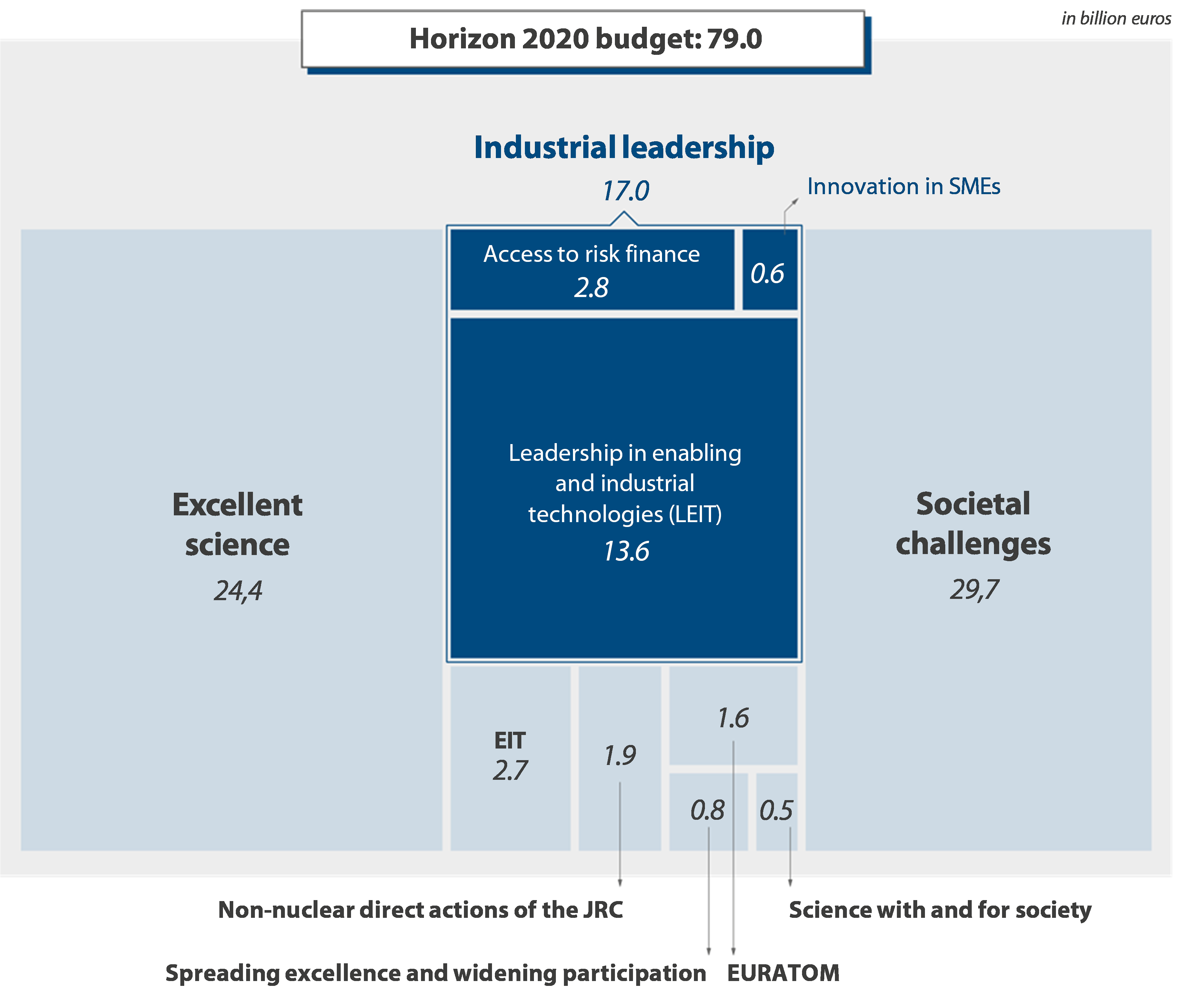
02H2020 covered all stages of the research and innovation chain, including market-oriented activities. It operated on the principle that the closer an activity is to the market, the greater the expected contribution from additional funding sources. Figure 2 shows the budget allocation by priority and specific objective.
Figure 2 | Horizon 2020 budget allocation
Source: ECA, based on Commission information.
Industrial leadership
03Under “industrial leadership”, support was intended to stimulate private-sector research and development (R&D) and innovation investment, promote a business-driven research and innovation agenda, and accelerate the development of new technologies underpinning future business activity and economic growth2.
04The “industrial leadership” priority was the part of the H2020 programme which aimed to promote the industrial competitiveness by fostering the exploitation of industrial potential of innovation, research, and technological development policies3 (paragraph 04).
05Within the “industrial leadership” priority, the objective “leadership in enabling and industrial technologies” (LEIT) was implemented by Commission departments, executive agencies and joint undertakings and had a total budget of around €13.6 billion. For the remaining objectives, the EIB Group (comprising the EIB and EIF) managed a budget of around €2.8 billion (“Access to risk finance”), and the European Innovation Council and SMEs Executive Agency (EISMEA) managed around €0.6 billion for the SME Instrument. We did not include “co-funded actions” such as “Enterprise Europe Network” or “Eurostars”, nor space projects within LEIT in the scope of the audit.
Type of activity and funding rates
06H2020 supported research and innovation activities through grants (the main form of EU support), prizes, procurement and financial instruments (i.e. loans, guarantees and equity). Projects were implemented mainly by entities outside the Commission, including research organisations, secondary or higher education establishments, other public bodies, and private for-profit entities, including small and medium enterprises (SMEs). Funding opportunities were largely defined in multiannual work programmes. According to the Commission, 78 % of H2020 funding was allocated to collaborative projects.
07The H2020 Regulation also set a target4 of allocating at least 20 % of the combined LEIT and “societal challenges” budgets to SMEs. Based on the Commission’s database, SMEs participated in all areas under the “industrial leadership” priority, receiving about €4 billion (or 59 %) of the total of around €7 billion granted to private, for-profit entities.
08One of the specific objectives of the “industrial leadership” priority was to strengthen SME access to risk finance. In this regard, H2020 established the “Access to Risk Finance” financial instrument. This instrument was implemented through the InnovFin product family and comprised a broad set of debt, guarantee, equity and advisory products (Box).
Overview of the InnovFin financial products
Corporate products:
- Emerging innovators: Bridges the research and innovation investment gap in Moderate and Modest Innovator EU member states and H2020 associated countries. It applies to both EU member states and H2020 associated countries whose innovation performance score is between 70 % and 100 % of the EU average for the moderate innovators, or less for the modest innovators.
- Mid-Cap Guarantee: Makes debt financing available to innovative mid-caps which are not eligible under the InnovFin SME Guarantee.
- Corporate Research Equity: Increases the supply of equity-type financing under the European Fund for Strategic Investment to large R&I programmes and to innovative large mid-caps.
Thematic finance products:
- Energy Demonstration Projects: Involves projects in the fields of energy system transformation, such as renewable energy technologies, smart energy systems, energy storage, carbon capture and storage, or carbon capture and use. SMEs accounted for 8 % of the final recipients and received 4 % of all Energy Demonstration Projects financing.
- Infectious Diseases Finance Facility: Involves projects to develop innovative vaccines, drugs, medical and diagnostic devices or novel research infrastructures for combatting infectious diseases. SMEs accounted for 16 % of final recipients and received 5 % of the Facility’s total financing.
- InnovFin Thematic Investment Platforms: Platform managed by a financial intermediary or fund manager to be selected through an open call for expressions of interest. SMEs accounted for 15 % of final recipients and received 2 % of the total financing.
- Mid-Cap Growth Finance: Enabled the EIB to provide between €7.5 million and €25 million in long-term senior, subordinated or mezzanine loans to innovative businesses with fewer than 3 000 employees to support their growth and investment in R&I. SMEs accounted for 9 % of the total final recipients and received 3 % of the total financing.
Source: EIB; InnovFin brochure.
Roles and responsibilities
09The Directorate-General for Research and Innovation (DG RTD) had the leading role and was primarily responsible for the H2020 programme’s implementation and coordination. The roles and responsibilities are listed in Figure 3.
Figure 3 | Roles and responsibilities in managing H2020, with a focus on “industrial leadership”
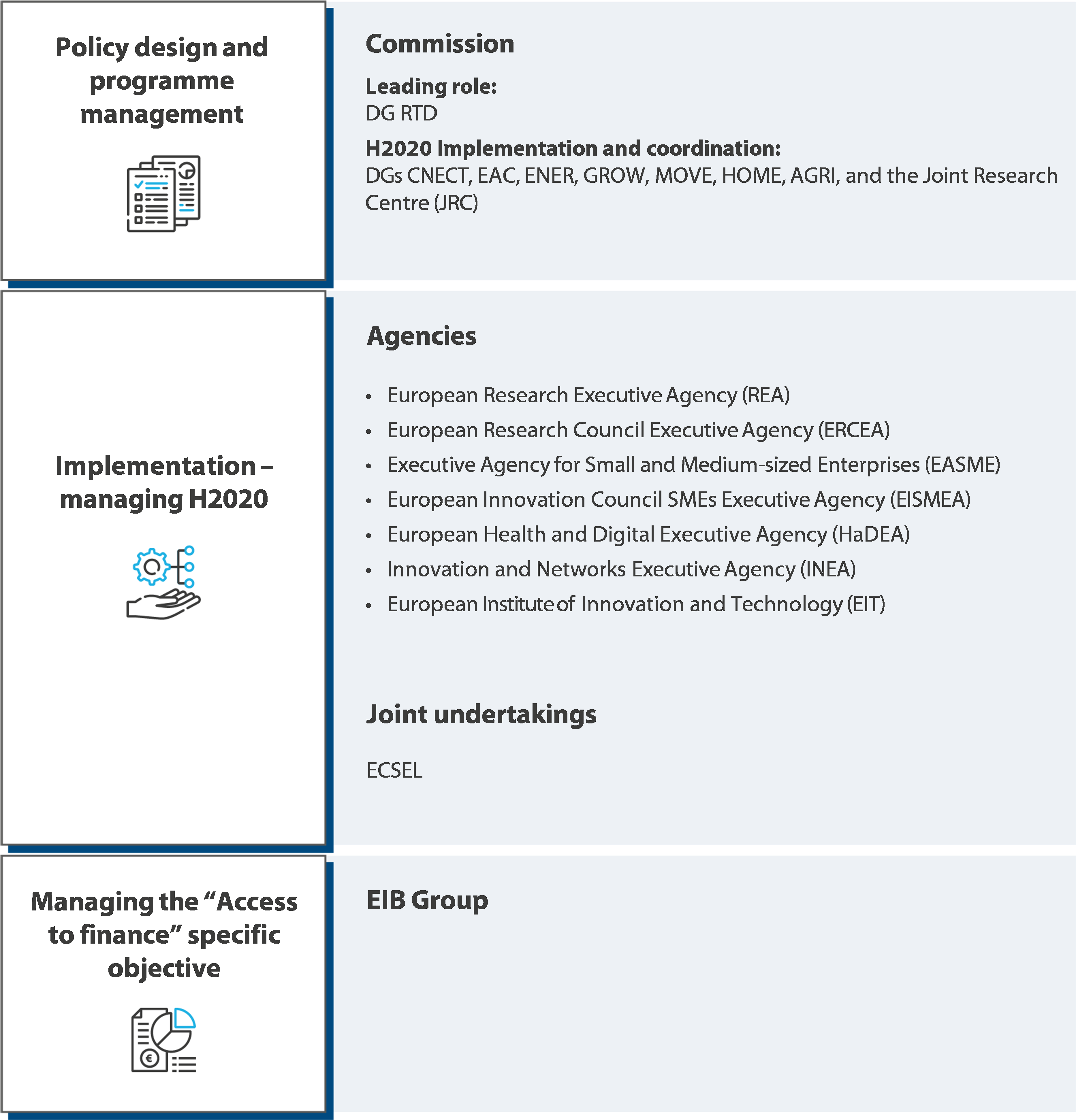
Source: ECA, based on Commission information.
10To implement the “Access to Risk Finance” financial instruments, the Commission signed a delegation agreement with the EIB Group (the EIB and the EIF), which acted as the key partners responsible for deploying the financial products and overseeing their operational delivery. The agreement5 required the collection of structured data on SME applications, approvals and rejections.
Audit scope and approach
11The main objective of the audit was to examine whether, and to what extent, the EU funding under the H2020 “industrial leadership” priority focussed on supporting innovation and economic performance. We assessed:
- to what extent the Commission’s work programmes and calls for proposals addressed the needs and specific barriers faced by participants, particularly SMEs; how projects with economic and scale-up potential were identified and whether the right priorities were set to fund such projects;
- whether the new instruments aimed at funding breakthrough, disruptive innovations and the scaling up of European high-growth innovative companies were effective in supporting innovation and commercialisation outcomes;
- whether the Commission’s framework for monitoring the way in which the EU funding contributed to participants’ economic performance and innovation capacity was adequate; and
- to what extent the Commission evaluated the contribution of the EU support to participant’s economic performance and innovation capacity.
12The audit covered the 2014-2025 period. Where justified (for example, for aspects related to the design and impact assessment of H2020), we also reviewed earlier documents from 2011 onwards (Figure 4).
Figure 4 | Audit approach
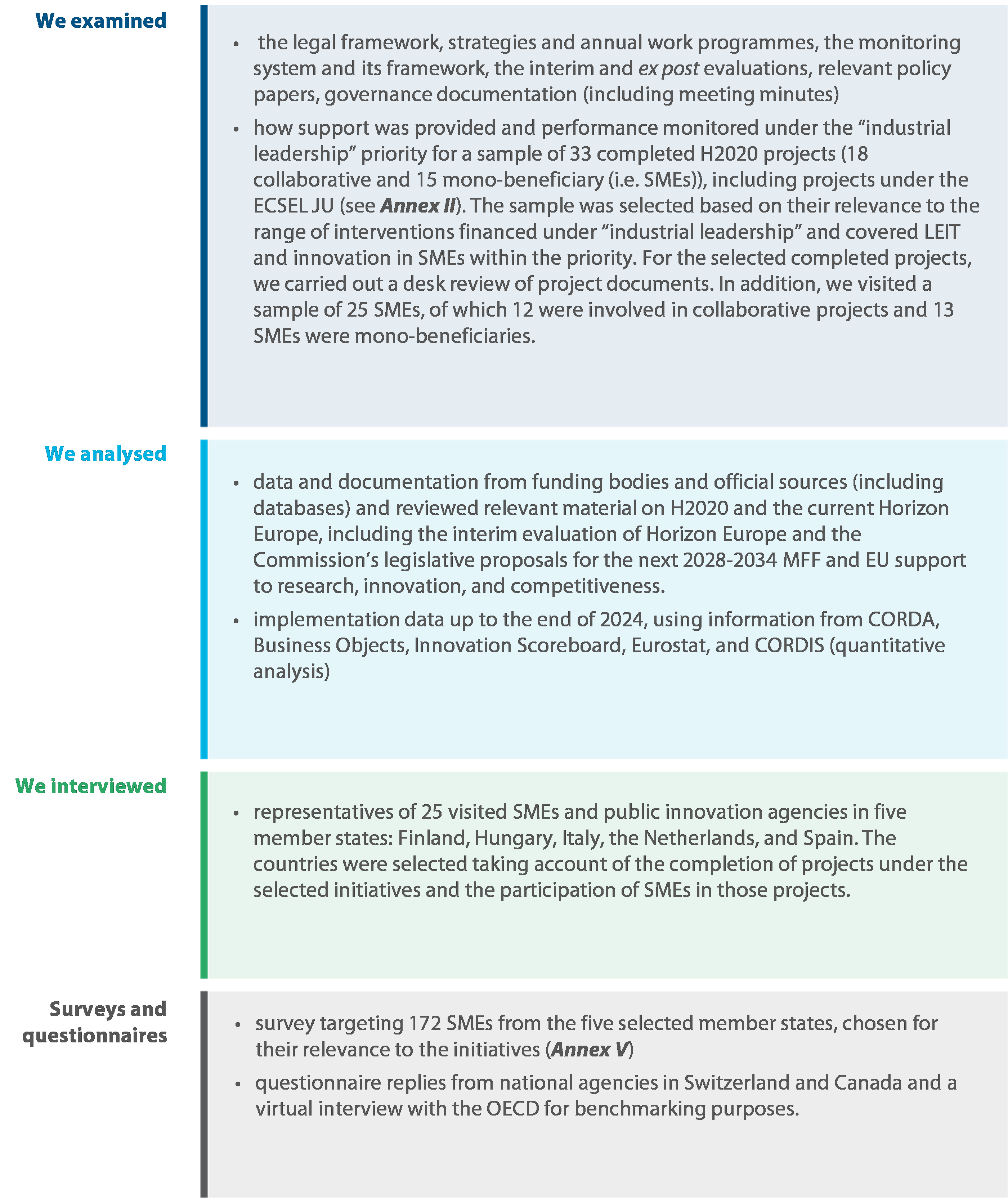
Source: ECA.
13Our audit methodology complies with the international standards on auditing issued by the International Organization of Supreme Audit Institutions (INTOSAI).
Annex II – Sample of projects examined for this audit
Project reference number | Project name | Managing body | Thematic priority | EU contribution | Collaborative/ Mono-beneficiary | SMEs visited/interviewed member state |
|---|---|---|---|---|---|---|
662133 | ECSEL | Information and communication technologies | €584 192.05 | Collaborative | 0 | |
662155 | ECSEL | Information and communication technologies | €1 836 035.4 | Collaborative | 1 Finland 1 Netherlands | |
666774 | EISMEA | Nanotechnologies | €1 332 625 | Mono-beneficiary | Hungary | |
666794 | EISMEA | Nanotechnologies | €2 179 363 | Mono-beneficiary | Italy | |
674049 | EISMEA | Information and communication technologies | €2 392 873 | Mono-beneficiary | 0 | |
674282 | EISMEA | Nanotechnologies | €1 841 591 | Mono-beneficiary | Netherlands | |
682804 | EISMEA | Information and communication technologies | €2 428 192.38 | Mono-beneficiary | Spain (interviewed but did not reply to our questions or provide any additional information) | |
684016 | EISMEA | Information and communication technologies | €2 499 999 | Mono-beneficiary | Finland | |
686116 | HADEA | Nanotechnologies | €2 171 255 | Collaborative | 1 Hungary 1 Spain | |
686135 | HADEA | Nanotechnologies | €1 426 775 | Collaborative | 0 | |
686165 | HADEA | Nanotechnologies | €578 987.5 | Collaborative | 0 | |
723441 | HADEA | Advanced materials | €582 912.5 | Collaborative | 0 | |
723538 | CNECT | Information and communication technologies | €957 900 | Collaborative | 1 Italy | |
723574 | HADEA | Advanced materials | €723 574 | Collaborative | 0 | |
723805 | HADEA | Information and communication technologies | €149 625 | Collaborative | 0 | |
723868 | HADEA | Advanced materials | €2 171 604 | Collaborative | 1 Netherlands | |
723945 | HADEA | Information and communication technologies | €610 360 | Collaborative | 0 | |
731884 | HADEA | Information and communication technologies | €1 430 727.01 | Collaborative | 1 Italy | |
732350 | HADEA | Information and communication technologies | €946 047 | Collaborative | 1 Netherlands | |
732679 | HADEA | Information and communication technologies | €2 716 203 | Collaborative | 1 Spain | |
733400 | EISMEA | Information and communication technologies | €1 723 615.25 | Mono-beneficiary | Hungary | |
737459 | ECSEL | Information and communication technologies | €1 404 481.56 | Collaborative | 2 Hungary | |
738517 | EISMEA | Nanotechnologies | €1 399 934.38 | Mono-beneficiary | Finland | |
738523 | EISMEA | Information and communication technologies | €1 716 791.13 | Mono-beneficiary | Italy | |
767287 | HADEA | Advanced manufacturing and processing | €1 423 450 | Collaborative | 1 Italy | |
767561 | HADEA | Advanced manufacturing and processing | €491 225 | Collaborative | 0 | |
768869 | HADEA | Advanced manufacturing and processing | €910 437.5 | Collaborative | 0 | |
779152 | EISMEA | Nanotechnologies | €1 617 378 | Mono-beneficiary | 0 (SME closed down and the entire amount was recovered) | |
783790 | EISMEA | Information and communication technologies | €2 355 937.50 | Mono-beneficiary | Finland | |
822956 | EISMEA | Innovation in SMEs | €2 499 999 | Mono-beneficiary | Netherlands | |
823614 | EISMEA | Innovation in SMEs | €2 343 950 | Mono-beneficiary | Italy | |
830550 | EISMEA | Innovation in SMEs | €2 457 902.13 | Mono-beneficiary | Spain | |
858355 | EISMEA | Innovation in SMEs | €2 425 937.50 | Mono-beneficiary | Finland |
Source: Commission database.
Annex III - Innovation and digitalisation eligibility criteria under the SMEG
Criterion | Aggregate number of final recipients | % | Aggregate amounts committed | % |
|---|---|---|---|---|
| 17 064 | 41 % | 10.3 | 42 % |
| 3 316 | 8 % | 2.2 | 9 % |
| 1 520 | 4 % | 0.5 | 2 % |
| 1 057 | 3 % | 0.7 | 3 % |
| 4 126 | 10 % | 1.4 | 6 % |
| 8 197 | 20 % | 5.3 | 22 % |
| 223 | 1 % | 0.1 | 0 % |
| 886 | 2 % | 0.8 | 3 % |
| 2 254 | 5 % | 1.0 | 4 % |
| 653 | 2 % | 0.4 | 1 % |
| 1 262 | 3 % | 0.9 | 4 % |
| 23 | 0 % | 0.1 | 0 % |
| 546 | 1 % | 0.5 | 2 % |
| 237 | 1 % | 0.2 | 1 % |
| 237 | 1 % | 0.2 | 1 % |
TOTAL | 37 440 | 100 % | 24.4 | 100 % |
Source: Table published in the final Implementation Report InnovFin SME Guarantee Facility as of 31 December 2022.
Annex IV - Comparison - H2020 v Horizon Europe
Technology transfer
Purpose | Horizon 2020 Tools | Weaknesses identified (H2020) | Horizon Europe Tools | Weaknesses identified (HE) |
|---|---|---|---|---|
Early stage breakthrough research | FET Open |
| EIC Pathfinder |
|
Risk finance for high risk innovation | InnovFin Technology Transfer (TT) facility |
| EIC Transition |
|
Bridging research to market | EIC pilot (2018–2020) |
| EIC Transition |
|
Monitoring and visibility | Innovation Radar |
| EIC Portfolio Management / European Innovation Scoreboard |
|
Market uptake
Purpose / dimension: market uptake and commercialisation | Horizon 2020 tools | Weaknesses (H2020) | Horizon Europe tools | Weaknesses (HE) |
|---|---|---|---|---|
Commercialisation support | SME Instrument (Phase 1 and Phase 2) |
| EIC Accelerator (grant + equity) |
|
Risk finance for high-risk innovation | InnovFin (debt and equity facilities) |
| EIC Fund/Invest-EU |
|
Coaching and network services | SME Instrument coaching and networking events |
| EIC Community Platform and curated matchmaking |
|
Dissemination and exploitation
Purpose / dimension: dissemination and exploitation | Horizon 2020 tools | Weaknesses (H2020) | Horizon Europe tools | Weaknesses (HE) | |
|---|---|---|---|---|---|
Transparency and project visibility | CORDIS (project summaries) |
| Funding and Tenders Portal / CORDIS (updated) |
| |
Credibility and protection of innovation | IPR |
| IPR support via EIC Community Platform |
| |
Technical and promotional outreach | Project websites |
| EIC Community Platform profiles and digital dissemination |
| |
Communication and business model development | SME Instrument coaching |
| EIC Business Acceleration Services (BAS) |
| |
Stakeholder engagement | Events and networking |
| European Innovation Ecosystems (EIE) networking actions |
| |
Annex V – Our survey of H2020 participants
01Our survey of H2020 participants focused on SMEs in five member states – Finland, Hungary, Italy, the Netherlands and Spain – the same countries that we visited on the spot for the purpose of our audit. They were all recipients of grants under the “industrial leadership” priority in innovation actions, and we covered “leadership in enabling and industrial technologies” (LEIT) and the SME Instrument.
02The SMEs targeted were participants in both collaborative or mono-beneficiary projects, completed by 2022, at the latest, under the initiatives selected for our review, more specifically, “information and communication technologies” (ICT), “nanotechnologies”, “photonics”, “advanced materials, and advanced manufacturing and processing”, some projects under “ECSEL” joint undertaking, and SME-specific schemes. Focusing on these beneficiaries allowed us to gather insights that accurately reflect the diversity and scope of LEIT-supported activities across these strategic areas.
03The purpose of the survey was to gather direct information relevant for our audit, on issues such as the importance of EU support for R&I activities, difficulties encountered in accessing support, dissemination and exploitation of results, and actual and expected contribution to economic performance.
04We received 85 responses out of the 172 companies initially contacted, representing approximately 49.4 % participation. However, after deducting the 11 SMEs that were no longer active, the adjusted sample consisted of 161 active companies, bringing the effective response rate to approximately 53 %.
Abbreviations
Abbreviation | Definition/Explanation |
|---|---|
CORDA | Common research data warehouse |
CORDIS | Community, Research and Development Information Service |
ECF | European Competitiveness Fund |
EIB | European Investment Bank |
EIC | European Innovation Council |
EIF | European Investment Fund |
EISMEA | European Innovation Council and Small and Medium-sized Enterprises Executive Agency |
GDP | Gross domestic product |
H2020 | Horizon 2020 |
HADEA | European Health and Digital Executive Agency |
HE | Horizon Europe |
ICT | Information and Communication Technology |
InnovFin | EU Finance for Innovators |
IPR | Intellectual property rights |
KET | Key enabling technology |
KPI | Key performance indicator |
LEIT | Leadership in enabling industrial technology |
MFF | Multiannual financial framework |
NMBP | Nanotechnologies, advanced materials, biotechnologies and advanced manufacturing and processing |
R&D | Research and development |
R&I | Research and innovation |
SME | Small- and medium-sized enterprises |
TRL | Technical readiness level |
Glossary
Term | Definition/explanation |
|---|---|
Action | In the context of EU research framework programmes, one of various types of funding scheme. |
Close-to-market measure/action/activity | In the context of Horizon 2020, an activity intended to produce plans or designs for new, altered or improved products, processes or services. |
Commercialisation | Process of bringing a product or service to market. |
CORDA | Central repository of data collected or generated during implementation of an EU framework programme for research and innovation. |
CORDIS | Primary public repository and portal for information on all EU-funded research projects and their results. |
Data | Set of values for qualitative or quantitative variables, such as facts or measurements, from which information can be generated. |
Database | Structured set of data stored electronically and available for consultation and extraction. |
Delegation agreement | Contract concluded with individuals or entities, in certain policy areas, for the implementation of EU funds under indirect management. |
Digitalisation | Introducing digital technology and digitised information to processes and tasks. |
Dissemination | In the context of Horizon 2020 and Horizon Europe, planned, strategic process to share project results, research findings or information with specific audiences. |
Economic performance | Effectiveness of a government or company in producing goods or services. |
Effectiveness | Extent to which the objectives pursued are achieved through the activities undertaken. |
Exploitation | In the context of Horizon 2020, making use of the results of an EU project in further activities, other than those covered by the project. |
Financial instrument | Financial support from the EU budget in the form of equity or quasi-equity investments, loans or guarantees, or other risk-sharing instruments. |
Gross domestic product | Standard measure of a country's wealth, based on the total value of goods and services produced there (usually during one year). |
Horizon 2020 | The European Union’s research and innovation funding programme for the 2014-2020 period. |
Horizon Europe | The European Union’s research and innovation funding programme for the 2021-2027 period. |
Impact | Wider long-term consequences of a completed project or programme, such as socio-economic benefits for the population as a whole. |
Impact assessment | Analysis of the likely (ex ante) or actual (ex post) effects of a policy initiative or other course of action. |
Innovation gap | Difference between an organisation's or economy's current innovative output and its actual potential, or between different entities, countries or sectors. |
Intellectual property | Original creation such as an invention, a literary or artistic work, or symbol, name or image used in commerce. |
Intellectual property right | Legal right over intellectual property. |
Joint undertaking | EU body established with a public and/or private partners to carry out a project or activity in the area of research and technology. |
Key performance indicator | Quantifiable measure showing performance against key objectives. |
Mid cap | Company with up to 3 000 employees |
Small and medium-sized enterprises | Size definition applied to companies and other organisations, based on the number of staff employed and certain financial criteria. Small enterprises have fewer than 50 staff, and turnover or a balance sheet total not exceeding €10 million. Medium-sized enterprises employ fewer than 250 staff, and have turnover up to €50 million or a balance sheet total up to €43 million. |
Technology readiness level | Metric used to state the maturity of a technology and allow different technologies in a given system or environment to be reliably compared. |
Audit team
The ECA’s special reports set out the results of its audits of EU policies and programmes, or of management-related topics from specific budgetary areas. The ECA selects and designs these audit tasks to be of maximum impact by considering the risks to performance or compliance, the level of income or spending involved, forthcoming developments and political and public interest.
This performance audit was carried out by Audit Chamber IV – Regulation of markets and competitive economy, headed and led by ECA Member Petri Sarvamaa, supported by Benjamin Jakob, Head of Private Office and Elmo Torppa, Private Office Attaché; John Sweeney, Principal Manager; Maria Isabel Quintela, Head of Task; Felipe Andres Miguelez, Georgia Bichta, Maria Eleni Andreou, Tarik El Rhani, Orsolya Szarka, Auditors, Adam Czarnecki, and Carlotta Gisonni, Trainees. Michael Pyper provided linguistic support. Dunja Weibel provided graphical support.

From left to right: Carlotta Gisonni, Dunja Weibel, Benjamin Jakob, Maria Isabel Quintela, Petri Sarvamaa, Georgia Bichta, Elmo Torppa, Tarik El Rhani, Adam Czarnecki, John Sweeney, Maria Eleni Andreou.
COPYRIGHT
© European Union, 2026
The reuse policy of the European Court of Auditors (ECA) is set out in ECA Decision No 6-2019 on the open data policy and the reuse of documents.
Unless otherwise indicated (e.g. in individual copyright notices), ECA content owned by the EU is licensed under the Creative Commons Attribution 4.0 International (CC BY 4.0) licence. As a general rule, therefore, reuse is authorised provided appropriate credit is given and any changes are indicated. Those reusing ECA content must not distort the original meaning or message. The ECA shall not be liable for any consequences of reuse.
Additional permission must be obtained if specific content depicts identifiable private individuals, e.g. in pictures of ECA staff, or includes third-party works.
Where such permission is obtained, it shall cancel and replace the above-mentioned general permission and shall clearly state any restrictions on use.
To use or reproduce content that is not owned by the EU, it may be necessary to seek permission directly from the copyright holders.
Figures 1, 3, 5, 6, 8, 9, 10, 11, boxes 2 and 5, Annex I - figures 2 and 3: icons have been designed using resources from Flaticon.com. © Freepik Company S.L. All rights reserved.
Cover photo: © kkolosov / stock.adobe.com.
Software or documents covered by industrial property rights, such as patents, trademarks, registered designs, logos and names, are excluded from the ECA’s reuse policy.
The European Union’s family of institutional websites, within the europa.eu domain, provides links to third-party sites. Since the ECA has no control over these, you are encouraged to review their privacy and copyright policies.
Use of the ECA logo
The ECA logo must not be used without the ECA’s prior consent.
HOW TO CITE
European Court of Auditors, special report 24/2026 “EU funding for innovation and competitiveness Limited focus on close-to-market measures under Horizon 2020’s “industrial leadership” priority”, Publications Office of the European Union, 2026.
| ISBN 978-92-849-8274-5 | ISSN 1977-5679 | doi:10.2865/5369947 | QJ-01-26-045-EN-N | |
| HTML | ISBN 978-92-849-8273-8 | ISSN 1977-5679 | doi:10.2865/9702971 | QJ-01-26-045-EN-Q |
Endnotes
1 Article (1) of Regulation (EU) No 1291/2013.
4 Annex I, Part II, Priority Industrial Leadership.
5 Preambles 20 and 34, and Annex I, Part II, (a).
6 Annex 1.
7 Article 7 of Regulation No 1290/2013.
9 Recital (34) and Article 10.
10 Article 15 of Regulation No 1290/2013.
11 Article 25 of COM (2025)543.
12 Recitals 11 and 20 of Regulation No 1291/2013.
13 Annex I, Sections 2 and 3, under the provisions on access to risk finance.
14 Annex I, Article 35(e).
15 Impact assessment, section 2, page 7.
17 Article 30 of Regulation No 966/2012; Article 33 of Regulation No 2018/1046; and Article 33 of Regulation 2024/2509.
18 Recital 46.
19 Annex II to Council Decision 2013/743/EU. In June 2012, the impact assessment identified only three possible indicators, one for each specific objective.
21 H2020 periodic report template.
22 Paragraph 3.55: “The lack of details behind the reported KPIs for Horizon 2020 significantly limits the reliability of the data presented.”
23 Article 32.
24 Article 32 (4).
25 Ibid.
27 Regulation 549/2013 (ESA2010) and SNA2008.
Annex I – About the audit
2 Recital 9 of Council Decision of 3 December 2013 establishing the specific programme implementing Horizon 2020.
3 Recital 2 of H2020 Regulation.
4 Annex I, Part II, Priority Industrial leadership.
5 Annex I, Article 35(e).